
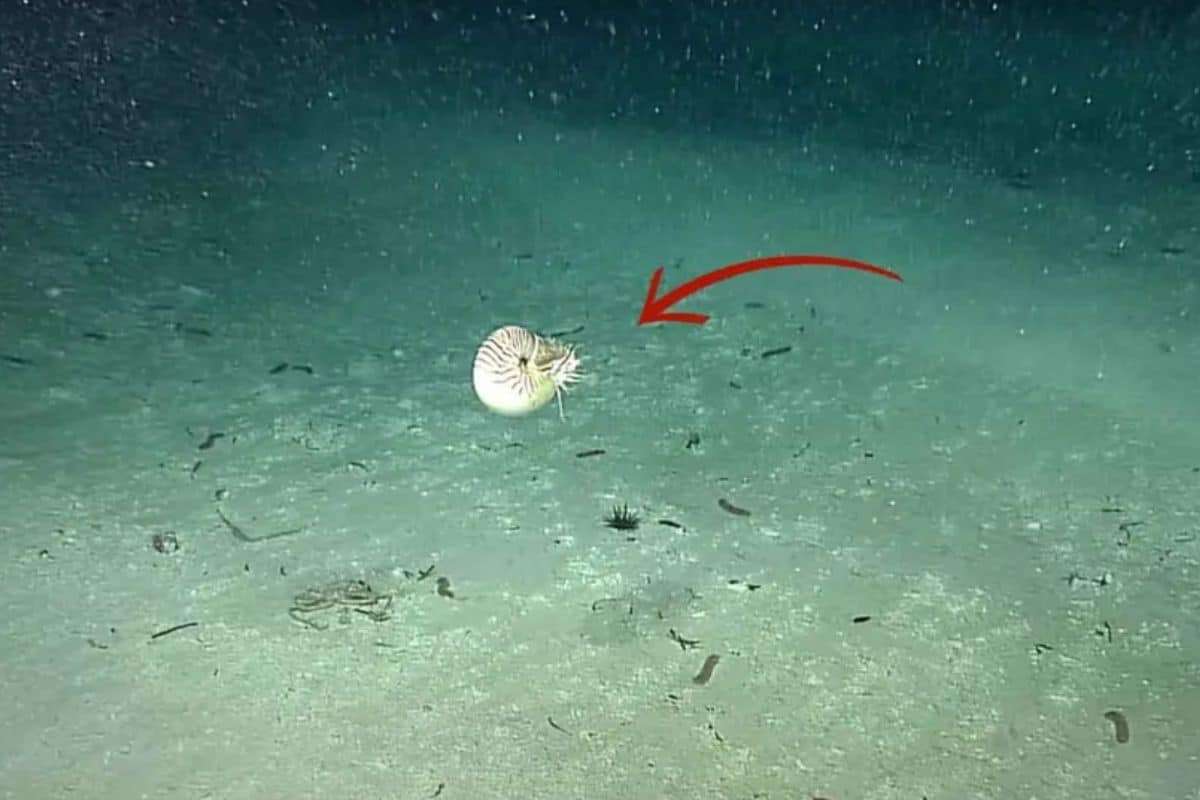
In the depths surrounding the Palau Islands, a remarkable find was made by the E/V Nautilus, a research vessel exploring the ocean’s mysteries. Scientists encountered a rare marine species that has scarcely evolved over millions of years.
This ancient cephalopod, often hailed as a “living relic,” was observed in late November 2024 near the German Channel off Palau. This exciting sighting was the first of its kind in 15 years, sparking great interest among marine researchers.
Palau Nautilus: A Living Window Into Prehistoric Seas
The Palau nautilus is among the most ancient surviving cephalopods, belonging to the nautiloid family alongside creatures like octopuses, squid, and cuttlefish. What astonishes scientists most is the species’ remarkable evolutionary consistency, as it has retained a nearly identical form for an estimated half a billion years, directly linking it to the era of dinosaurs.
This nautilus species features a distinctively patterned shell and specialized buoyancy mechanisms that differentiate it from other cephalopods. Yet, many aspects of its lifecycle and migration remain elusive. Classified as “near threatened” by the International Union for Conservation of Nature (IUCN), its protection has become critical.

A Historic Find in Oceanic Research
The sighting of the Palau nautilus occurred during the final voyage of 2024 aboard the E/V Nautilus, a vessel committed to deep-sea discovery. The expedition, NA169, focused on detailed seafloor mapping and water column studies near the Palauan Islands.
Led by Samantha Wishnak, the team observed four specimens gliding close to the seabed at depths between 200 to 340 meters (220 to 375 yards). As video specialist Jacob Ottaviani recalled, “being in the control van for our first sighting of this animal was pretty incredible.”
State-of-the-Art Tools Unlock Deep-Sea Secrets
The discovery was facilitated by sophisticated technologies and years of dedicated research. The E/V Nautilus is outfitted with advanced equipment such as remotely operated vehicles (ROVs), high-definition submersible cameras, and precise mapping instruments. These tools enabled thorough documentation of the nautilus' habitat and behavior.
The 2024 expedition also benefitted from oceanographic devices provided by the Scripps Institution of Oceanography. Techniques included wave and buoyancy gliders alongside autonomous surface craft, all designed to monitor currents and seafloor characteristics. Vertical microstructure turbulence profilers were employed to examine how water flows along Palau’s steep underwater slopes.
The sighting took place in a terrain marked by sixgill sharks and relics from past conflicts. Yet, the presence of the ancient nautilus offered a profound glimpse of Earth’s primordial life amidst human artifacts.
Shaping the Future of Nautilus Conservation
Scientists are currently working to enhance the accuracy of seafloor mapping where the Palau nautilus dwells. This knowledge is key to pinpointing observation sites and identifying critical areas for preservation amid growing pressures from environmental changes and habitat loss.
Collaboration between entities such as NOAA Ocean Exploration and the Ocean Exploration Trust (OET), coupled with emerging maritime technologies, promises to deepen our insight into the Palau nautilus and other deep ocean life forms.
Preserving an Evolutionary Time Capsule
The recent sighting of the Palau nautilus underscores the urgency of ongoing scientific study and conservation initiatives. As a creature that has endured nearly unchanged since dinosaur times, it represents a unique biological link to Earth's distant past.
This finding, alongside efforts to chart the ocean floor and investigate marine ecosystems, fosters optimism for safeguarding the future of the Palau nautilus and other understudied species inhabiting our planet’s depths.
- Categories:
- Science





0 comments
Sign in to Comment