
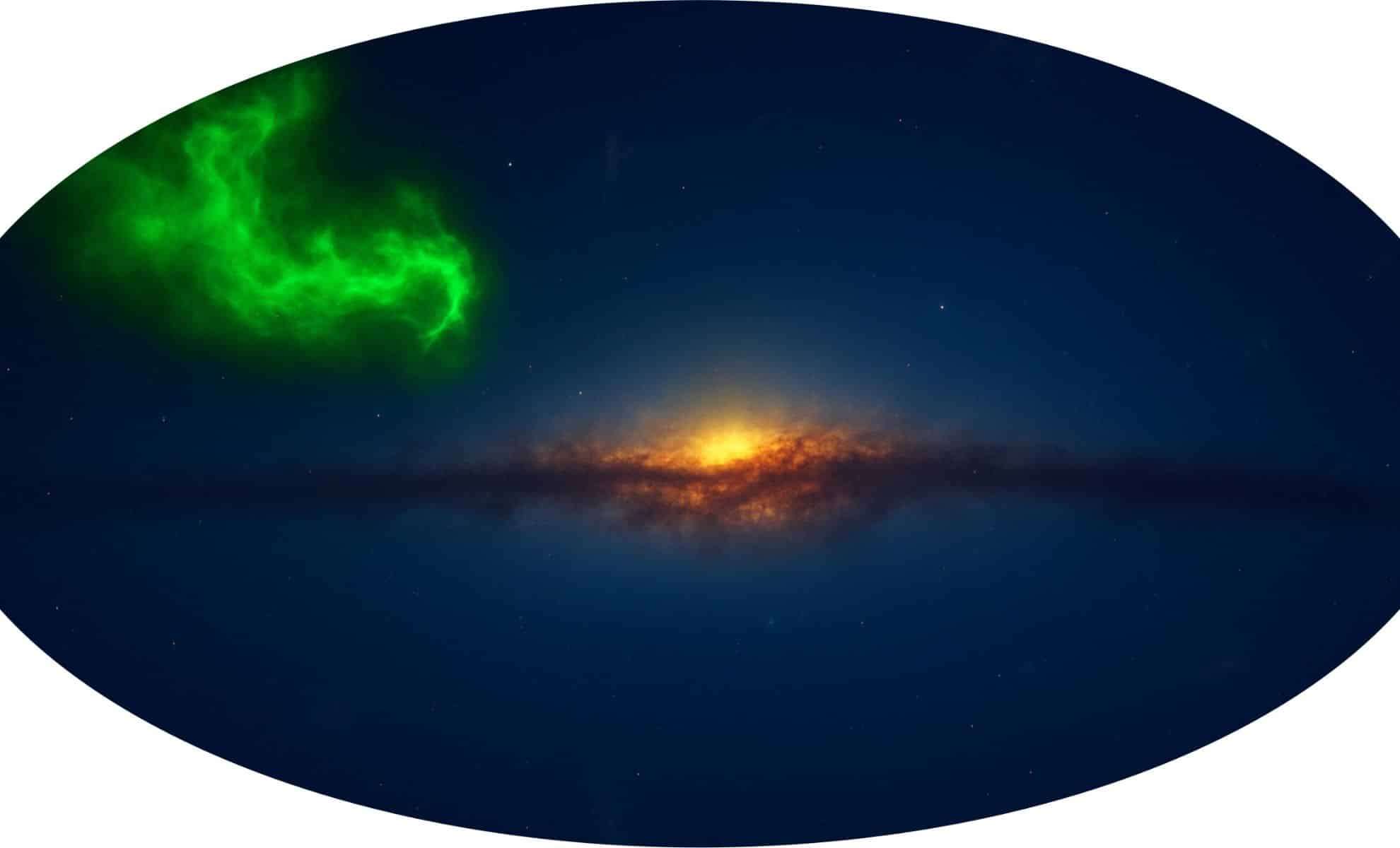
A group of astronomers, spearheaded by experts at the Shanghai Astronomical Observatory (SHAO), has revealed a surprising, tangled web of supersonic filaments inside a very-high-velocity cloud (VHVC) named G165. Traveling at 300 kilometers per second and positioned roughly 50,000 light-years from Earth, this gas cloud offers an unprecedented look into early interstellar cloud development. Published in Nature Astronomy, the study highlights how turbulence and magnetic fields may primarily shape interstellar gas structures, overshadowing gravitational influences. These findings promise to reshape our comprehension of gas behavior in regions largely unaffected by gravity, advancing our knowledge of the interstellar medium's role in the evolution of galaxies.
An Exceptional Setting to Explore G165
G165 stands out as a vast, rapidly moving cloud of atomic hydrogen, offering a rare chance to analyze interstellar gas in conditions minimally disrupted by nearby stars or gravitational pull. Its position, far above the plane of the galaxy and free from obstructing matter, makes it perfect for examining early cloud evolution processes. In contrast to clouds in denser galactic zones influenced heavily by stars and gravity, VHVCs like G165 represent an untouched early phase in the cycle of interstellar gas. This research provides a nearly unobstructed perspective on the mechanisms driving cloud formation, enhancing our grasp of atomic gas dynamics.
The investigators leveraged the capabilities of the Five-hundred-meter Aperture Spherical Radio Telescope (FAST) to probe G165's makeup and structure in remarkable detail. Surprisingly, G165 is predominantly composed of the warm neutral medium (WNM), a gas phase between the cold and warm states typically found in interstellar space. Unlike many high-velocity clouds (HVCs), G165 lacked cold gas components, implying VHVCs might correspond to an earlier, less evolved stage of cloud development.

Supersonic Turbulence and Intricate Filament Patterns Unveiled
A standout revelation from the observations is the dynamic, intricate nature of the gas inside G165. Previous views considered such clouds as relatively stable and uniform; however, FAST data revealed a network of supersonic filaments. These filaments weave a multi-layered, velocity-dependent web, creating a twisted, 3D lattice across space. Detailed turbulence signs, marked by “velocity wiggles,” indicate active gas motions. This suggests turbulence drives the formation of the filamentary structures within the cloud.
The discovery of supersonic, entangled filaments defies earlier models that treated interstellar clouds as mostly homogeneous and placid. Instead, the observations demonstrate that turbulence is pivotal in defining the cloud’s form. The velocity variations are structured, reflecting coherent gas flows propelled by turbulent forces. This reveals that G165's gas undergoes complex, fast movements leading to the emergence of distinct filament patterns rather than being static.
Reevaluating Interstellar Gas Mechanics: Magnetic Fields and Turbulence
To decode the underlying physical processes behind G165’s complexity, the team ran magnetohydrodynamic simulations. These models indicated that supersonic turbulence interacting with magnetic fields can inherently produce the filamentary networks observed. This underscores that turbulence, together with magnetic influences, can sculpt early interstellar cloud architecture without gravitational forces playing a central role. This is a groundbreaking insight, suggesting gravity’s role in cloud formation may be less critical than assumed.
The simulations also illuminated unique gas traits within G165, including layered velocity patterns, skewed density distributions, and uneven radial structures, all emblematic of organized turbulence. Remarkably, these features appear even in the absence of gravitational shaping, traditionally thought necessary for large cosmic structures. This discovery paves the way for new studies into interstellar gas behavior in environments where gravity is minimal.
- Categories:
- News



0 comments
Sign in to Comment