
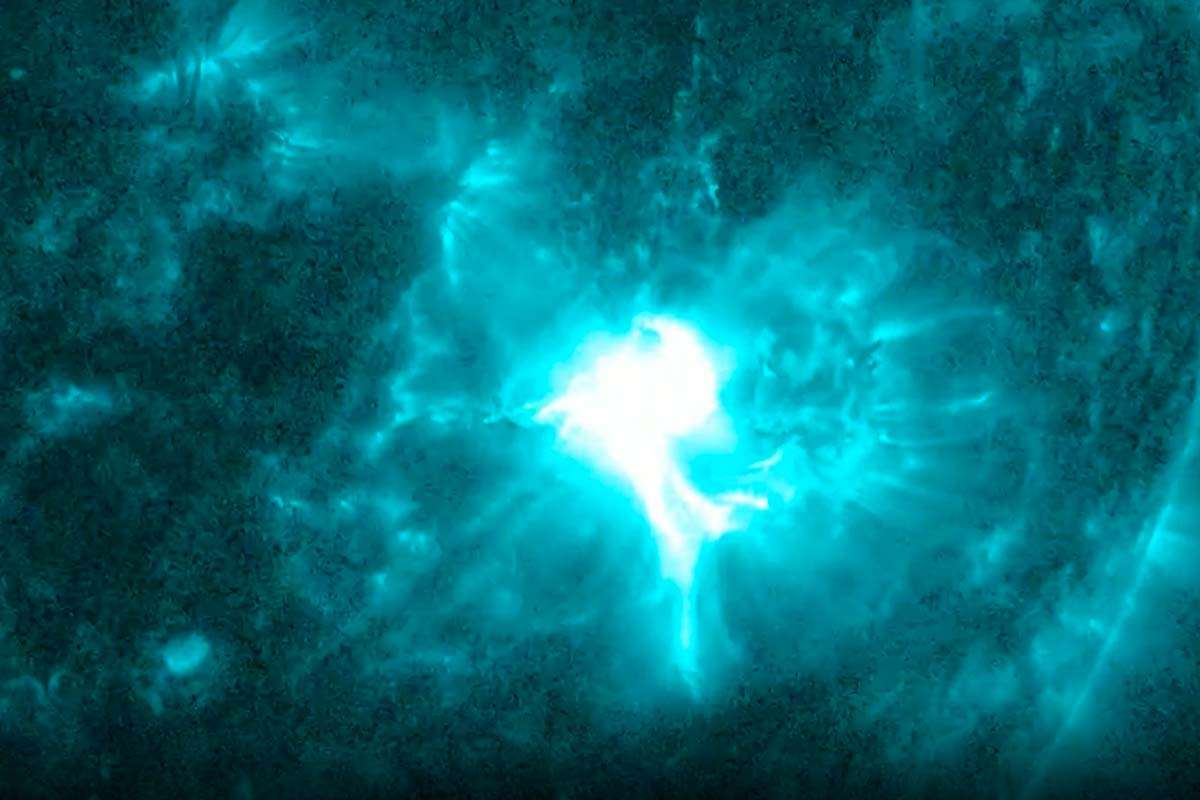
In a remarkable celestial event, massive sunspot AR3664 has released an X3.98-class solar flare, marking its strongest emission recorded so far. This powerful solar eruption took place during the early hours of May 10, 2024, and caused notable disturbances on Earth, including interruptions in high-frequency radio communications across parts of Asia, eastern Europe, and eastern Africa.
Understanding the solar flare event
Sunspot AR3664, which has recently generated several X and M-class flares, produced this exceptional X-class flare at around 2:54 a.m. GMT. Flares of this category are the most intense type, releasing vast amounts of electromagnetic energy that immediately affect Earth’s ionosphere. This can disrupt radio transmissions and sometimes cause brief blackouts.
X FLARE IN PROGRESS: Here we go again active region 3664 just produced an X4 flare that peaked at 06:50 UT. That would be the 4th largest X-ray flare so far during this solar cycle. Clearly there was ejecta off to its north which demonstrates that a CME was launched towards Earth pic.twitter.com/xLER0j21Bz
Add Cosmo Herald as a Preferred Source— Keith Strong (@drkstrong) May 10, 2024

Effects on Earth: Radio interference and more
The X3.98 flare resulted in widespread disruptions, causing either temporary or total blackouts of high-frequency radio signals across extensive regions. The National Oceanic and Atmospheric Administration (NOAA) has been monitoring the situation closely, linking the disturbances to the ionization of Earth's upper atmosphere triggered by intense X-rays and ultraviolet emissions from the flare. This ionization increases the density of the ionosphere layers, which interferes with the usual propagation of radio waves.

Future outlook: Geomagnetic storm potential
The flare was accompanied by a coronal mass ejection (CME), complicating the forecast of near-Earth space weather. This gigantic release of plasma and magnetic fields from the sun can take days to arrive and may trigger geomagnetic storms upon reaching Earth. Such storms are known to intensify auroras and pose risks to satellites and electrical grids. The NOAA Space Weather Prediction Center has issued a G4 alert for severe geomagnetic storm activity expected over the weekend, signaling potentially significant technological impacts.
Rising solar activity as the solar maximum approaches
The surge in solar flares aligns with the sun’s progression toward its solar maximum, a peak phase in the 11-year solar cycle characterized by heightened sunspot frequency and flare intensity. Researchers closely observe these changes to better predict space weather phenomena that influence Earth. The ability to forecast solar activity remains critical given our growing dependence on satellites for communication, navigation, and data exchange. Agencies such as NASA and NOAA continue to provide crucial updates to help mitigate space weather’s effects on modern technology.




0 comments
Sign in to Comment