
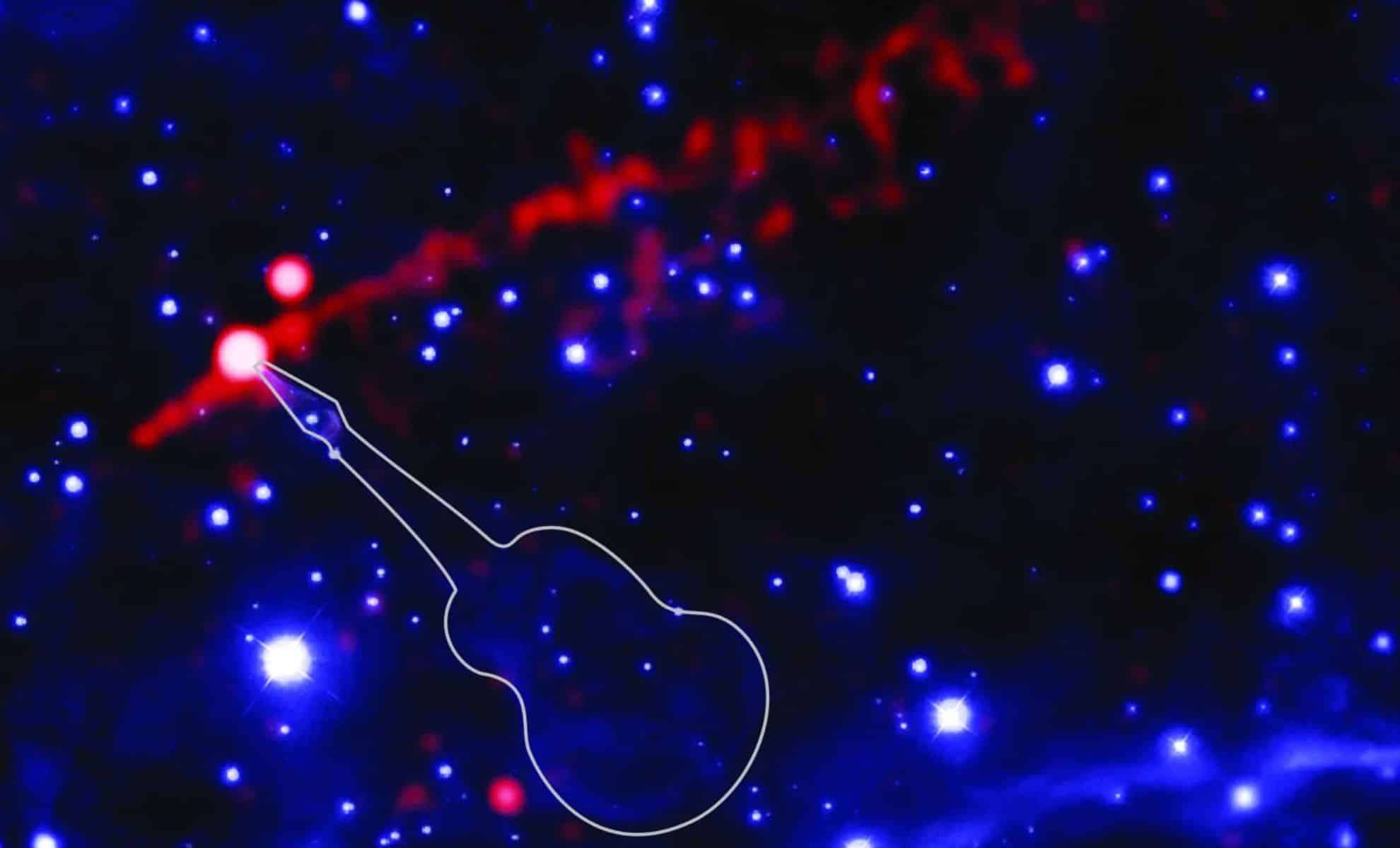
Scientists utilizing NASA’s Chandra X-ray Observatory and Hubble Space Telescope have captured spectacular images of the Guitar Nebula, an extraordinary space structure shaped by the interaction of pulsar winds, magnetic forces, and interstellar gas. This nebula, named for its unique guitar-like appearance, is molded by the rapidly rotating neutron star PSR B2224+65, which emits streams of particles that carve the surrounding space into a blazing, torch-like formation.
Through years of data from Chandra and Hubble, astronomers have compiled time-lapse sequences showcasing the nebula’s transformation. These observations offer invaluable clues into how energetic particles engage with cosmic matter, emphasizing the pulsar’s role as a potent agent in the cosmos. The results highlight both the nebula’s captivating beauty and its significance in understanding extreme astrophysical phenomena.
Crafting the Fiery Guitar Shape in Space
The Guitar Nebula arises from the fierce interaction between the pulsar PSR B2224+65 and the surrounding clouds of interstellar gas. Born from the remnants of an exploded massive star, pulsars are dense, fast-spinning neutron stars. As PSR B2224+65 spins, it releases intense beams of high-energy particles, including electrons and their antimatter equivalents, positrons. These emissions sculpt the nebula’s iconic shape, glowing brilliantly in hydrogen emission.

A remarkable feature is the extended X-ray filament stretching close to two light-years from the pulsar, visible in Chandra’s observations. This filament forms the “neck” of the glowing guitar shape. The pulsar’s rapid travel—clocked at hundreds of kilometers per second—through the cosmos amplifies this effect, producing a glowing, flame-like tip on the nebula.
The nebula’s structure also changes with shifts in interstellar gas density. When the pulsar moves into denser gas pockets, the nebula’s brightness shifts, revealing the constantly evolving nature of these cosmic interactions. These changes offer critical data on how the pulsar’s particle emissions influence its environment.
Monitoring Cosmic Changes Over Time
With combined data from the Chandra X-ray Observatory and the Hubble Space Telescope, researchers have traced the Guitar Nebula’s gradual transformation over several decades. X-ray data from 2000, 2006, 2012, and 2021, together with Hubble’s optical imagery stretching back to 1994, have been used to produce dynamic time-lapse visuals. These sequences document the pulsar’s ongoing movement and the subtle evolution of the nebula’s luminous form.
The trail of energy left by the pulsar in its wake allows scientists to observe how it interacts with surrounding space. Variations in brightness along the X-ray filament correspond to the pulsar encountering different hydrogen densities. These fluctuations provide essential insight into the nature of pulsar wind nebulae, formed from near-light-speed particles escaping the pulsar.
Time-lapse images further emphasize the Guitar Nebula’s function as a galactic “blowtorch,” scattering high-energy particles and magnetic influences across vast distances. This mechanism plays a vital role in dispersing energy and matter throughout the Milky Way, underlining pulsars’ profound impact on their cosmic neighborhoods.
A Window Into Extreme Astrophysical Phenomena
The Guitar Nebula acts as a distinctive natural laboratory for exploring how energetic particles and magnetic fields interact over enormous scales. The X-ray filament detected by Chandra presents a unique chance to analyze particle behavior in the presence of interstellar magnetic fields. Gaining deeper understanding of these interactions is crucial for deciphering cosmic ray propagation and pulsars’ contribution to the galaxy’s overall energy distribution.
Additionally, the Guitar Nebula plays a key role in antimatter studies. The pulsar emits positrons, antimatter particles that accompany electrons. Investigating the distribution and dynamics of these particles sheds light on the nature of cosmic rays and their journey through space. This research has wide-reaching implications for uncovering the mechanisms behind extreme astrophysical events, including the life cycles of neutron stars and the broader dispersal of matter in the universe.
- Categories:
- News



0 comments
Sign in to Comment