
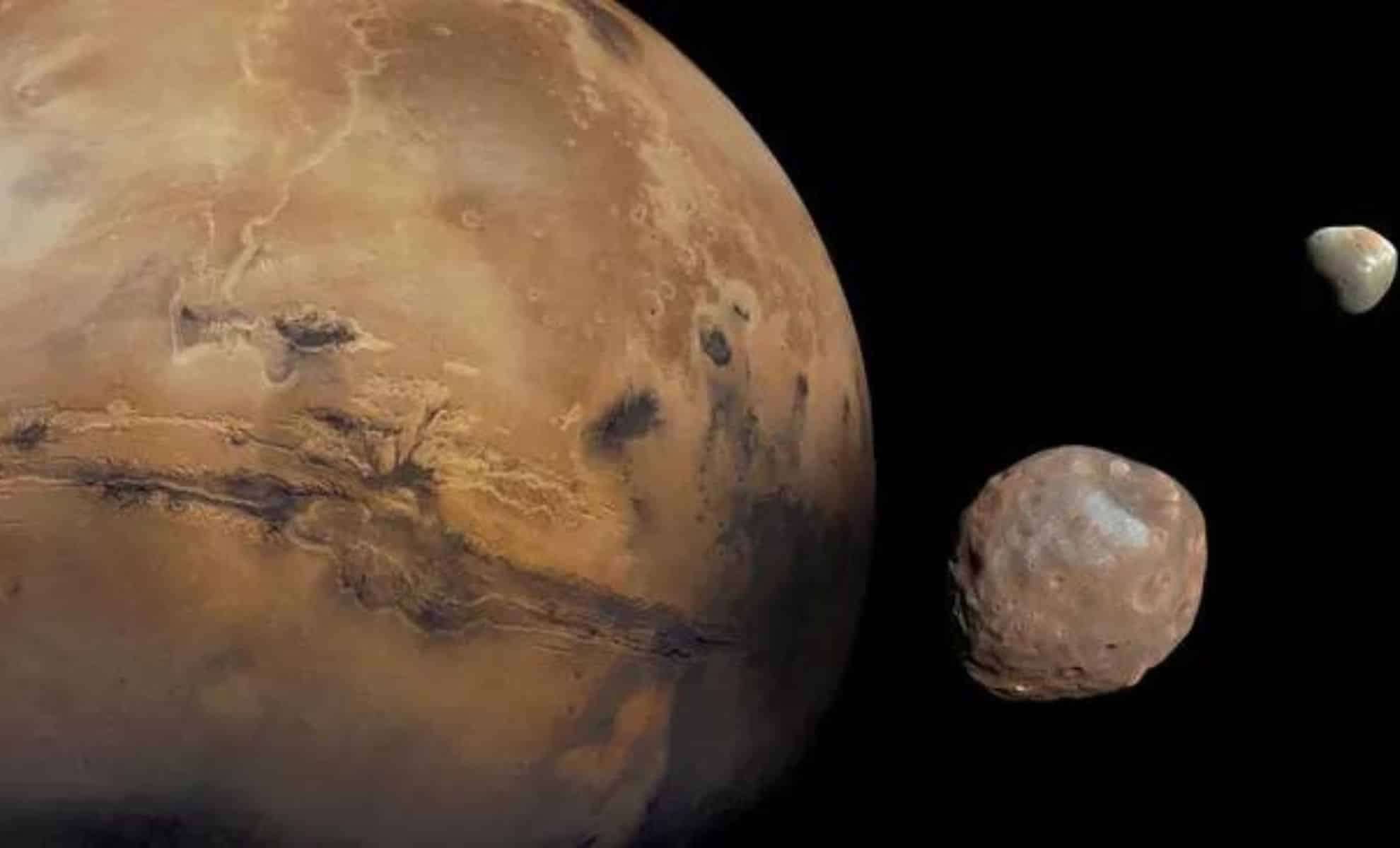
Recent investigations challenge the traditional belief that Mars’ moon Phobos is a captured asteroid, suggesting instead it could be a remnant of a comet or a piece of one.
This emerging idea is based on fresh analyses of unpublished imagery and in-depth examinations of the moon’s surface features. Clarifying the true nature of Phobos could greatly enhance our understanding of solar system evolution and dynamics.
Unveiling the Mystery of Mars’ Moon
Phobos, one of the two Martian satellites, has always intrigued scientists due to its atypical orbit and surface texture. New data from the European Space Agency’s Mars Express mission have shed light on this enigmatic moon’s exterior.

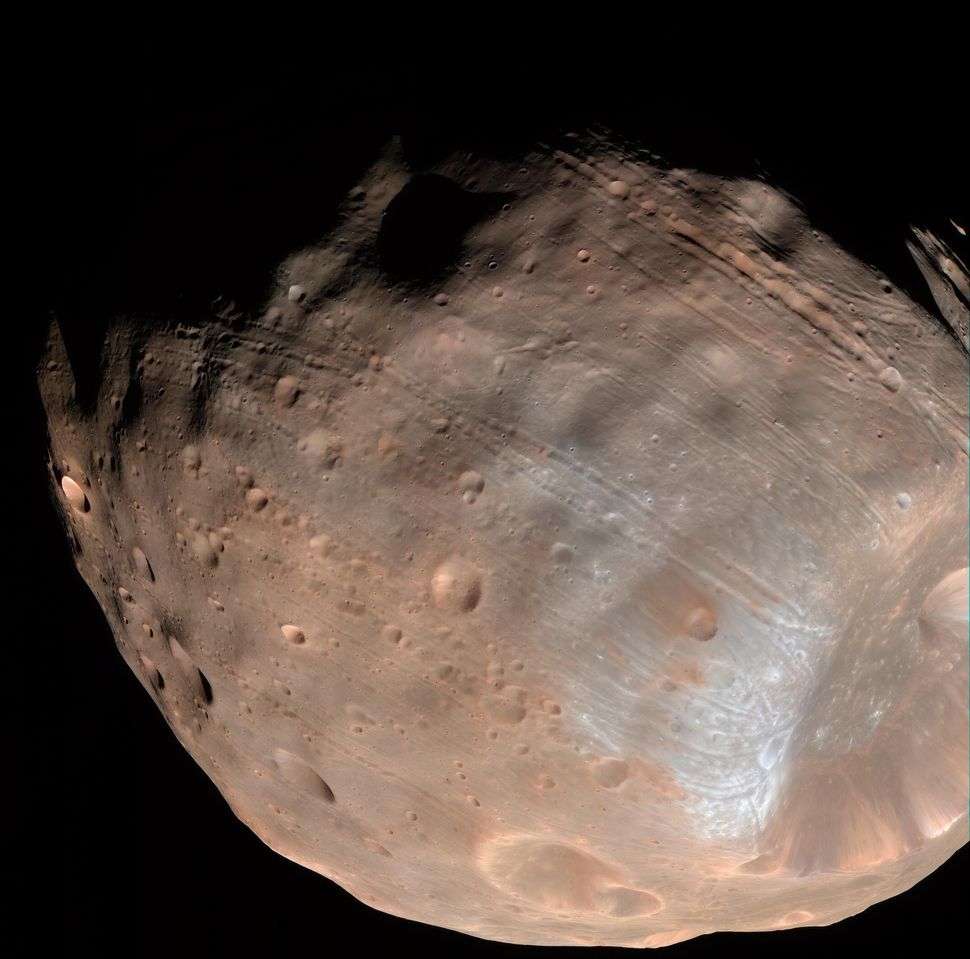
The imagery, studied by a group spearheaded by Sonia Fornasier at Paris Cité University, reveals that Phobos does not reflect light evenly—an attribute more typical of cometary objects than asteroids. Its surface shows porosity and heightened reflectance in spots, echoing the traits seen on known comets.
Thorough examination of these visuals indicates Phobos shares characteristics commonly linked to comets. These insights dispute the orthodox idea of both Mars’ moons, Phobos and Deimos, being captured asteroids and instead imply a more intricate history involving the capture and fragmentation of a cometary body.
Exploring the Comet Origin Theory
The proposal that Phobos might be a captured comet is supported by several observations. Notably, the photometric traits of Phobos closely resemble those of Jupiter-family comets — especially Comet 67P, extensively studied by ESA’s Rosetta probe.
Phobos’ surface shows an "opposition surge," where it appears brightest when the Sun shines directly above and dims when viewed from other perspectives. This phenomenon aligns with properties of cometary surfaces blanketed by fine dust.
Moreover, its surface composition is marked by high porosity and uneven reflectivity (albedo), traits traditionally associated more with comet nuclei than typical asteroids. These factors point to a composition made up of icy, dusty materials akin to those found in comets.
Insights From Orbital Modeling
Earlier computational models aimed at recreating Mars’ capture of asteroids failed to explain Phobos’ nearly circular orbit. The comet capture scenario, however, offers a more convincing explanation.
These simulations propose that Phobos and its companion moon, Deimos, may have originated from a bifurcated comet. Mars’ gravitational pull could have ensnared this celestial object, shattering it into the two fragments currently observed as moons. This account aligns well with their orbital and surface nuances.
The models further suggest that capturing and fracturing a comet could produce moons possessing the specific physical and orbital features found in Phobos and Deimos. This supports the idea that both are remnants of a larger captured comet that disintegrated after Mars’ gravitational interaction.
Consequences for Deimos’ Origins
Accepting Phobos as a comet fragment bears significant consequences for understanding Deimos. The research posits that both moons may share a cometary origin. Confirming this would revise current perspectives on how minor celestial bodies get captured and modified by planetary forces. Comparative analysis of Deimos’ surface properties remains critical to validate this theory.
Revealing Deimos' connection to the comet hypothesis could illuminate broader themes in moon formation and planetary body interactions across the solar system. It might also provide deeper insights into the mechanisms behind the capture and breakup of small bodies by planets.
Upcoming Investigations and Space Missions
The forthcoming Martian Moons eXploration (MMX) mission by the Japan Aerospace Exploration Agency (JAXA), planned for launch in 2026, aims to resolve questions surrounding the origins of Phobos and Deimos. By retrieving samples from Phobos and bringing them back to Earth, this mission will enable detailed compositional studies.
MMX’s analyses promise to deliver new knowledge about Phobos’ material makeup, potentially verifying its cometary origin. Direct examination of returned samples will allow scientists to identify unique minerals and isotopic signatures characteristic of cometary bodies.
Wider Significance for Planetary Science
Reclassifying Phobos as a comet fragment could have far-reaching consequences for the science of planetary formation. It would challenge existing moon formation paradigms and stimulate new research into the capture and evolution of natural satellites around planets.
This insight would deepen our understanding of early solar system events and the complex gravitational interactions between planets and smaller objects.
Additionally, studying Phobos and Deimos as potential comet remnants might reveal critical information about Mars’ history, shedding light on its past environment and interactions within the solar system.
- Categories:
- Astronomy ,
- News ,
- Space








0 comments
Sign in to Comment