

NASA’s Double Asteroid Redirection Test (DART) mission has unlocked remarkable new knowledge about the paired asteroids Didymos and Dimorphos.
The mission, involving a deliberate impact onto Dimorphos, aimed to evaluate our capability to modify an asteroid’s path—a critical development in planetary defense strategies.
Data gathered from this endeavor, alongside imagery from the Italian Light Cubesat for Imaging of Asteroids (LICIACube), uncovered surprising clues regarding the history and formation of these space rocks.

These insights advance our comprehension not only of these particular asteroids but also broaden our understanding of asteroid genesis and the early solar system’s evolution.
Exploring the Dynamics of the Binary Asteroid Pair
NASA’s DART mission homed in on the binary asteroid system composed of Didymos and its smaller satellite Dimorphos. The primary mission objective was to monitor how the spacecraft’s collision altered Dimorphos’s orbit, testing a promising planetary defense tactic.
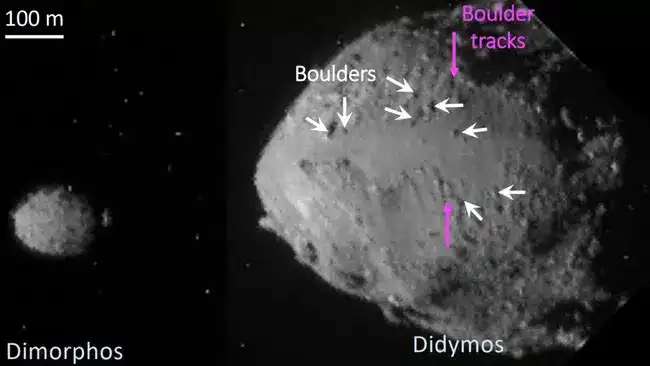
Beyond that, the mission unveiled critical information about the characteristics and past of these asteroids. Led by Olivier Barnouin of the Johns Hopkins University Applied Physics Laboratory, researchers observed that Didymos features rugged, elevated terrain dotted with large boulders alongside smoother, lower zones with fewer impact marks.
Meanwhile, Dimorphos displayed a broader variety of boulder sizes and surface textures, including multiple fault lines but comparatively sparse cratering. Scientists concluded that Dimorphos likely emerged from debris shed by Didymos during a major disruption event approximately 300,000 years ago.
This hypothesis was reinforced by similarities in rock composition, indicating a strong genetic link between the two bodies.
Significant Findings and Their Broader Meaning
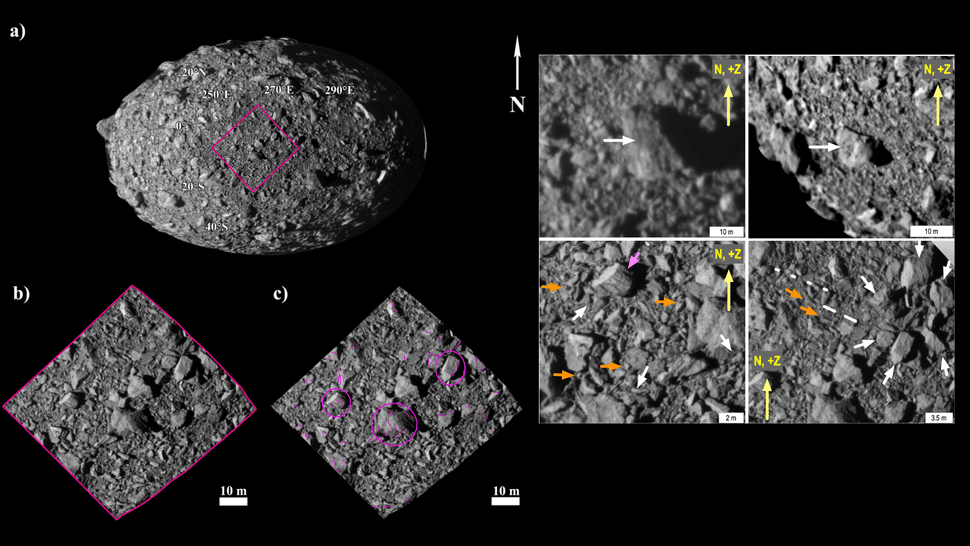
A major breakthrough of the DART mission was detecting thermal fatigue on Dimorphos, a process where continual heating and cooling cycles weaken rocks, causing fractures. This marks the first observation of thermal fatigue on a rocky asteroid like Dimorphos, implying rapid surface evolution occurring over about 100,000 years.
“These observations enhance our grasp of asteroid surface transformations,” explained Thomas Statler, lead scientist for Solar System Small Bodies at NASA Headquarters in Washington. “They are vital not only for assessing the impact hazard from near-Earth objects but also for decoding the solar system’s formative history from these ancient remnants.”
The study also exposed the fragile surface structure of both Didymos and Dimorphos, which likely contributed to the notable alteration in Dimorphos’s orbit after the DART impact.
This fragility renders such asteroids more vulnerable to forces that can shift their paths. Analyzing the shapes and sizes of boulders on Dimorphos supported the idea that these rocks accumulated gradually, bolstering the conclusion that Dimorphos formed from debris shed by Didymos.
Next Steps: ESA’s Hera Mission
The success of the DART mission paves the way for the European Space Agency’s Hera mission, planned to reach the Didymos system in 2026. Hera will conduct detailed surveys of the impact region and investigate the aftermath of DART’s collision with Dimorphos. This mission is essential for validating DART’s findings and deepening insight into how binary asteroid systems behave.
Olivier Barnouin remarked on the broader significance: “The images and data from DART’s encounter with the Didymos system provide an unparalleled geological perspective on a near-Earth binary asteroid system. These observations allowed us to deduce extensive geophysical details about both Didymos and Dimorphos, enhancing our understanding of their formation.”
Through DART, scientists have demonstrated a promising planetary defense tool while significantly advancing knowledge of asteroid structures and behaviors. The mission highlights the power of international collaboration and cutting-edge spacecraft technology to confront challenges posed by near-Earth objects.
With Hera set to build upon DART’s revolutionary achievements, the scientific world looks forward to further discoveries about these ancient wanderers of space.
- Categories:
- Astronomy ,
- News ,
- Space ,
- Nasa




0 comments
Sign in to Comment