
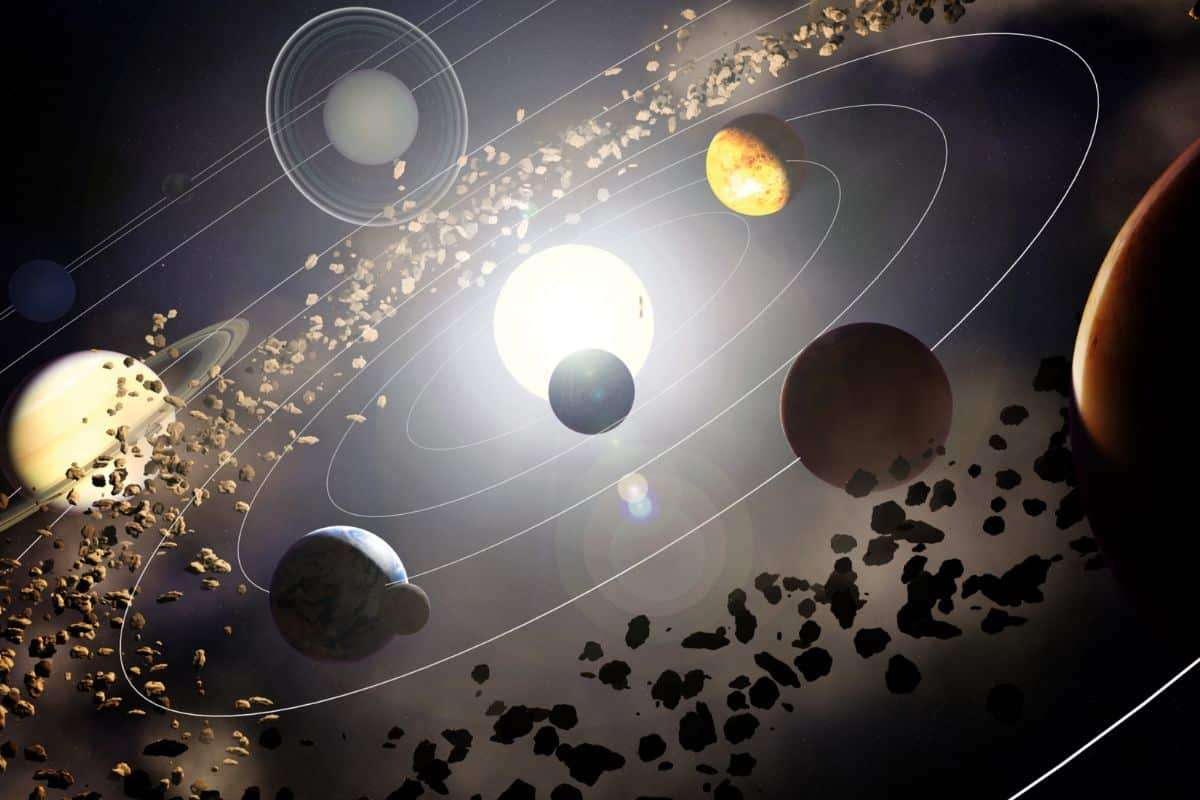
Recent findings propose that a colossal, unknown object may have passed through our Solar System billions of years ago, leaving a significant mark on the trajectories of its planets. This thought-provoking idea, advanced by researchers from the University of Toronto and the University of Arizona, could explain the unusual orbital shapes and tilts observed in our planetary family.
Unexpected Twists in Planetary Orbits
If one imagined forming a solar system from the ground up, the expectation would be planets moving in nearly perfect circles within a flat, spinning disk of material. Such an arrangement aligns well with fundamental physical principles.
However, the reality of our Solar System deviates from this ideal. Planetary orbits are somewhat inclined and more elliptic than the textbook model. This inconsistency prompts the critical question: what triggered these orbital anomalies?
The Hypothesis of an Interstellar Visitor
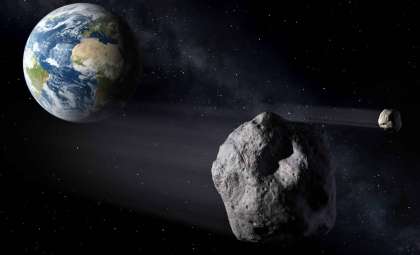
The research points to a potentially alien intruder from beyond our Solar System as a likely cause. This interstellar entity, possibly weighing up to 50 times Jupiter’s mass, could have crossed the Solar System during its early formation, applying a gravitational pull strong enough to disrupt the giant planets’ orbits before continuing its journey away. The scientists theorize this passage could have introduced the orbital irregularities we observe today.

Modeling the Impact Through Simulations
To explore this theory, the team created simulations modeling how such an enormous object could influence the planets. Their results indicate that an object with roughly eight times Jupiter’s mass might have traveled within Uranus’s orbit at a velocity of 2.69 km/s.
This speed would allow the object to escape the Sun’s gravitational grasp yet still exert substantial influence on the planets it passed, reshaping their orbital paths.
A Rare, Yet Possible Encounter
Although still hypothetical, this event may not be as improbable as once thought. The simulation data suggests encounters like these might happen once every 1,000 to 10,000 years, especially considering the numerous star clusters scattered throughout the galaxy.
These findings emphasize the active and interactive environment of the Milky Way, where our Sun routinely approaches other stars, possibly accompanied by wandering planets or rogue bodies capable of influencing our Solar System’s dynamics.
Possibility of Future Intrusions
The concept of a rogue object passing through the Solar System again invites fascinating inquiries regarding Earth's future. Although such events are unlikely in the immediate future, they remind us that the Solar System is not as isolated as it often seems.
As the Sun traverses the galaxy, it could encounter another massive interstellar visitor, potentially leading to further perturbations in planetary orbits.
The prospect of such an interstellar passage underscores the vulnerability of our otherwise stable planetary system amid the galaxy’s complex gravitational landscape. Over vast timescales, such close encounters could prompt dramatic shifts in planetary orbits or even the ejection of a planet from the Solar System.
Tracing Signs in Our Cosmic History
Although the idea of wandering celestial bodies passing through may sound speculative, history shows it’s plausible. The most notable example is ‘Oumuamua, which transited our Solar System in 2017.
Though comparatively small, ‘Oumuamua’s passage provided valuable clues about the potential influence of extrasolar objects.
The authors of the study emphasize that this theory is preliminary and requires more investigation and peer evaluation. Still, their work offers a fresh perspective on Solar System evolution and might eventually solve the mystery behind its unusual planetary orbits.
- Categories:
- Astronomy






0 comments
Sign in to Comment