

SpaceX has proven its pioneering position in aerospace again by deploying 116 satellites aboard its Falcon 9 rocket during the Transporter-11 rideshare mission.
Launching from Vandenberg Space Force Base in California, this flight delivered numerous payloads to orbit, demonstrating the success of SpaceX’s rideshare initiative, designed to provide affordable launch opportunities for a variety of small satellites tailored to commercial and scientific needs.
Falcon 9 Launch and Booster Recovery Highlights
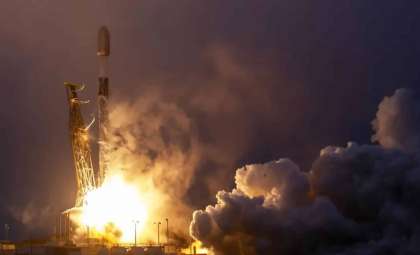
The Falcon 9 lifted off from Space Launch Complex 4 East (SLC-4E) at 11:56 a.m. PDT (2:56 p.m. EDT, 1856 UTC), beginning a deployment sequence lasting over two hours. The rocket’s first stage, B1075, which had been reused 11 previous times, successfully touched down at Landing Zone 4 (LZ-4) about seven and a half minutes post-launch. This achievement marked the 20th booster landing at LZ-4 and extended SpaceX’s Falcon rocket recovery count to 340 successful returns.

This mission underscored the durability and reusability of SpaceX’s boosters. Booster B1075 had flown on key assignments such as SDA-0A, SARah-2, and nine Starlink launches. Its successful recovery reinforces how reusable rocket technology reduces costs and increases launch frequency for space access.
Robert Sproles, CEO of Exolaunch and partner in this project, commented, “Transporter-11 perfectly showcases the Falcon 9’s adaptability. Successfully landing a booster that has flown over 10 times while deploying more than 100 satellites highlights SpaceX’s technical prowess and potential for future missions.”
A Global Collaboration via Rideshare Services
The Transporter-11 flight illustrates the expanding international reliance on SpaceX’s rideshare platform, which allows diverse organizations from corporations to research institutions and governments to share launch costs. Payloads hailed from nations including Japan, Chile, the UK, and Australia, emphasizing extensive global cooperation in space exploration.
Among the cargo was Chile’s Lemu Nge satellite, the world’s first satellite dedicated to monitoring Earth’s biodiversity. Developed by Lemu, a Chilean environmental tech firm, this satellite aims to surveil the health of wetlands protected under the Ramsar Convention. “Chile hosts 16 Ramsar sites,” Lemu announced via social media, “with monitoring planned from the northern highlands to Tierra del Fuego.” This initiative plays a key role in conserving vulnerable ecosystems through satellite data.
Australia contributed three aircraft—Kanyini, Waratah Seed-1, and Cuava-2. The 6U CubeSat Waratah Seed-1 carried experiments such as the Perovskites in Orbit Readiness Test (PORT-2) and the Spiral Blue Space Edge-1 (SE-1) payloads. These reflect how small satellites are revolutionizing space science by facilitating advanced, cost-efficient research.
Focus on Environmental Monitoring and Cutting-Edge Science
Several satellites launched on this mission emphasize environmental surveillance, including monitoring Earth’s surface and detecting methane emissions. Planet Labs PBC dispatched 36 SuperDove satellites along with the sophisticated Tanager-1 satellite, engineered in partnership with NASA’s Jet Propulsion Laboratory and the Carbon Mapper Coalition.
Tanager-1 excels at identifying emissions of methane and CO2 from specific sources like pipeline leaks, coal mining operations, or landfill sites. As stated by the Carbon Mapper Coalition, “Tanager-1 is optimized for pinpointing emissions at the level of individual facilities and equipment,” a breakthrough technology expected to advance climate change mitigation by enabling transparency in greenhouse gas measurement.
NASA also launched two CubeSats linked to its Pathfinder Technology Demonstrator (PTD) series. The PTD-4 satellite tests the Lightweight Integrated Solar Array and anTenna (LISA-T), a compact, deployable solar panel system developed at NASA’s Marshall Spaceflight Center. Meanwhile, Deep Purple will assess new optical sensing technologies utilizing ultraviolet and short-wave infrared telescopes, supporting NASA’s goal of advancing space instrumentation.
Exolaunch’s Integral Contribution to Payload Integration
The Transporter-11 endeavor also marked a milestone for Exolaunch, responsible for integrating 42 of the 116 satellites aboard. This launch was Exolaunch’s 30th, with CEO Robert Sproles attributing success to strong partnerships with SpaceX and customer trust. “We deeply appreciate our clients’ confidence,” Sproles said. “Their collaboration drives our innovation and achievement.”
The scale and complexity of Transporter-11 underscore the versatility and affordability of SpaceX’s rideshare model, which is increasingly enabling smaller companies, emerging nations, and research bodies to join space endeavors previously dominated by major agencies and corporations.
SpaceX’s Growing Role in Frequent Launches
The Transporter-11 mission is part of SpaceX’s dense launch lineup. In the same week, SpaceX completed four other launches, including two aimed at expanding the Starlink network, their satellite internet constellation. This busy launch cadence and consistent success exemplify SpaceX’s leadership in advancing spaceflight through innovative technologies like reusable rockets and highly efficient operations.
As SpaceX continues to offer dependable and economical access to orbit for commercial and scientific users, missions like Transporter-11 will drive progress in space research, climate monitoring, and hi-tech innovations.
- Categories:
- Astronomy ,
- News ,
- Space







0 comments
Sign in to Comment