
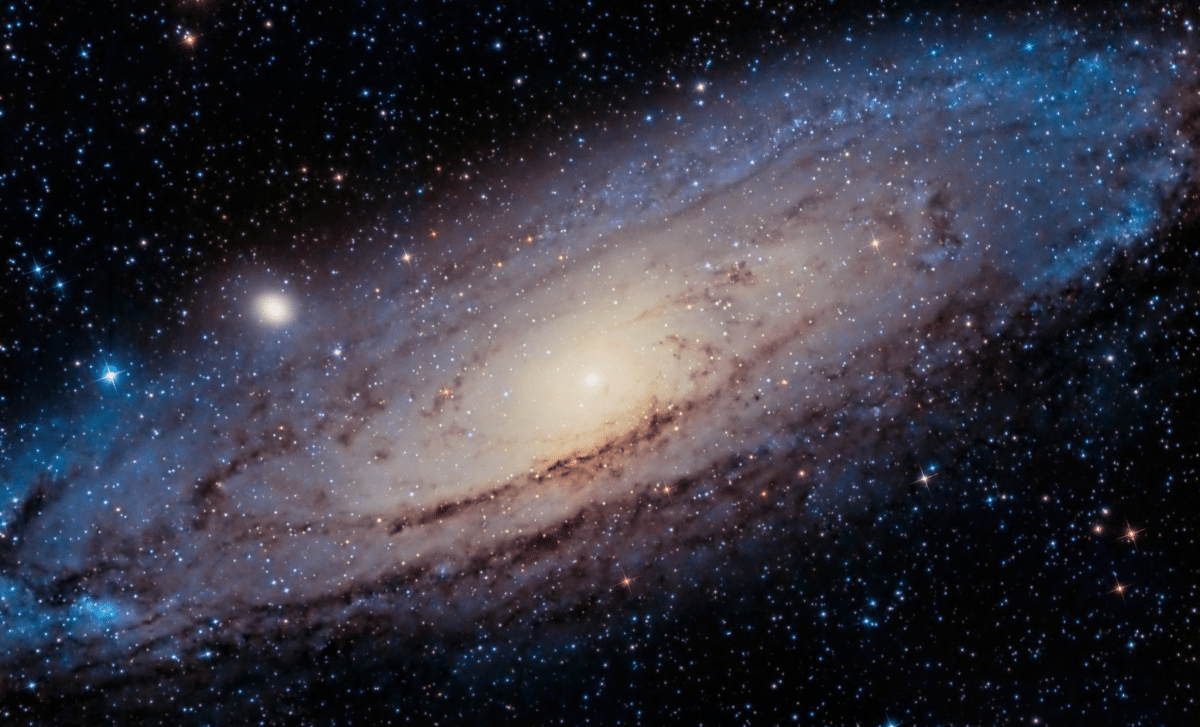
Researchers have made a breakthrough in explaining one of astrophysics’ enduring puzzles: the formation of vast, structured magnetic fields across the universe from chaotic plasma turbulence. Utilizing some of the most sophisticated plasma simulations ever created, scientists found that stable velocity gradients within turbulent plasma can convert disorderly magnetic fluctuations into large-scale cosmic magnetic configurations. This discovery has significant implications for understanding phenomena such as black holes, neutron star mergers, stellar life cycles, and powerful solar storms that impact Earth.
The Quest to Decode Cosmic Magnetic Fields
Magnetic fields permeate nearly every corner of the cosmos. They envelop planets, shape stellar environments, influence the structure of galaxies, and direct high-energy particle flows across the galaxy. Although astronomers have observed these fields for decades, a fundamental inconsistency persisted: turbulence—usually linked to chaos and breakdown—contrasts starkly with the highly ordered magnetic fields observed across enormous cosmic distances.
For almost seven decades, scientists have explored magnetic dynamos—processes in which moving conductive fluids or plasma generate magnetic fields. While traditional models have successfully simulated chaotic, small-scale magnetic patterns, they have struggled to elucidate how these fields mature into the immense, cohesive structures that dominate cosmic observations. This discrepancy has stood as a major challenge within astrophysics.

The team at the University of Wisconsin–Madison adopted a novel approach. Rather than assuming plasma turbulence is purely random, they examined if hidden large-scale flow patterns could induce magnetic order within the magnetic chaos. Their groundbreaking simulations demonstrated that when a steady velocity gradient exists within the plasma, magnetic fields progressively organize themselves into expansive structures.
“Magnetic fields across the cosmos are large-scale and ordered, but our understanding of how these fields are generated is that they come from some kind of turbulent motion,” says the study’s lead author Bindesh Tripathi, a former UW-Madison physics graduate student and current postdoctoral researcher at Columbia University. “Given that turbulence is known to be a destructive agent, the question remains, how does it create a constructive, large-scale field?”
Enormous Simulations Expose a Hidden Mechanism
To explore this behavior, the researchers leveraged Purdue University’s Anvil supercomputer to conduct one of the most extensive plasma simulation projects ever performed. The scope was massive, involving 137 billion grid points across full 3D space and consuming nearly 100 million CPU hours. About 90 individual simulations combined to generate roughly 0.25 petabytes of data.
The simulations began with plasma flows containing stable velocity gradients—zones where different regions of plasma flow at varying speeds. Small perturbations were applied to initiate turbulence naturally over time. Throughout the simulation, the team tracked how disordered magnetic patches gradually coalesced into large-scale ordered magnetic fields spanning the entire simulated volume.
“We start our simulations with a flow that has a velocity gradient, then we add some tiny perturbations, like moving one fluid particle infinitesimally, we let that perturbation propagate over the system and grow, and then analyze the data over time,” Tripathi says. “Initially, these perturbations lead to turbulent flows and magnetic fields in small-scale structures, then, over time, they emerge into larger, ordered structures.”
The key insight came when the velocity gradient was removed from the simulation. Without this organized flow, magnetic fields remained chaotic and never transitioned into coherent, large-scale forms. This behavior strongly indicates the velocity gradient is essential for fostering cosmic magnetic field organization.
“So that’s really the main key: to have a steady, large-scale gradient in velocity,” Tripathi explains.
Broader Impact on Astrophysics and Space Weather Forecasting
The conclusions of this research stretch beyond plasma theory, influencing our understanding of some of the universe’s most dramatic events: the creation of black holes, neutron star collisions, and intense solar outbursts. A deeper grasp of magnetic field formation could refine models across multiple areas of astronomical research.
Moreover, the findings align with puzzling results from earlier laboratory experiments at the Wisconsin Plasma Physics Laboratory in 2012, which exhibited magnetic phenomena existing dynamo theories could not fully replicate. Incorporating steady velocity gradients into the models brings theory and experiment into closer agreement.
This discovery also has relevance to the expanding field of multimessenger astronomy, where gravitational waves, electromagnetic signals, and cosmic particles are combined to study energetic astrophysical occurrences. Magnetic fields substantially affect these observations, particularly in the context of neutron star mergers and black hole births.
“This work has the potential to explain the magnetic dynamics relevant in, for example, neutron star mergers and black hole formation, with direct applications to multimessenger astronomy,” Tripathi says. “It may also help better understand stellar magnetic fields and predict gas ejections from the Sun toward the Earth.”
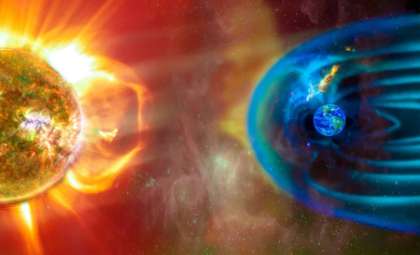
In practical terms, improved knowledge of stellar magnetic activity could greatly enhance space weather predictions. Magnetic solar eruptions can disrupt Earth’s satellites, communication networks, GPS systems, and electrical grids. More accurate forecasting models based on this research could help mitigate these impacts.
- Categories:
- Physics




0 comments
Sign in to Comment