
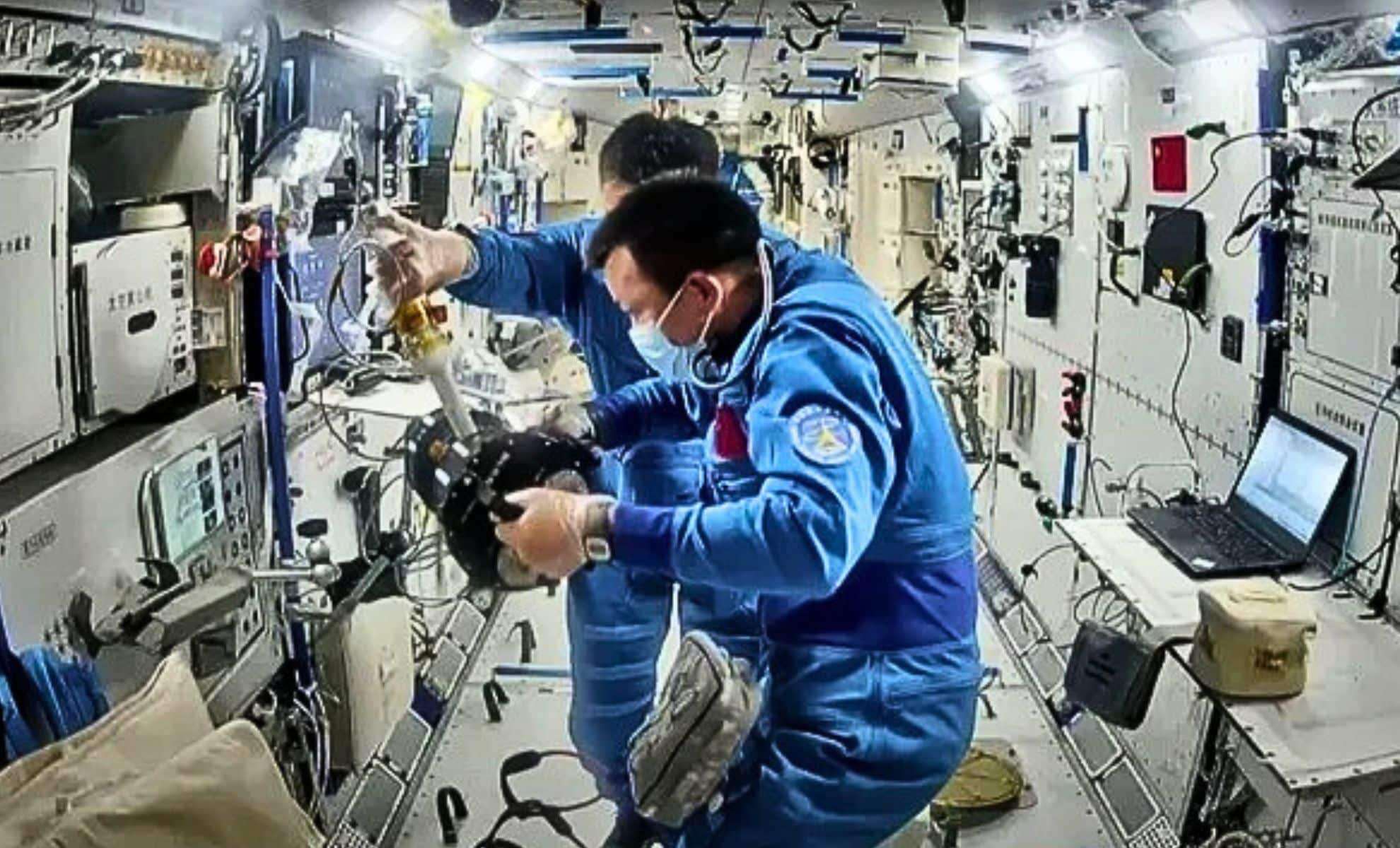
Move over, astronauts—China’s Tiangong space station is hosting some unexpected pioneers: diminutive fruit flies that could revolutionize our understanding of space biology. These tiny travelers are at the forefront of research to unlock how living beings withstand the rigors of space travel and could play a crucial role in securing human life on Mars.
In November 2023, a group consisting of 15 adult fruit flies and 40 larvae was sent to orbit aboard Tiangong alongside human crew members. Far from mere passengers, these insects serve as living test subjects in a daring experiment examining the effects of both microgravity and a low-magnetic environment on biological systems. According to the scientific team, their goal is to “investigate how microgravity combined with reduced magnetic field strength influences fundamental biological processes”.
The Tiangong space station provides an exceptional platform for research because it partially excludes Earth’s protective magnetic field. This magnetic shield normally deflects harmful cosmic radiation, but in low Earth orbit, organisms experience elevated radiation exposure. Tiangong allows scientists to approximate the extreme conditions found in deep space, where magnetic defense is almost nonexistent.

Exploring the Final Frontier with Fruit Flies
Visualize this: a colony of fruit flies traveling through low Earth orbit confronting an environment stripped of Earth’s natural magnetic protection. This normally shields against lethal cosmic radiation, and observing how life adapts in its absence is groundbreaking research, currently underway aboard Tiangong with immense implications.
These Drosophila melanogaster aren’t just any insects—they share approximately 60% of their genetic makeup with humans. This genetic closeness makes them invaluable for space biology studies. Their fast reproductive cycles enable scientists to monitor multiple generations in a compressed timeframe, yielding crucial insights into the biological effects of space environments.
Additionally, their minimal resource needs, quick breeding, and simple care routines make them highly practical for extended missions where conserving supplies is paramount.
Why Fruit Flies Are Essential for Space Science
Despite their size and status as insects, these fruit flies could drive major breakthroughs in human spaceflight. Their genetic resemblance to humans makes them perfect subjects for examining how space conditions impact living tissue. Crucially, they offer data on how exposure to radiation, microgravity, and diminished magnetic fields might alter biological functions—data impossible to obtain elsewhere.
According to the mission report, “these small insects are perfect partners for space exploration. They reproduce quickly, require little maintenance, and are ideal for exploring molecular mechanisms and biological rhythms in extreme conditions.” This makes them vital for revealing how prolonged space travel could affect human health, especially on long-term missions to distant destinations like Mars.
Could These Insects Unlock the Future of Space Travel?
The implications of this research are profound: the insights gained could help safeguard human survival during extended space journeys. Preparing for crewed missions to Mars demands a thorough understanding of how space impacts the nervous, muscular, and skeletal systems. The fruit flies of Tiangong are central to unraveling these mysteries.
Tiangong’s unique low-magnetic environment presents an unprecedented opportunity to examine biological effects unlike anywhere else. By monitoring the fruit flies’ responses, scientists may uncover answers to long-standing questions such as whether humans can endure deep-space travel and the challenges posed by extended isolation. These small creatures may hold the key to humanity’s future beyond Earth.






0 comments
Sign in to Comment