
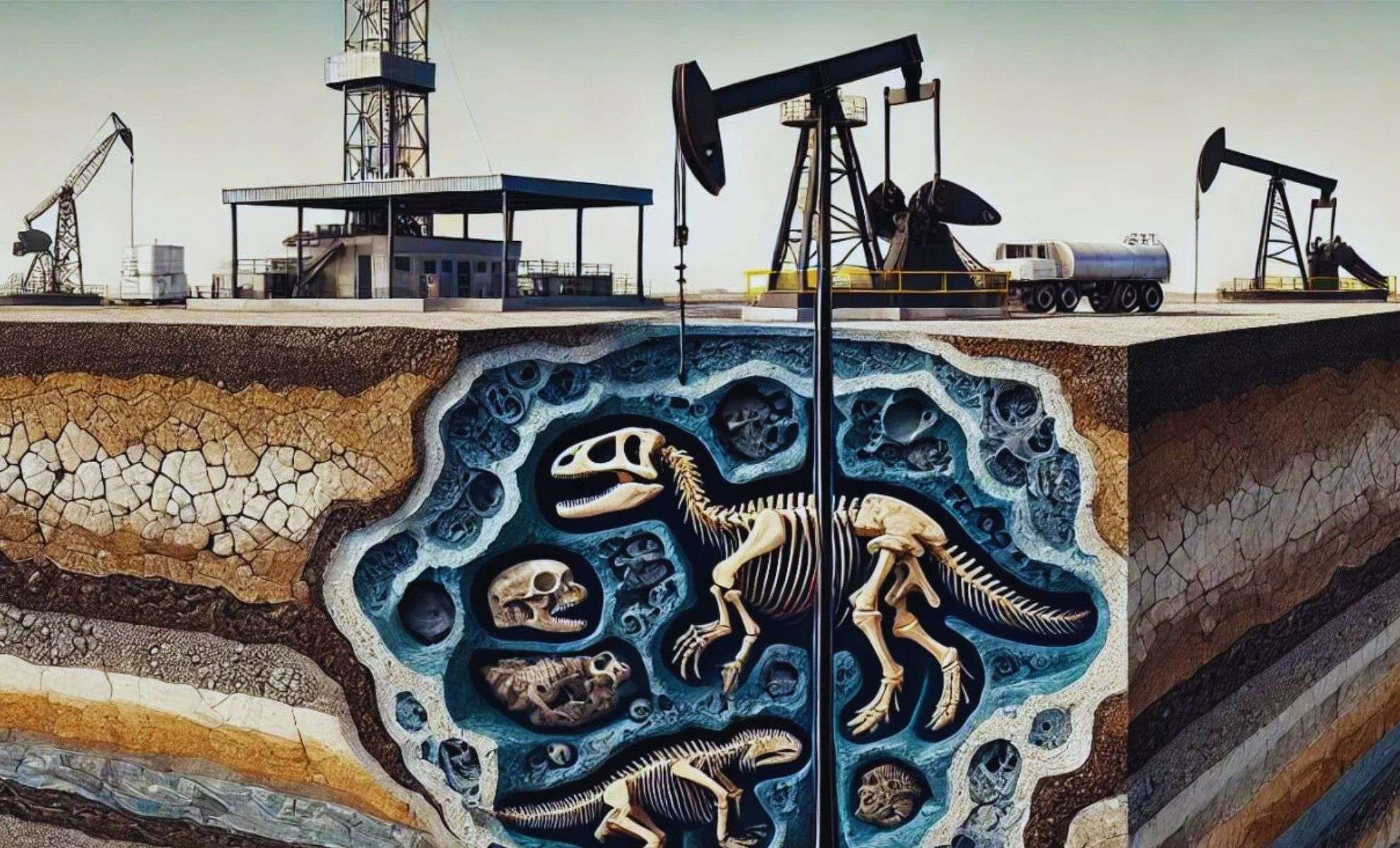
The common belief that oil is formed from the remains of dinosaurs has captured public imagination but doesn't hold up under scientific scrutiny. While fossil fuels emerged millions of years ago, their composition is mainly traced back to tiny ancient life forms rather than massive prehistoric creatures.
Where Does Oil Really Come From?
Geological research shows that oil and natural gas primarily originate from the burial and breakdown of microscopic organisms like phytoplankton and algae. Over millions of years, these tiny life forms accumulated in sediment layers, where intense heat and pressure deep below the Earth transformed them.
The conversion of organic matter into hydrocarbons — carbon and hydrogen-rich compounds that make up petroleum — occurs through distinct long-term stages:

- Organic deposit buildup: Microscopic organisms settle in ancient water bodies.
- Burial: Sediments cover these deposits, protecting them from oxygen-driven decay.
- Conversion: Heat and pressure turn organic remains into kerogen and then hydrocarbons under suitable conditions.
- Movement and accumulation: These hydrocarbons migrate through porous rocks and become trapped beneath impermeable layers, forming oil reservoirs.
Contrary to popular myths, studies of biomarkers—chemical traces of ancient life—reveal that oil originates mostly from marine microorganisms, not from large land-dwelling animals like dinosaurs. This is consistent with the fact that many oil fields once were seabeds or delta regions abundant in microbial life.

Dating Discrepancies: Oil Versus Dinosaurs
Geological timelines further debunk the dinosaur-oil connection. While dinosaurs existed approximately between 230 and 66 million years ago, some oil deposits formed from organic matter dating back over 500 million years, long before dinosaurs appeared.
Oil formation demands specific geological scenarios aligned with Earth's history, such as:
- Age span: From about 15 million years up to more than 1 billion years old.
- Source sediments: Typically marine shales rich in organic carbon.
- Optimal temperature range: Between 60 °C and 120 °C, termed the “oil window.”
Even oil created during the Jurassic and Cretaceous eras, when dinosaurs thrived, predominantly comes from algal and planktonic sources rather than dinosaur remains. This highlights the pivotal influence of Earth's ancient oceans on hydrocarbon development.
Why Dinosaurs Played a Minimal Role
Though the idea of fossil fuels containing remains of creatures like T-Rex or Diplodocus is intriguing, dinosaurs made up only a tiny fraction of the biomass on Earth. Present-day estimates place animals, including mammals, reptiles, and humans, at less than 0.5% of the planet’s organic carbon. In contrast, microorganisms and plants contribute the vast majority of organic matter.
Furthermore, fossil fuel generation favors environments where small organisms rapidly accumulate and decompose within sediments. The relatively sparse and scattered dinosaur remains make them an improbable source of significant oil deposits.









0 comments
Sign in to Comment