
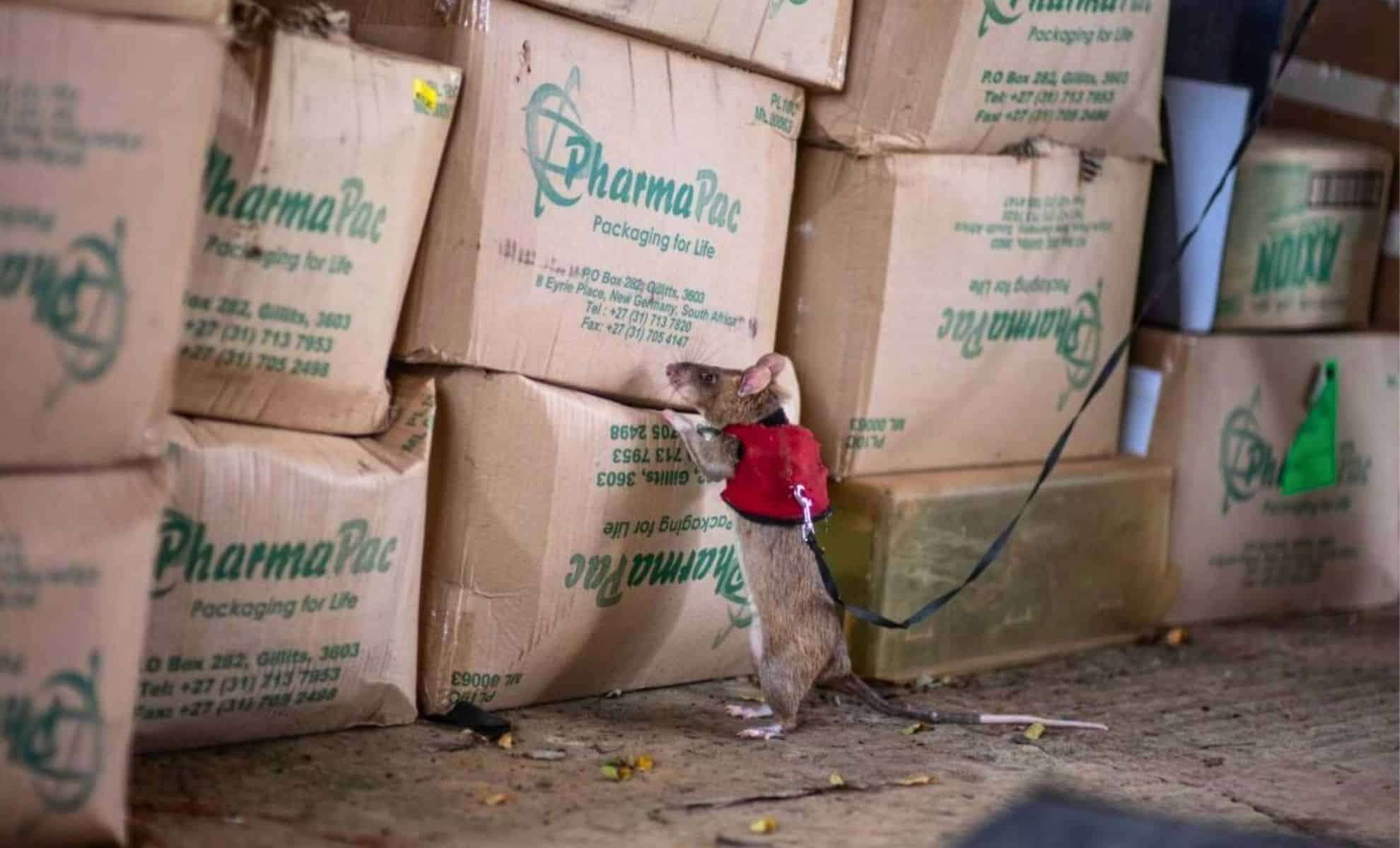
One of the world’s most profitable illicit trades, wildlife trafficking, is now facing an innovative countermeasure: African giant pouched rats. These rodents are specially trained to detect illegal wildlife items such as pangolin scales, rhino horns, elephant ivory, and endangered hardwoods, potentially transforming enforcement efforts against smuggling.
A recent publication in Frontiers in Conservation Science highlights these rats as an affordable and remarkably effective option for identifying contraband hidden within legitimate shipments.
A Remarkable Scent Detection Tool
To evade law enforcement, traffickers often use advanced tactics to hide endangered species and their parts during transport. While customs officials rely on sniffer dogs and X-ray technology, both have notable constraints. Dogs require lengthy training and significant upkeep, whereas scanners are costly and sometimes fail to accurately distinguish organic materials.

The African giant pouched rat (Cricetomys ansorgei) offers an alternative with an exceptional olfactory ability, adaptability to confined environments, and low maintenance demands. Developed at the APOPO Research and Training Center in Tanzania, these rodents have demonstrated their capability to spot illicit wildlife products even when obscured among legitimate cargo. Unlike dogs, they can be easily reassigned between handlers, enhancing their deployment flexibility in high-risk zones.
Shaping Skilled Rodent Agents
The research trained eleven rats through positive reinforcement techniques. They were repeatedly introduced to the scents of specific wildlife contraband and conditioned to signal detection by maintaining their nose over the source for a set period. Over time, the rats grew adept at separating illegal items from legal merchandise with impressive precision.
Findings revealed these rats could pinpoint pangolin scales, rhino horn, ivory, and African blackwood, even when concealed amidst other items. Their compact form allows access to tight spaces within densely loaded shipping containers—a big advantage over traditional detection dogs.
Will Rodents Replace Canines at Checkpoints?
Though unconventional, using rats for wildlife crime detection shows promise as either a supplement or alternative to standard methods. They are more cost-effective to train, tend to live longer, and can be housed in greater numbers with fewer resources compared to dogs.
Their resilience in hot, humid climates—conditions that often impair canine efficiency—makes them ideal candidates for use in Africa and Southeast Asia, areas heavily plagued by wildlife trafficking.
If broadly implemented, these trained rats could operate at airports, seaports, and border crossings, detecting illegal cargoes before they enter illicit markets. This could significantly hinder criminal trafficking pipelines, making smuggling more difficult and riskier for perpetrators.
Looking Ahead in Wildlife Protection
As the illegal trade in wildlife is estimated to generate $7–23 billion annually, the urgency for effective interventions continues to grow. Utilizing African giant pouched rats may revolutionize conservation and law enforcement efforts by providing a practical, scalable, and highly accurate means of contraband detection. With further studies and pilot projects, these unlikely allies could soon become key players in the global battle against wildlife trafficking.
Source: frontiersin
- Categories:
- News













0 comments
Sign in to Comment