
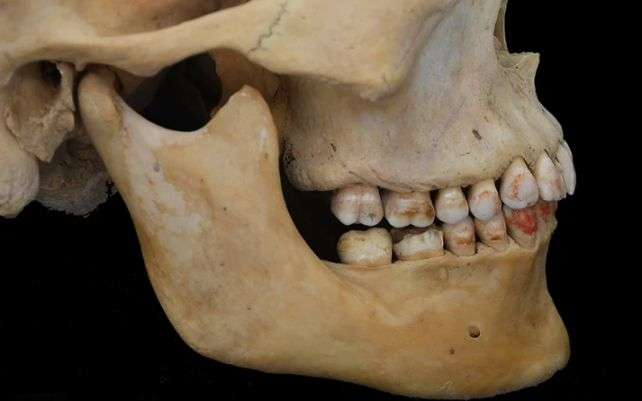
Researchers have made a remarkable archaeological find: the remains of a young woman who lived more than two millennia ago along the historic Silk Road. This individual, known as the “Red Princess,” is notable for her teeth, which were deliberately colored with cinnabar, a poisonous red mineral.
Unveiling the Red Princess at a Silk Road Burial Site
Excavations at the Shengjindian cemetery in Xinjiang, China, a key area along the ancient Silk Road, revealed several burials, including that of a young woman aged approximately 20 to 25 years. The excavation, conducted in the early 2000s, uncovered four individuals buried together, among them a child.
Her distinctive trait—remarkably preserved teeth coated in cinnabar—sets her apart from those found elsewhere.

“This unique instance of intentionally applying cinnabar, a toxic material, to teeth is unparalleled. Although singular, the discovery carries significant cultural implications beyond its immediate setting,” the scientists noted.
Decoding the Red Pigment Chemistry
Early analyses led by Sen You from Jilin University confirmed cinnabar residues on the teeth of the woman. To validate the findings, experts utilized Raman spectroscopy and X-ray fluorescence, effectively eliminating the possibility of contamination.
In addition, Fourier transform infrared (FTIR) spectroscopy detected a protein-based binder presumed to hold the cinnabar in place.
Though the binder’s exact nature remains uncertain, it is believed to consist of ancient Chinese materials traditionally used as adhesives.
These insights reveal advanced knowledge of cosmetic and ritual techniques, highlighting a developed culture with access to exotic and valuable resources.
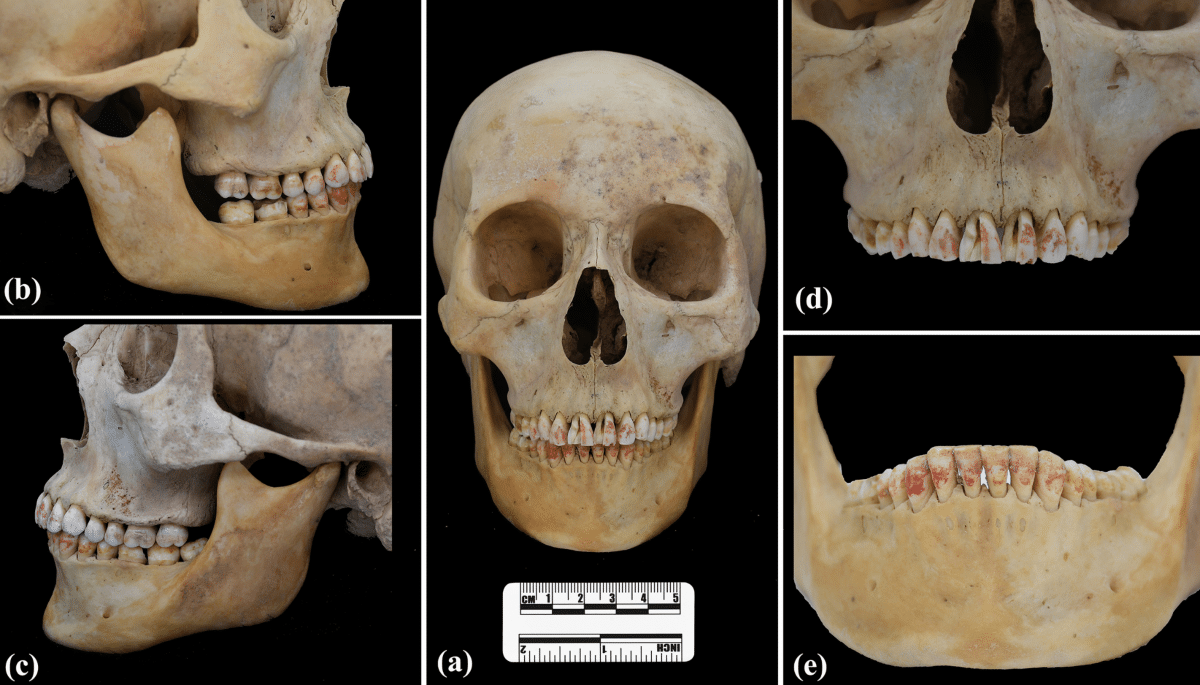
Different perspectives showing the Red Princess’s cinnabar-stained teeth. Credit: Sen You et al.
Motivations for Red Dental Staining
Multiple explanations exist for this rare practice. In ancient Chinese tradition, the color red symbolized good luck and power, suggesting the teeth staining might have had spiritual or ceremonial significance.
Alternatively, the vibrant red could simply have served cosmetic purposes, signifying beauty or social rank. Throughout history, many cultures—from Southeast Asia to Oceania—have modified teeth to reflect status. The presence of luxurious burial items such as silk, ceramics, and precious metals supports this possibility.
Because cinnabar is not local but traded from far-off regions including central China and Europe, it implies the woman—or her community—had connections to extensive trade routes.
Silk Road: A Network of Trade and Cultural Interaction
The occurrence of cinnabar in this grave underscores the Silk Road’s function as a conduit for exchanging rare materials and cultural practices. Due to the mineral’s rarity and toxicity, it was likely highly valued and transported over vast distances.
The possession of such a resource suggests the “Red Princess” held a distinctive social position within a community linked to broad commercial networks across Asia and possibly beyond.
“Given the geographical spread of cinnabar and those who utilized it, the social standing of the tomb occupant was probably unique enough to obtain this precious mineral.”
- Categories:
- Science



0 comments
Sign in to Comment