

Rock art found in the Amazon has exposed depictions of extinct animals predating their official scientific discovery by around 2,000 years. This extraordinary finding reveals the depth of environmental awareness held by indigenous cultures long before modern paleontology arose.
Revealing prehistoric fauna through indigenous artistry
Deep within South Africa’s Karoo region, a captivating find has attracted scientific interest. A rock painting crafted between 1821 and 1835 by the San people, hunter-gatherers noted for their cultural heritage, illustrates a creature with curved tusks. Once dismissed as mythical, this image is now identified as representing an extinct dicynodont species.
Julien Benoit, a paleontologist at the University of Witwatersrand, argues that this artwork draws from fossil evidence of dicynodontes. These large herbivores, which existed roughly 200 million years ago, lived well before the age of the dinosaurs. Their fossils are plentiful in the Karoo, historically a thriving, biodiverse landscape.

This link between ancient fossils and San artwork prompts compelling discussions about how indigenous groups interpreted these relics. It implies the San held sophisticated knowledge of extinct species, predating formal scientific classification by nearly a century.
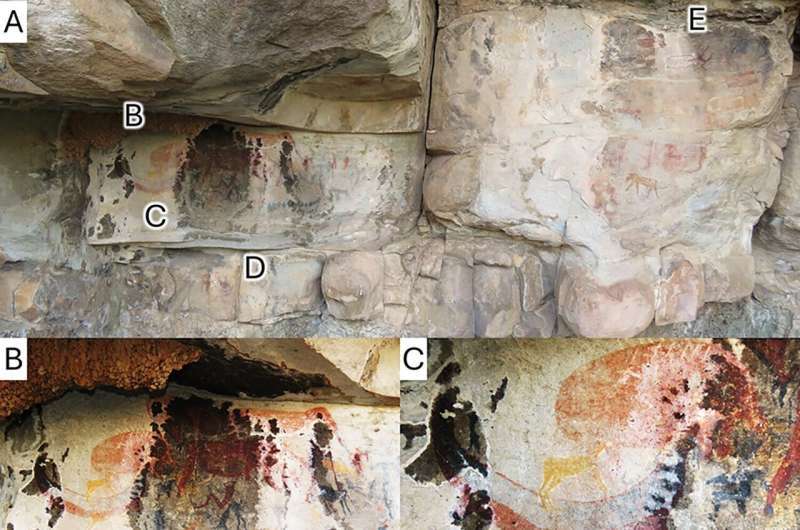
Rock paintings of the Horned Serpent panel.
A, general view.
B, close-up of the section depicted in plate 39 of Stow and Bleek.
C, close-up of the tusked animal.
D, close-up of the warriors painted below the Horned Serpent panel.
E, close-up of the warriors painted to the right of the panel.
© Julien Benoit, 2024
Linking indigenous insights with scientific findings
The research published in PLOS ONE confronts previous beliefs about the origins of paleontological knowledge. It posits that the San likely discovered and understood fossil remains long before Richard Owen officially described dicynodonts in 1845. This emphasizes the value of incorporating indigenous perspectives into scientific research frameworks.
Archaeological discoveries such as stone tools at fossil-rich locations back up the notion that the San had an intimate awareness of their environment. Their sharp observational abilities allowed them to weave these ancient fossils into cultural and spiritual narratives, symbolizing mythical “rain animals” — supernatural beings integral to their traditions.
The fusion of fossils into San mythology and artistry highlights their capacity to create meaning from prehistoric remnants, well before paleontology became a formal discipline. It reflects a profound bond with the natural world and an ability to conceive a remote past filled with now-extinct colossal beings.
Spiritual roles and ceremonial meaning
These “rain animals” held vital significance in San spiritual beliefs and ritual practices, especially within dry regions like the Karoo. Seen as beings capable of navigating the spirit realm and summoning rain, they featured prominently in shamanic rituals where trance states were used to connect with these entities.
The portrayal of a dicynodont in San rock paintings could embody deep spiritual meaning. As a creature from the extinct past, it likely symbolized the spirit world, intensifying its mystical importance in their ceremonies.
Benoit suggests fossils of extinct animals, representing eternal death, might have served as a link between the living and the dead — a concept central to shamanism. The San seemingly revered these fossils as powerful relics that bridged their present world with ancient times through rain-making rites.
Aspect San Interpretation Scientific Understanding Fossil Remains Sacred relics, “rain animals” Extinct creatures (dicynodonts) Time Frame Mythological past Circa 200 million years ago Significance Spiritual and ritual Scientific fossil record
Connecting age-old wisdom with contemporary science
Julien Benoit’s study reveals the often-overlooked depth of indigenous paleontological understanding, focusing on the San’s interpretations. Contrary to the idea that ancient species were “discovered” solely by modern scientists, indigenous peoples had their own meaningful interpretations of fossils they encountered.
This research underscores the necessity of:
- Valuing indigenous contributions to scientific knowledge
- Incorporating traditional wisdom into current scientific inquiry
- Recognizing longstanding ties between native cultures and their ecosystems
- Reevaluating artifacts by combining multiple academic perspectives
Comparable examples exist in North America, where Indigenous tribes embedded dinosaur fossils into oral histories and myth-making processes. Globally, this pattern indicates that indigenous cultures everywhere instinctively understood extinct animal life, often conferring profound cultural and spiritual meaning to these findings.
Neglecting this knowledge for so long has led to an underestimation of indigenous peoples’ intellectual curiosity and insight. Their inclusion of fossils in myths and artwork confirms a sophisticated grasp of deep time, rooted in careful observation of their natural settings.
As we deepen our exploration of Earth’s past, it becomes increasingly vital to merge ancient cultural knowledge with modern science. The San’s rock art stands as a potent reminder that diverse perspectives enrich our collective understanding of the universe.
- Categories:
- Evolution













0 comments
Sign in to Comment