

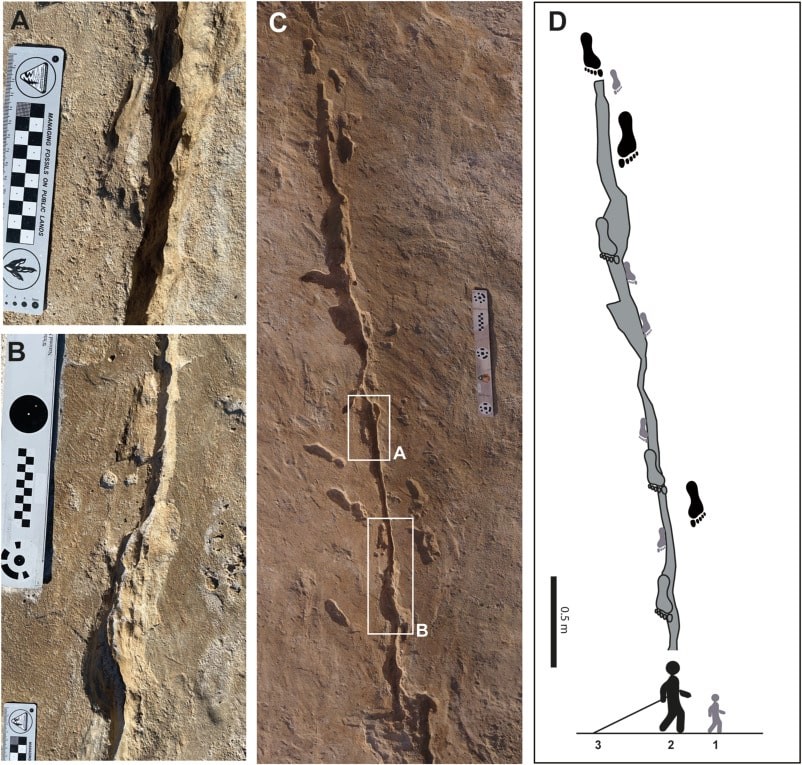
Researchers in New Mexico have discovered ancient track marks dated to approximately 22,000 years ago that could be among the earliest signs of human-made vehicles. These impressions, found in White Sands National Park, are believed to have been created by a wooden pole apparatus — potentially a travois, a primitive yet effective hauling method. This discovery challenges previous ideas by revealing advanced transportation practices predating the invention of the wheel in North America.
Wooden Pole Transport Instead of Wheels
The ancient device, akin to a wheelbarrow without wheels, consisted of wooden poles used to carry loads. Matthew Bennett, a co-author of the research from the University of Bournemouth, described it as “a wheelbarrow without the wheel.” These tracks, found near human footprints, are dispersed throughout White Sands and imply that this early form of transportation was widely utilized.
“[Tracks like this] occur in lots of different areas [of White Sands National Park], so it was widespread. It’s not just one inventive family using a travois,” Bennett said.”
Add Cosmo Herald as a Preferred Source

It is thought that the travois was employed by ancient groups to move goods, and variations in track patterns suggest different designs for the device.
Some impressions show a singular, straight line likely formed by a triangular construction with two wooden poles meeting at a point that dragged along the ground. Others reveal pairs of parallel lines, which could reflect a sturdier X-shaped frame featuring two handles and multiple contact points.

Insights into Family Roles in Prehistoric Times
Remarkably, alongside the travois traces, scientists identified small footprints corresponding to children. This detail hints that young individuals might have participated in hauling or accompanied adults on transport routes, offering a glimpse into the social dynamics of ancient groups.
While animal-drawn sleds were common in other regions, the study published in Quaternary Science Advances highlights that these travois tracks were made by humans themselves, based on the current evidence.
Rethinking the Complexity of Prehistoric Technology
With this discovery, the timeline for human occupation in the White Sands area extends further back, possibly over 23,000 years ago. The travois traces reinforce the idea that early people were inventing practical transport methods well before the wheel’s invention.
This evidence acts like a significant missing piece, challenging previously held notions about ancient human migration and ingenuity. As stated by the study’s authors, should these tracks indeed stem from a travois,
“it may represent one of the earliest pieces of evidence for the use of transport technology,” and could help fill in some of the gaps in our understanding of how ancient societies functioned.
- Categories:
- Science







0 comments
Sign in to Comment