
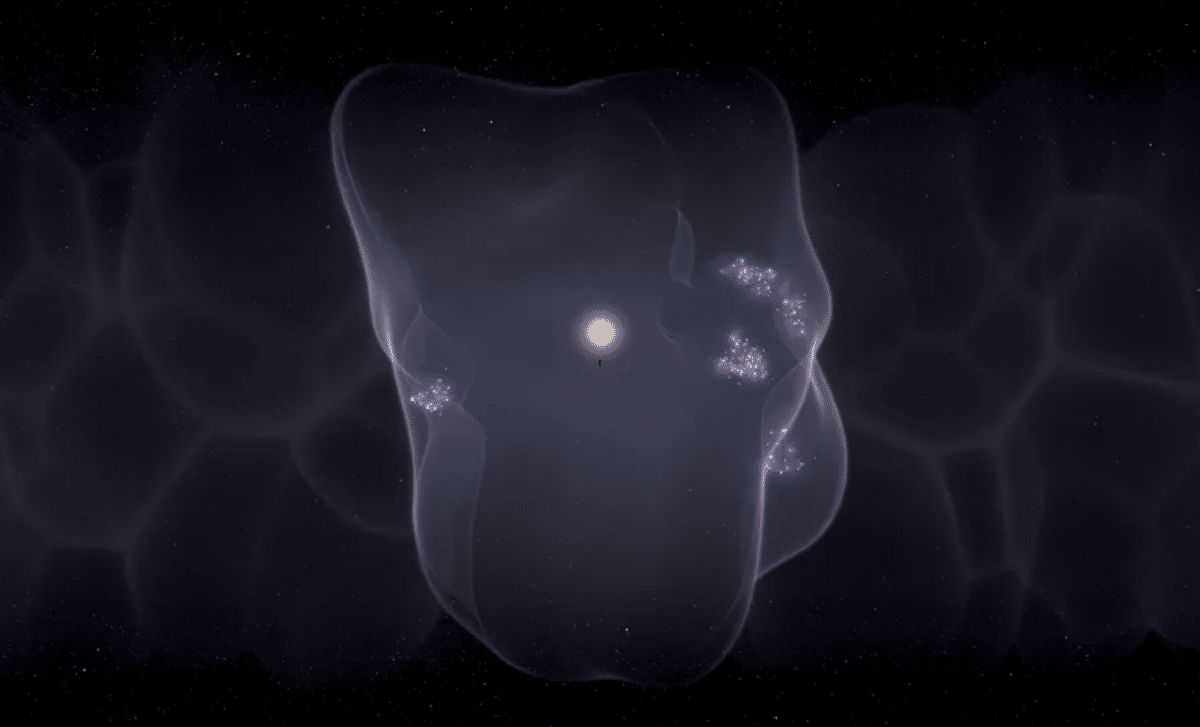
Recent research featured in The Astrophysical Journal reveals an extraordinary event in the solar system’s history. Approximately 4.4 million years ago, two massive stars made a close approach to the Sun, leaving an enduring “cosmic mark” within the surrounding interstellar material. This discovery offers vital clues about the influence of such stellar interactions on Earth and deepens our understanding of the Sun’s celestial environment.
The Sun’s Near Miss: A Tale of Two Giants
Some 4.4 million years back, our Sun experienced a near passage with two colossal stars, Epsilon Canis Majoris and Beta Canis Majoris, each roughly 13 times the Sun’s mass. They came within 30 light-years of our solar system, significantly disturbing the nearby interstellar clouds. While this distance sounds vast, it is remarkably close on cosmic scales. Their proximity caused widespread ionization of gas and dust in these clouds, leaving a long-lasting “scar” detectable through advanced astronomical instruments.
Michael Shull, the study’s lead researcher from the University of Colorado Boulder, described the situation as a dynamic cosmic puzzle:

“It’s kind of a jigsaw puzzle where all the different pieces are moving,” Shull said. “The sun is moving. Stars are racing away from us. The clouds are drifting away.”
This complex scenario involving the Sun, the interstellar clouds, and the passing stars enriches our comprehension of the ever-changing setting our solar system inhabits.
Decoding the Ionized Trail and Its Cosmic Importance
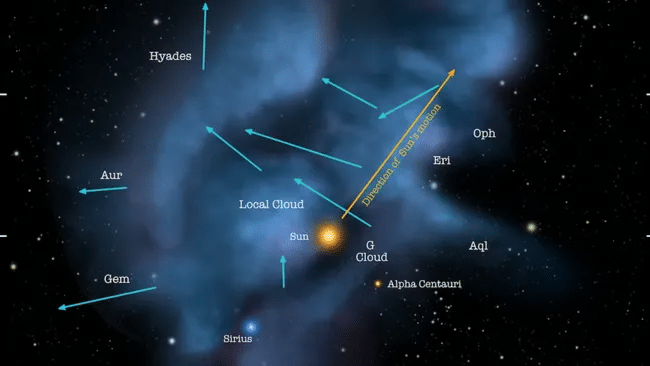
The core finding highlights significantly elevated ionization within the nearby interstellar clouds stretching about 30 light-years around us. These clouds primarily comprise gaseous hydrogen and helium and play a crucial role in our cosmic locale. The intense ultraviolet radiation emitted by the massive stars ionized these elements, knocking electrons out of atoms and creating a trail of positively charged ions. This “scar” has long intrigued astronomers.
Shull and colleagues discovered that nearly 20% of the hydrogen and 40% of the helium in these clouds were ionized—particularly notable because helium typically resists ionization more than hydrogen. By simulating the stars’ and clouds’ motions, the team confirmed that this radiation was chiefly responsible for the effect, emphasizing how the Sun’s interaction with these clouds was profoundly shaped by these stellar visitors.
Highlighting the significance of this cosmic mark, Shull remarked that “The fact that the sun is inside this set of clouds that can shield us from that ionizing radiation may be an important piece of what makes Earth habitable today.” The study, appearing in The Astrophysical Journal , proposes that the same clouds altered by stellar radiation now act as a protective barrier, limiting harmful ionizing radiation’s reach to Earth.
The Influence of the Local Hot Bubble and Additional Radiation Sources
Besides the two stars, other elements likely contributed to the ionization effects observed. Among these is the “local hot bubble,” a section of the Milky Way deficient in gas and dust, formed by the supernova explosions of around 10 to 20 previous stars. This region not only heated surrounding gas but also generated ionizing radiation, intensifying the ionization of nearby clouds.
The team suggests that radiation from at least four more ultraviolet sources supplemented the ionizing effect—this includes three white dwarf stars, remnants of Sun-like stars, plus ionization stemming from the local hot bubble itself. Together, these factors sculpted the space around our solar system and may have played a role in Earth’s biological evolution.
What Lies Ahead for These Stellar Giants?
Although Epsilon and Beta Canis Majoris have since traveled farther away, they are approaching the end of their life cycles. Massive stars like these consume their fuel rapidly and are expected to culminate in supernova explosions within a few million years. Such an event is both catastrophic and visually dramatic, resulting in a brilliant stellar explosion.
Currently more than 400 light-years distant, these stars’ eventual supernovae could still be bright enough to witness from Earth. Shull noted, “A supernova blowing up that close will light up the sky. It’ll be very, very bright but far enough away that it won’t be lethal.” The explosion’s glow might persist for months, offering a striking celestial show without posing a direct danger to our planet.
This scenario highlights the potential long-term threats and wonders posed by nearby stars. While supernovae can emit hazardous radiation, this impending event would likely be a spectacular cosmic light show rather than a hazard to terrestrial life.
- Categories:
- Space



0 comments
Sign in to Comment