
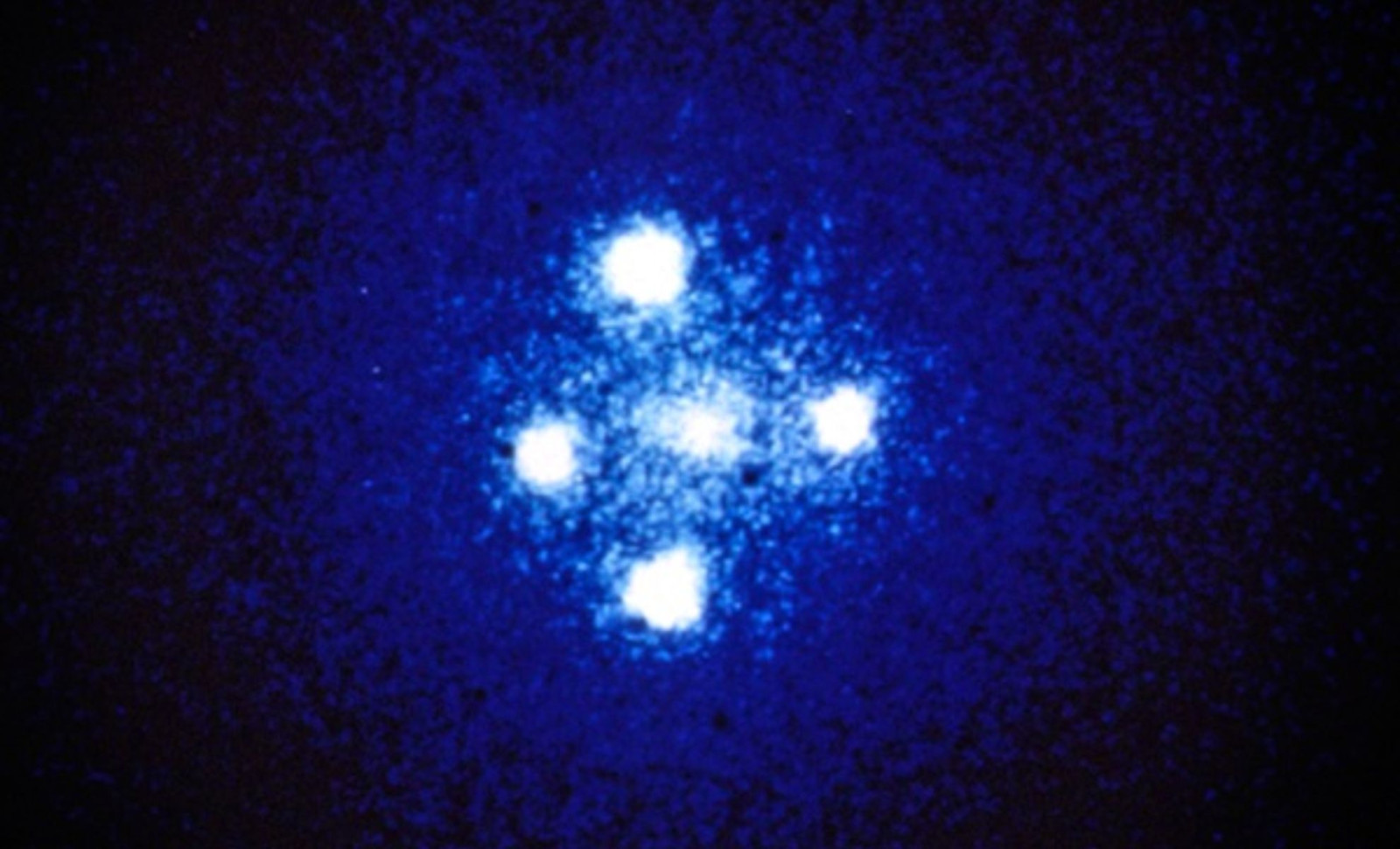
Astronomers have leveraged a rare gravitational lens known as the “Einstein Cross” to study a distant galaxy exhibiting surprisingly evolved stars. This galaxy, designated J1453g, challenges prevailing ideas about the lifecycle of massive galactic systems.
Situated roughly 8 billion light-years away, J1453g is an elliptical galaxy observed as it existed 8 billion years ago, during an early phase of cosmic history. The gravitational lensing effect, predicted by Albert Einstein, enables astronomers to view far-flung objects like quasars through the gravitational influence of a nearer massive galaxy. This phenomenon has provided new insights into J1453g’s stellar population, revealing unexpected aspects of its age and makeup.
Leveraging Cosmic Magnification
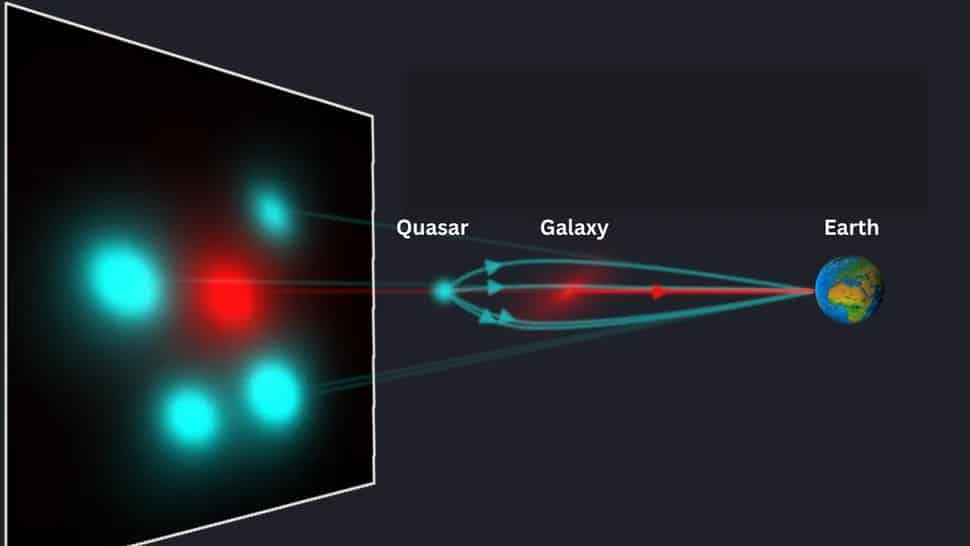
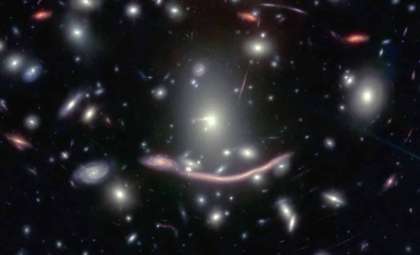
Gravitational lensing happens when light from a faraway source, such as a quasar, is bent by the gravitational field of a massive object in between, causing the background source to appear enlarged or multiplied.

In this instance, the gravitational pull from J1453g magnified the light of a distant quasar, producing the distinctive “Einstein Cross” configuration, where multiple images of the quasar are seen arranged in a cross-like pattern. Quirino D’Amato, an astrophysicist at the Italian National Institute for Astrophysics (INAF), explained:
“The discovery of this exceptional object has allowed us to accurately study the nature of the stars at the center of an elliptical galaxy in a remote era of the universe, when the galaxy was still young.”
This lensing effect has permitted detailed measurement of the stellar mass distribution within J1453g, granting a rare glimpse into a distant galaxy’s structure with unprecedented resolution. These insights were detailed in a study published on April 2 in Nature Astronomy.
A Surprisingly Mature Population in a Young Galaxy
Though J1453g is relatively youthful in cosmic terms, its stars exhibit characteristics commonly associated with much older galaxies, such as the Milky Way. Conventional wisdom expects elliptical galaxies at these early stages to primarily host low-mass stars concentrated at their centers, which typically form rapidly during initial formation phases.
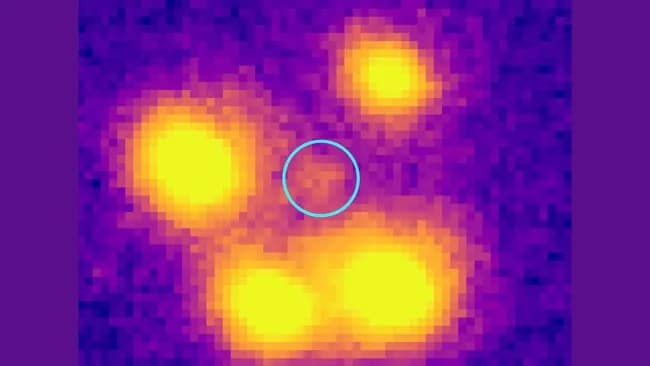
Contrary to expectations, J1453g contains a prominent core made up of high-mass stars, a feature generally found in much older galaxies.
“The fact that their composition is very similar to what we see today in the Milky Way, in a completely different environment and era, is surprising,” D’Amato commented. “This tells us that we are still far from fully understanding the processes of galaxy formation and evolution, and represents an important point for the development of future models.”
This revelation indicates that the mechanisms behind how galaxies form and mature might be more intricate and diverse than previously understood.
- Categories:
- Astronomy


0 comments
Sign in to Comment