
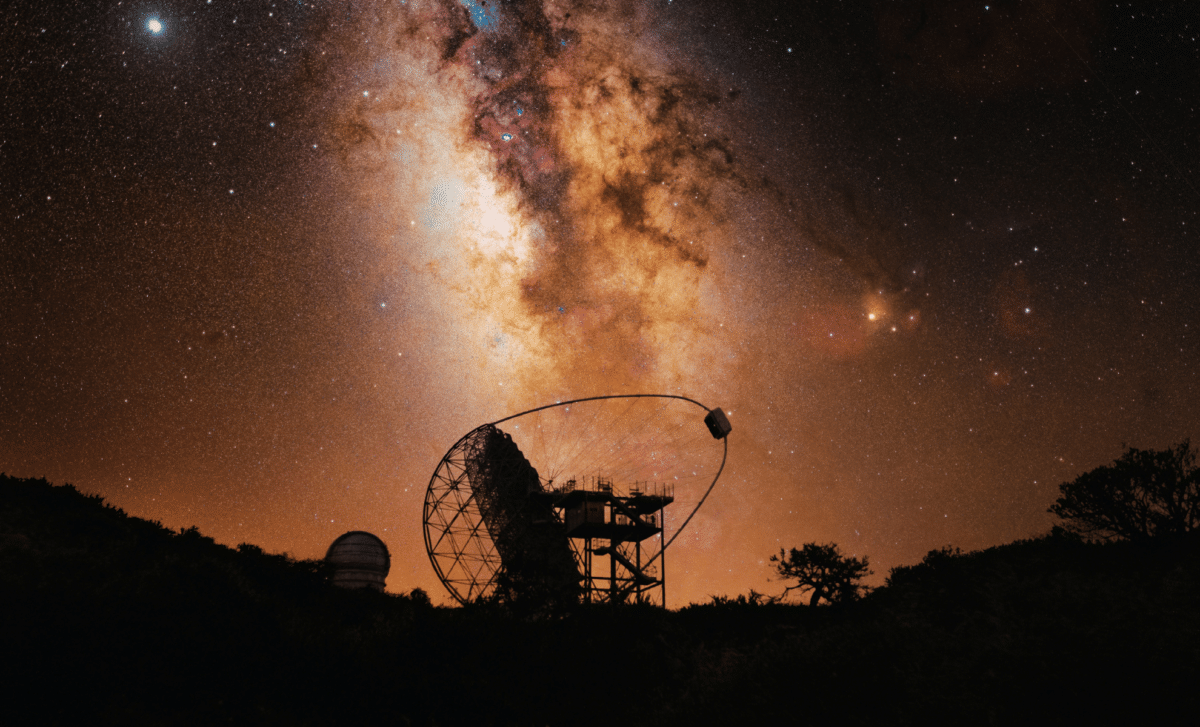
Scientists have charted a colossal cosmic formation previously masked by the Milky Way, uncovering one of the universe’s largest known structures. Presented in a new study on arXiv, this finding transforms how astronomers perceive the universe’s large-scale framework and matter distribution.
Unveiling a Supercluster Hidden Beyond Reach
The Vela Supercluster had long evaded detection, obscured by the thick stellar disk of our galaxy. Situated about 800 million light-years away, this enormous entity lies behind the so-called Zone of Avoidance, where dense stars, gas, and dust obstruct direct view. Even though it’s relatively nearby by cosmic standards, its full size has only just been revealed.
New findings depict a structure stretching around 300 million light-years wide, approximately 3,000 times the scale of the Milky Way. Contained within are at least 20 clusters of galaxies, each holding hundreds to thousands of galaxies gravitationally bound. The supercluster’s mass rivals roughly 30 quadrillion suns, ranking it among the heaviest formations in our local universe. It surpasses the Laniākea supercluster, home to our galaxy, and rivals the enormous Shapley Supercluster.

Scientists also discovered two significant cores within the supercluster that are slowly converging. This interaction sheds light on the evolving nature of enormous cosmic structures, revealing how they form and merge over billions of years. The supercluster has been named Vela-Banzi, a term from the Xhosa language meaning “revealing widely,” reflecting the discovery’s significance.
Seeing Beyond the Milky Way’s Thick Veil
Mapping beyond our galaxy is challenging due to the Milky Way’s dense disk, which acts as a natural screen. Astronomer Renee Kraan-Korteweg explains, “The millions/billions of stars forming the disk are so dense [and so] close to the galactic plane that we cannot easily see through it,” Kraan-Korteweg wrote. “Moreover, where we have stars, we also have lots of minuscule dust particles, and like the stars, this dust layer gets thicker and thicker as you approach the plane.”
To pierce this cosmic barrier, researchers merged a vast dataset comprising roughly 65,000 galaxy distance measurements with nearly 8,000 fresh redshift observations. Redshift data indicates how fast galaxies move away, helping determine their spatial location and trajectory. Key contributions came from South Africa’s MeerKAT radio telescope, which captures radio waves emitted by hydrogen gas in galaxies, enabling detection through the dust that blocks visible light.
About 2,000 redshift readings were acquired using MeerKAT, unveiling galaxies previously hidden from optical telescopes. This technique allowed astronomers to map the supercluster’s edges and inner dynamics with unmatched precision. Although the mapping remains partial, it forms a solid foundation outlining the structure’s vast extent and intricacy.
Impact on Cosmic Cartography
Identifying and detailing Vela-Banzi holds significance beyond this single cluster. Superclusters like this one are vital for testing cosmological models—the frameworks that explain the universe’s origin and growth. Understanding how matter organizes on such grand scales allows scientists to verify whether current theoretical models align with reality.
The research, available on arXiv, stresses the need to measure both dimensions and movement of cosmic features. Without comprehensive knowledge of these factors, models lack completeness. Kraan-Korteweg underlines this: “To understand the one, we need to know the other,” Kraan-Korteweg said. “And if we have both, we will be [able] to check if we can reconcile these observations with the models of the universe.”
This investigation also highlights how much remains hidden—not due to vast distance but because of observational barriers. Even within our cosmic vicinity, large regions are only partially charted. Employing radio astronomy to penetrate these blind spots marks a milestone in astronomical exploration.
Future Prospects for Exploring Hidden Realms
While this advance is groundbreaking, the Vela Supercluster map is far from complete. Since not all galaxies produce strong radio emissions, some sectors remain challenging to observe even with state-of-the-art technology. Upcoming telescopes with enhanced sensitivity may refine our vision, yet some areas might stay obscured indefinitely.
Nonetheless, the progress opens pathways for deeper study of the Zone of Avoidance. As observation methods advance and further data accumulates, astronomers anticipate discovering more hidden superstructures, potentially matching or surpassing Vela-Banzi’s magnitude. Every discovery adds to the cosmic map, gradually revealing a fuller picture of our universe.
The revelation of this immense supercluster is a testament that even well-examined parts of the sky can conceal massive mysteries. Improvements in astronomical tools continue to lift the veil on the universe’s secret framework, altering our perception of our place in the cosmos and what lies beyond.
- Categories:
- News





0 comments
Sign in to Comment