
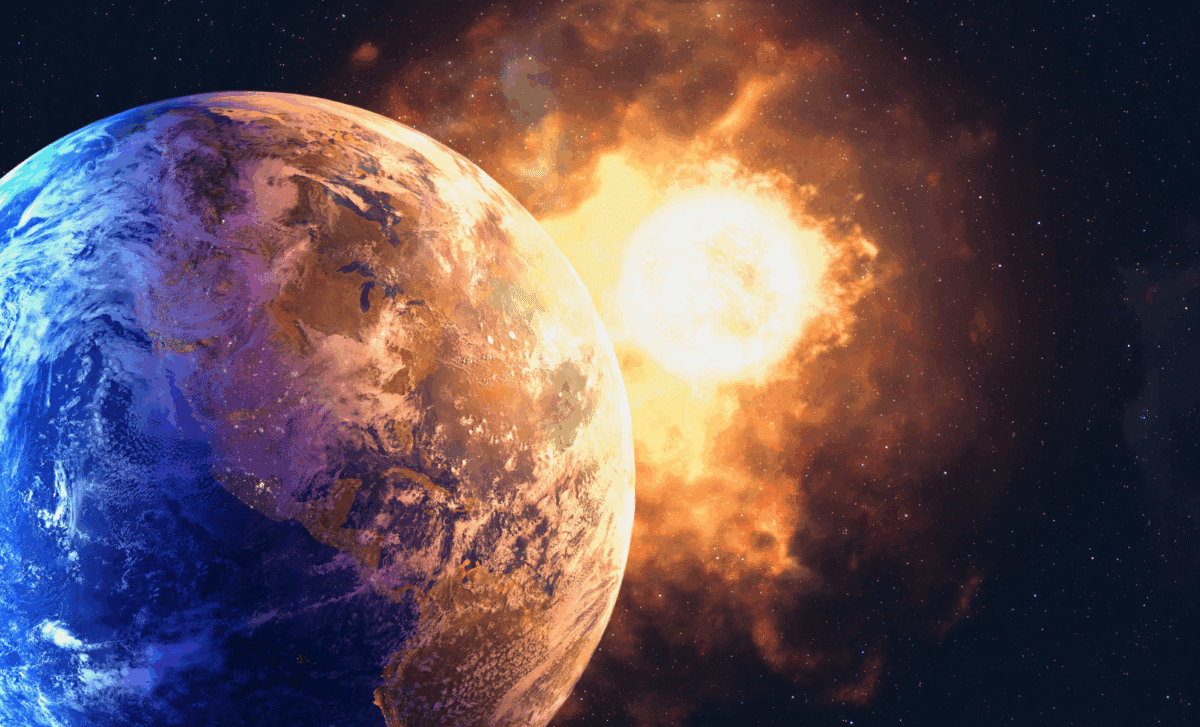
As humanity advances through the ages, questions about the longevity of our species grow increasingly pressing. Despite leaps in technology, scientific knowledge, and societal development, are we unknowingly approaching an imminent endpoint? In the 1980s, astrophysicist Brandon Carter introduced a compelling concept called the “Carter Catastrophe.” Through a mathematical framework, this theory proposes that our place in humanity’s timeline is random, raising the unsettling possibility that our era could be closer to the end than we expect.
Understanding Our Random Spot in History
The notion that we are simply a random point within humanity’s entire existence can feel disconcerting. We naturally tend to see our own epoch as unique or significant. However, Carter’s hypothesis challenges this, implying that our temporal position—somewhere between humanity’s birth and its potential demise—is likely arbitrary. By estimating the total number of individuals ever born and incorporating factors like birth rates and life spans, his theory suggests it’s plausible we’re living near the closing chapters of human history. Rather than relying on cosmic catastrophes, this model hinges on statistical probabilities—similar to forecasting events based on past trends.
Central to Carter’s argument is the Copernican Principle, a foundational idea in cosmology. Fermilab astrophysicist Albert Stebbins explains this principle as the assumption that "we do not live in a special part of the universe," which extends to the belief that we occupy no privileged moment in time. This perspective forms the core basis for applying statistical reasoning to our position within humanity’s overall timeline.

What the Copernican Principle Reveals
To fully appreciate Carter’s reasoning, it’s vital to examine the Copernican Principle itself. This principle posits that Earth isn't the center of the cosmos, naturally extending to suggest that our current time isn’t exceptional either. This implies that, statistically, we are typical observers and not living through a defining or extraordinary period. As Stebbins notes,
“It is a very handy principle, since it implies that here and now is the same as there and now, and here and then is the same as there and then.”
This principle underpins Carter’s idea that our temporal position is far more random than we'd like to believe.
Applying this notion, Carter’s equation suggests that we shouldn’t presume to be witnessing either the dawn or the conclusion of humanity. Instead, it’s statistically more probable that we exist somewhere near the middle of the timeline. This has significant consequences for how we view our future: if our current moment is an “average” point in history, humanity could be alarmingly close to its endpoint. It introduces an element of uncertainty and probabilistic foresight often neglected in everyday life.
Assessing Our Place on Humanity’s Timeline
Employing Carter’s equation, scientists such as astrophysicist J. Richard Gott have applied this logic to real-world phenomena. Gott notably used this technique to forecast the collapse of the Berlin Wall, showing that Carter’s equation can effectively approximate when significant events might end. By analyzing how long an event or structure has persisted, Gott accurately estimated the Wall’s eventual fall.
When extrapolating this approach to our species, it raises the sobering possibility that humanity’s extinction could be nearer than commonly thought. Gott’s calculations infer that humanity might survive only a few thousand more years unless there are transformative shifts in birth rates or longevity. This paints a grim scenario: humanity’s population could soon peak before experiencing a rapid decline, driven by unpredictable causes.
The Power of the Equation to Trace Our Destiny
Carter’s formula relies on principles of statistical probability, assuming observers exist within a finite timeline—much like our spatial positioning within an immense, boundless cosmos. If we envision humanity’s lifespan as a defined segment from start to finish, Carter’s theory indicates an equal chance of being born at any moment along this stretch. Thus, in probability terms, we are just as likely to be closer to humanity’s beginning as to its conclusion.
This reasoning leads to a chilling inference: the time left for humanity could be limited. By estimating those already born and extrapolating future births, Gott’s model estimates the total future population could range from around 1.8 billion to 2.7 trillion. Maintaining current birth trends, humanity might reach a crucial turning point within a few centuries, followed by a steep drop-off that could ultimately culminate in extinction.
Variables and Uncertainties in Predicting Humanity’s Future
While Carter’s theory offers a captivating framework, it comes with significant uncertainties. Numerous unpredictable factors can alter our projected timeline. Breakthroughs in healthcare, technology, or unforeseen global disasters—whether environmental, nuclear, or otherwise—could either extend or curtail humanity’s span significantly.
Moreover, the theory overlooks possible evolutionary changes. Will humans continue evolving biologically, or will advances in artificial intelligence and genetic engineering redefine what it means to be human? Could we merge with machines, creating an entirely different class of beings, rendering Carter’s original calculations obsolete?
- Categories:
- News









0 comments
Sign in to Comment