
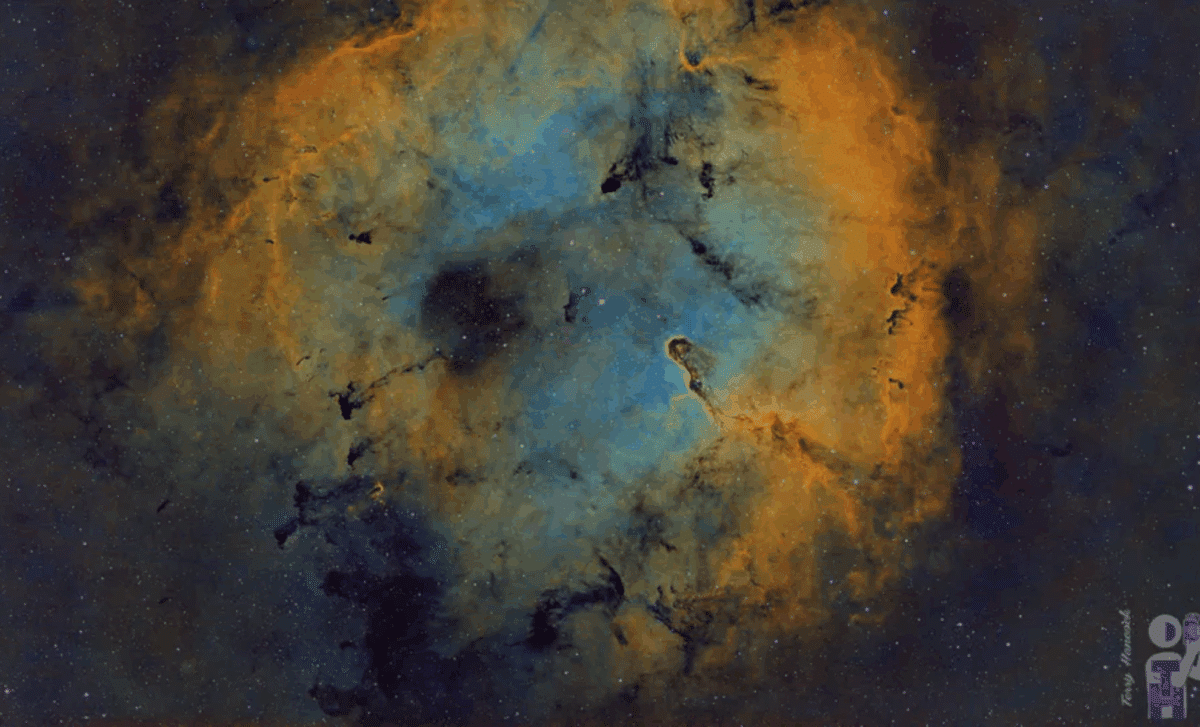
An enthusiastic astrophotographer has unveiled a spectacular image showcasing a distant star-forming region. Employing custom instruments and dedicating countless hours of exposure time, the final photograph reveals delicate cosmic formations beyond human vision.
Positioned within the Cepheus constellation, this highly detailed depiction of the Elephant Trunk Nebula exposes an active interplay between interstellar dust and radiant gas.
Through meticulous technique and sophisticated imaging software, the photographer transformed faint nebula features into a vivid portrait of stellar birth.
Peering Into a Stellar Nursery
Terry Hancock, an astrophotographer located in Whitewater, Colorado, produced a remarkably sharp image of IC 1396, widely recognized as the Elephant Trunk Nebula. This nebula region is situated roughly 2,400 light-years from Earth within the Cepheus constellation and features a distinctive, dark column of dust curving through space — the structure inspiring the nebula’s nickname.
Hancock’s approach involved a 180mm Newtonian reflector paired with a customized astronomical camera. Over the course of 114 hours, he precisely gathered light filtered through narrowband lenses tuned to detect emissions from ionized gases. The collected data was then processed with PixInsight and Adobe Photoshop, revealing intricate formations hidden in the depths of space.

Space.com highlighted Hancock’s work, praising it as an artful balance of illumination and darkness within a vast emission nebula, energized by ultraviolet radiation from young stars embedded within.
“The image highlights various celestial elements, including a notable emission nebula, by contrast against the bluish cavity that fills the center of IC 1396,” Hancock told Space.com in an email.
The nebula complex extends more than five degrees across the sky, roughly ten times the diameter of the full moon. However, to the unaided eye it appears as a faint glow visible only under ideal, dark skies. Thanks to advances in technology and patient dedication, astrophotography now reveals stunning cosmic landscapes invisible to human senses.
Dust, Gas, and Star Formation
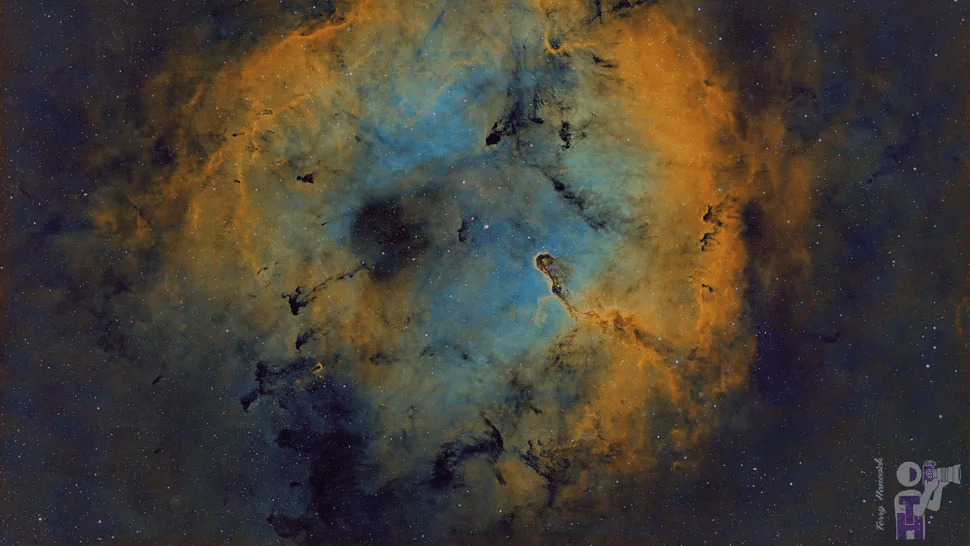
The allure of the Elephant Trunk Nebula lies in its ever-changing environment. This dense region, abundant with cosmic dust and molecular gases, functions as a cradle for infant stars. The dark filamentary structures captured in Hancock’s image are the essential ingredients for star creation.
The bluish cavity encompassing the pillar points to previous stellar influences: intense energy and winds from nearby massive stars have cleared gaseous material, forming an empty region and compressing dust to trigger new star births. This cycle of formation and destruction offers insight into stellar lifecycles.
Although professional observatories have produced comprehensive maps of IC 1396, high-resolution images from skilled amateurs like Hancock provide fresh details. The photo’s remarkable color separation distinguishes red hydrogen-rich zones from teal oxygen-emitting patches, offering a vivid chemical map of the nebula.
Beyond aesthetic beauty, such astrophotography inspires public interest, supports amateur scientific research, and enhances appreciation of the universe’s dynamic nature.
Transforming Backyard Observations into Worldwide Exhibits
Hancock’s equipment and methods, while specialized, exemplify the increasing number of passionate amateur astronomers pushing Earth-based astrophotography to new heights. His custom camera system is optimized to capture low-noise images during extended exposures of faint cosmic targets like IC 1396.
By using narrowband filters to isolate emissions from elements such as hydrogen-alpha, oxygen-III, and sulfur-II, he created a composite image that is as scientifically informative as it is visually stunning.
This undertaking also highlights the critical role of digital post-processing in astrophotography. The editing phase enhanced contrast, color nuances, and structural detail that raw data alone cannot achieve.
Within the expanding domain of citizen science and digital astronomy, projects like Hancock’s capture more than celestial light—they narrate a tale of time, technique, and artistry, merging amateur passion with scientific discovery.
- Categories:
- Astronomy




0 comments
Sign in to Comment