
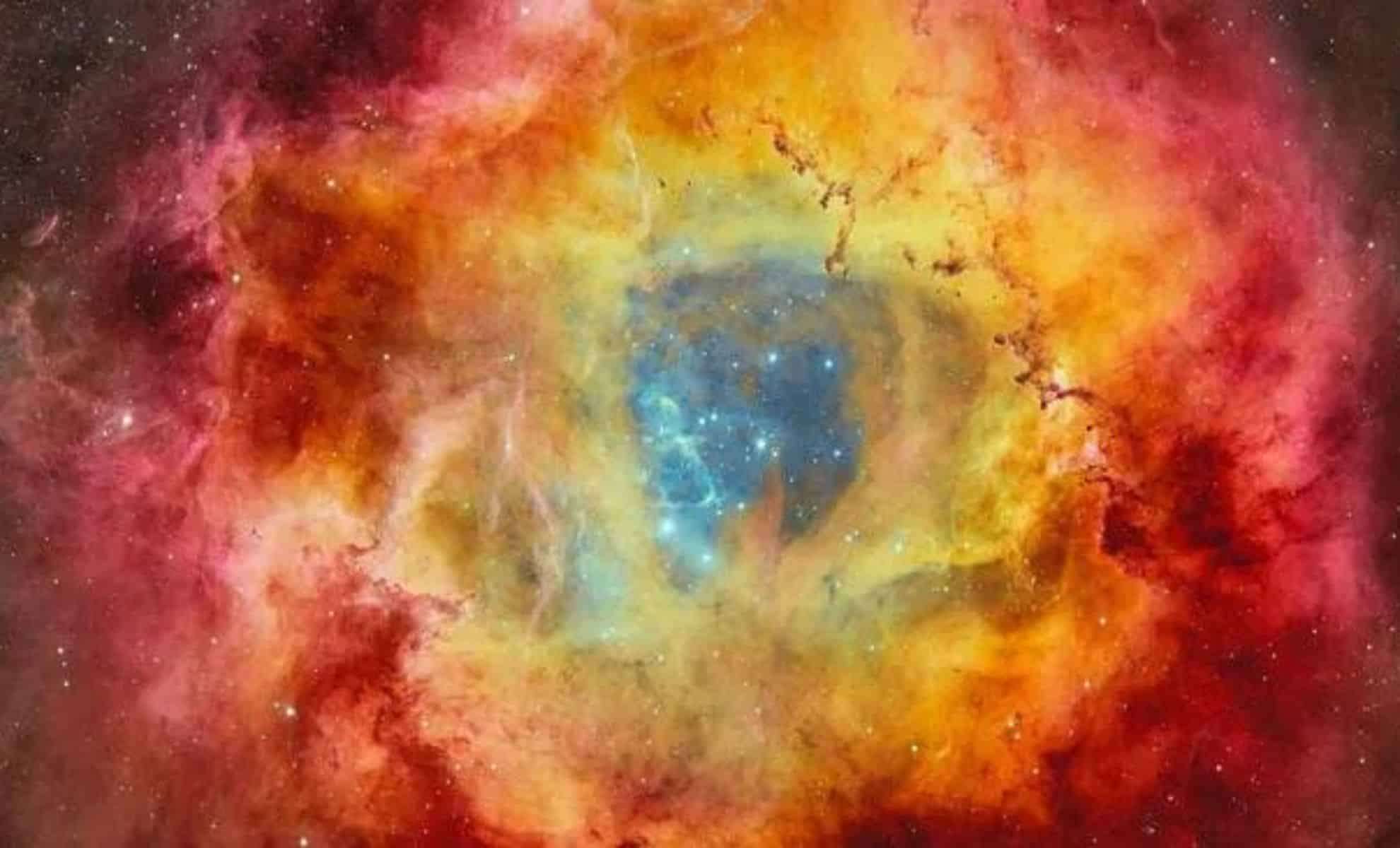
Using NASA’s Dark Energy Camera (DECam), astronomers have unveiled a breathtaking, detailed image of the Rosette Nebula, a vibrant star-creation zone situated 5,000 light-years away within the Monoceros constellation. This latest photograph highlights the nebula’s complex structures and the dynamic stellar birth processes occurring within its vast clouds of gas and dust. Renowned for its rose-like pattern, the Rosette Nebula provides a remarkable glimpse of how young stars’ intense radiation sculpts their cosmic environment.
An Expansive Stellar Cradle
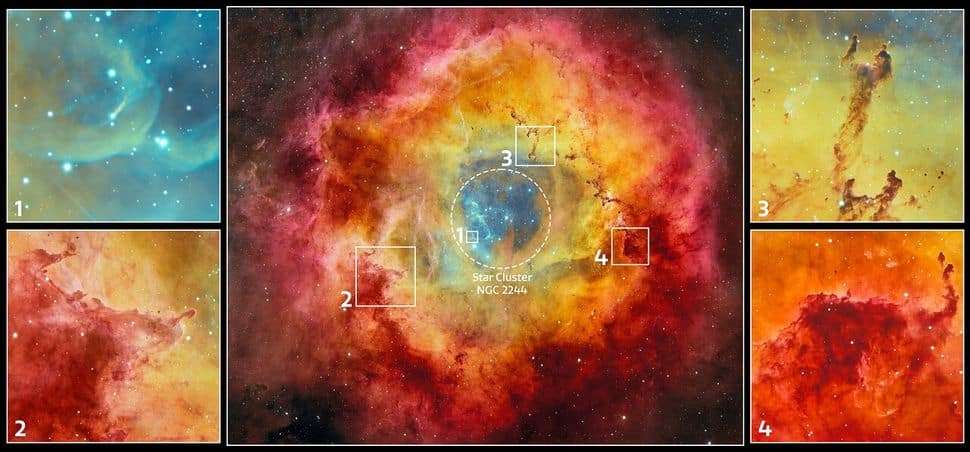
Spanning approximately 130 light-years, the Rosette Nebula represents a sprawling nursery where stars emerge from collapsing gas and dust clouds. At its core lies the NGC 2244 cluster, consisting of massive, hot stars only a few million years old. These stars emit strong ultraviolet light that ionizes nearby gases, causing the nebula’s vivid glowing appearance. The Dark Energy Camera, installed on the Víctor M. Blanco Telescope, captured this image at a stunning 500-megapixel resolution, revealing extraordinary detail.
According to NOIRLab, “The billowing red clouds are regions of H-alpha emission, resulting from highly energized hydrogen atoms emitting red light. Along the walls of the central cavity, closer to the massive central stars, the radiation is energetic enough to ionize a heavier atom like oxygen, which glows in shades of gold and yellow. Finally, along the edges of the flower’s petals are wispy tendrils of deep pink glowing from the light emitted by ionized silicon.” These hues illustrate how the powerful stars within the nebula energize its colorful glow.

Emerging Stars Within Dark Dust Pillars
Beyond the radiant gas, the image also captures dense, shadowy dust regions where new stars are forming. These thick structures, often called “elephant trunks,” are gravitationally contracting, providing raw material for star birth. One notable feature, dubbed the Wrench Trunk, twists through the cloud, shaped by its magnetic field.
In addition to these trunks, the nebula contains Bok globules—compact, dark clumps of gas and dust believed to nurture the earliest phases of star formation. These globules protect emerging low-mass stars from the harsh radiation emitted by the nebula’s larger stellar neighbors.
What Lies Ahead for the Rosette Nebula
As stars within NGC 2244 continue to mature, their powerful stellar winds will push away much of the surrounding gas and dust. These winds have already carved the nebula’s hollow central cavity seen in current images. Eventually, some of these stars will explode as supernovae, sending shock waves that further disperse the nebula’s material into space.
This sequence reflects a common lifecycle in star-forming clouds throughout the galaxy, where stellar births and deaths continually reshape their environments. In several million years, the Rosette Nebula is expected to dissipate, leaving behind a cluster of youthful stars that once formed within its gaseous arms. These stars may go on to develop planetary systems, much like how our own solar system emerged from a similar stellar nursery billions of years ago.
Unlocking the Mysteries of Star and Planet Formation
The Rosette Nebula offers a unique window into the birthplaces of stars and planets. Studying this region helps astronomers understand the conditions that led to the formation of the Sun and its planets over 4.6 billion years ago. Thanks to the high-resolution imagery from DECam, researchers can explore the complex interplay between young stars and their environments, shedding light on the early phases of stellar evolution.
With its vivid gas clouds, dark dust pillars, and emerging stars, the Rosette Nebula remains a prime target for uncovering the secrets of stellar birth. Its captivating beauty and scientific significance continue to inspire both the public and the astronomy community alike, illustrating the universe’s ongoing cycle of creation and change.
- Categories:
- Astronomy ,
- Space ,
- Nasa





0 comments
Sign in to Comment