
New computational analyses have unveiled a previously unrecognized origin of gravitational waves linked to the death throes of massive stars.
Gravitational waves — distortions in spacetime — typically arise from extreme cosmic events like mergers of black holes and collisions between neutron stars.
Yet, this fresh research suggests that as enormous stars undergo core collapse, they might emit a subtler, but detectable, form of gravitational waves.

Mechanism Behind These Gravitational Wave Emissions
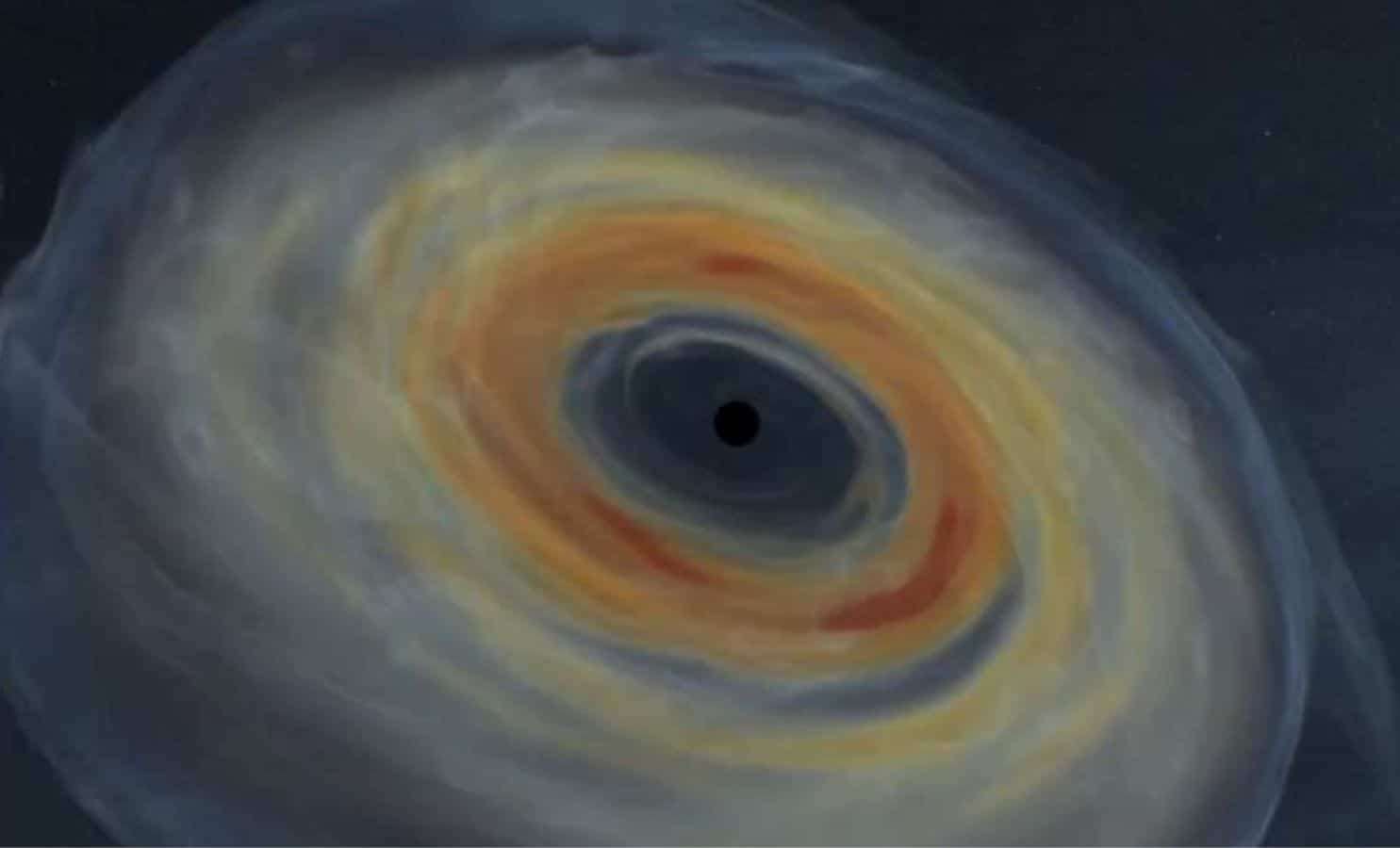
The study’s authors propose that stars weighing approximately 15 to 20 times the mass of our Sun produce these waves during their dramatic collapse into black holes, a process termed a collapsar. Instead of all material plunging straight into the black hole, some stellar matter forms a substantial accretion disk around it. This disk generates gravitational waves as the matter spirals inward.
This insight is striking because, until recently, scientists assumed such waves would be masked by chaotic noise from the turbulent surroundings, eluding detection. However, the new simulations reveal that the wave patterns created by the interaction between the black hole and its disk are more organized and consistent than previously believed.
Ore Gottlieb, a leading researcher at the Flatiron Institute’s Center for Computational Astrophysics, commented, “Our findings show that the gravitational wave signals from accretion disks are coherent and surprisingly strong.” These revelations challenge former beliefs and indicate that observatories like LIGO might already be capable of capturing these signals.
Broader Impact for Gravitational Wave Research
Detecting these waves could revolutionize our understanding of black holes and the collapse dynamics of massive stars. Up to now, gravitational wave detections have stemmed primarily from the collision of compact celestial objects. This development could open the door to identifying other unique sources, shedding light on the intricate processes happening within dying stars.
Instruments such as LIGO and future detectors like the Einstein Telescope stand to be instrumental in locating these signals. According to simulations by Gottlieb’s team, although these signals might be weaker than those originating from black hole mergers, they may still be observable from distances reaching 50 million light-years — approximately 10% of the range accessible for merger signals. This distance provides promising ground for investigating collapsars and their aftermaths.
Gottlieb stressed the significance, stating, “Gravitational waves are currently the only way to peer into the innermost regions around black holes during stellar collapse. These phenomena remain invisible through other means.” Harnessing these signals could yield profound insights into black hole properties, star collapse mechanics, and the internal structure of massive stars during their final stages.
Obstacles to Capturing These Signals
Despite this promising framework, identifying these gravitational waves remains complex. The vast diversity in star masses and rotational characteristics causes significant variation in wave signals produced by collapsars. Accurately modeling these would require simulating millions of such events, demanding enormous computational resources.
As an alternative, the researchers suggest mining existing gravitational wave data for patterns aligned with known supernovae or gamma-ray bursts, aiming to retrospectively pinpoint collapsar events. Yuri Levin, a co-author and professor at Columbia University, remarked on the challenges ahead: “Although the gravitational wave community is eager to detect these signals, the search is inherently difficult.”
The team plans to enhance their models and simulations, aiming to predict gravitational wave signatures more accurately. With ongoing technological progress and advancing observational methods, scientists remain hopeful about unveiling this new class of gravitational wave sources, unlocking additional cosmic mysteries.
- Categories:
- Astronomy ,
- News ,
- Science ,
- Physics









0 comments
Sign in to Comment