
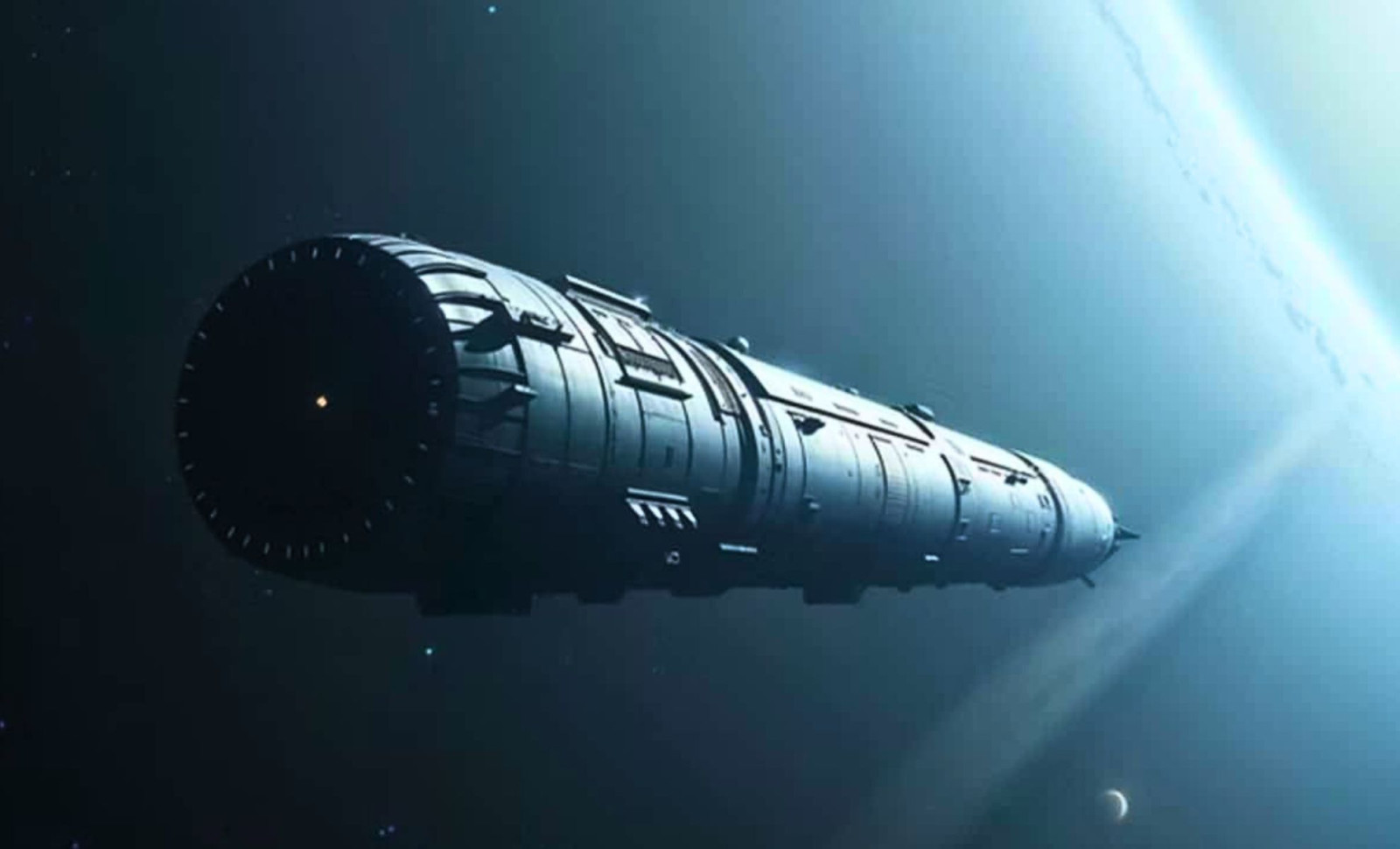
Envision a journey lasting 400 years, carrying 2,400 individuals who will neither witness the planet they left behind nor the future world their descendants create. This starship must produce its own gravity, cultivate food, recycle every drop of water and breath, and safeguard critical technological and cultural knowledge for 16 generations to complete a quest unlike any before.
The design known as Chrysalis, winner of a global competition in 2025, outlines the possible construction of such a vessel. Spanning hundreds of pages, it includes architectural visualizations of living spaces, mass distribution for agricultural sections, precise rotation calculations for artificial gravity, and governance frameworks aimed at maintaining societal stability during four centuries of isolation.
Unlike earlier generation ship ideas, Chrysalis emphasizes a high level of systems integration. It moves beyond merely assuming that closed-loop life support or prolonged thruster technologies will emerge. Instead, it details how these components interlink, the redundancies needed, and highlights where current scientific advancements fall short. The blueprint serves as much as an inventory of unanswered questions as it does a construction plan.

Physics Dictates a 58-Kilometer Structure
The need for artificial gravity influenced every architectural choice in the Chrysalis framework. The physics governing rotating habitats set stringent limitations. Research highlighted by ABC Science explains that human discomfort arises when spin rates exceed around two revolutions per minute. To generate effective gravity at this slow rotation, a habitat must be immense.
The Chrysalis team settled on a 58-kilometer-long structure featuring concentric cylinders spinning in opposite directions. Outer layers produce centrifugal force approximating 0.9 times Earth’s gravity. Inner rings counter-rotate to stabilize the vessel by dampening structural vibrations. The habitation module tapers at the front end to reduce risk from interstellar debris during acceleration and deceleration phases.

This colossal 58-kilometer dimension arises directly from the challenges of ensuring occupant comfort through rotational gravity. No current orbital station could assemble or support such scale, nor could existing launch systems deliver the components into space. Instead, the design envisages assembly at gravitationally stable Lagrange points, which NASA defines as locations where spacecraft require minimal fuel to maintain position. These points are increasingly favored for large-scale space manufacturing due to their low-energy environment.
Power, Life Support, and Bridging Conceptual Gaps
The Chrysalis plan depends on fusion energy both for propulsion and onboard systems. The design specifies a Direct Fusion Drive using helium-3 and deuterium fuels, accelerating for one year to reach cruise velocity, followed by 400 years of coasting and another year of deceleration. However, no operational fusion reactors suited for spacecraft propulsion were available as of early 2026.
Development roadmaps from governments anticipate demonstration reactors decades away, yet these timelines do not address crucial spacecraft-specific challenges: effective vacuum-compatible radiators, durable shielding for centuries-long missions, and safe maintenance access to reactors during hazardous periods. Radiation shielding is similarly problematic. Exposure to deep space brings intense cosmic rays and solar particles. Protecting crews over centuries would demand materials far beyond what current launch capabilities can handle.
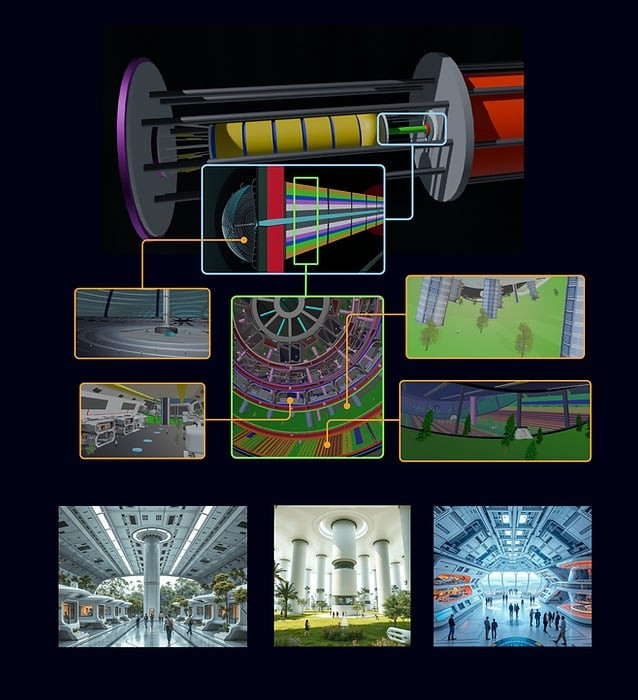
Chrysalis treats radiation shielding as an unresolved issue, relying on engineered materials that have not yet been created or tested. Other proposals have explored alternatives like embedding habitats within hollowed asteroids, but Chrysalis assumes advances in protective technology yet to be realized.
Maintaining a self-sustaining ecosystem might represent the most validated aspect. Experiments on the International Space Station have achieved around 98% water recycling efficiency and limited crop growth. Earth-based closed environmental experiments, like Biosphere 2 in the 1990s, showed how challenging it is to keep a balanced atmosphere without external inputs.
The ecological modeling report from Project Hyperion details biological cycles, water purification, and farming integration necessary for uninterrupted operation across centuries. Chrysalis presumes fully closed biological loops functioning flawlessly for 400 years—conditions not yet replicated in any experimental life support facility.
Sustaining Society Through 16 Generations
Contest requirements pushed teams to consider not only survival but also the social dynamics needed to support multi-century existence. Chrysalis incorporates crew selection guidelines inspired by psychological studies from Antarctic stations, where prolonged isolation induces intense stress. The plan includes extensive pre-launch training in harsh environments to identify people capable of tolerating long-term confinement.
Social systems got meticulous attention within the design. Instead of traditional nuclear families, child-rearing is envisioned as a community effort, with voluntary birth spacing to control population growth. Systems preserving technical knowledge and cultural heritage aim to maintain continuity across generations destined never to meet. Governance would leverage AI to assist decision-making processes.
These approaches confront a significant research gap since existing data are limited. Submarine crews rotate frequently, Antarctic deployments last only months, and space missions to date span mere months as well. The Chrysalis documents openly classify social stability across centuries as an unresolved area needing further research.
- Categories:
- Space








0 comments
Sign in to Comment