
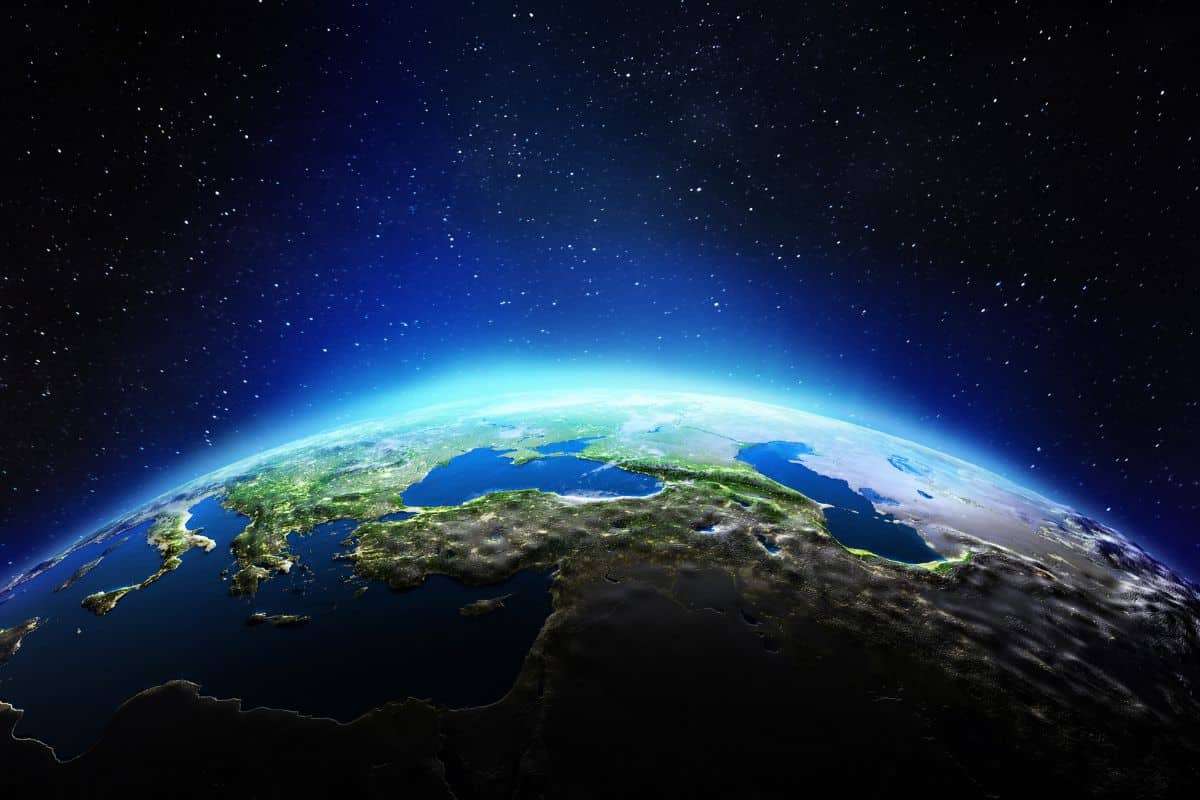
Engineer Jim Woodward has introduced a novel propulsion approach that could potentially allow spacecraft to overcome Earth’s gravitational pull without relying on conventional rocket propellants.
This innovative concept challenges established physics and could revolutionize the future of space exploration. Featured recently in Popular Mechanics, the idea centers on the Mach-effect gravity assist (MEGA) drive — a system that creates thrust without expelling any mass.
An Unconventional Concept Based on Historical Physics
The MEGA drive is inspired by the theories of Ernst Mach, a 19th-century physicist whose work helped shape Einstein’s relativistic theories.
This device relies on swiftly oscillating piezoelectric crystals that Woodward claims can induce directional movement by synchronizing fluctuations in mass. If verified, this technology would enable propulsion without the need for fuel, revolutionizing long-range space missions.

“The discovery of a New Force is significant as it shows that electric fields alone can generate continuous force on an object, enabling its center-of-mass to move without ejecting any mass,” explained Charles Buhler, NASA engineer and Exodus Propulsion Technologies co-founder.
Preliminary Experiments Draw Attention
Early trials at California State University, Fullerton, have reportedly measured slight thrust generation. These findings have sparked interest alongside healthy skepticism within the scientific community.
While some scientists find the theory promising, others raise concerns about possible experimental errors including thermal distortions, vibration effects, or electromagnetic noise. The concept’s challenge to the conservation of momentum remains a major point of debate.
Potential to Transform Deep Space Missions
A functional MEGA drive could have far-reaching consequences. Eliminating the need for onboard propellant would reduce spacecraft mass and increase travel distance. Expeditions to Mars, the outer planets, or even distant star systems could become more achievable. Continuous acceleration propulsion might significantly cut travel times, reshaping mission plans.
Independent Validation Is Critical
The focus now turns to replicating results independently. Woodward is partnering with external labs to verify the thrust observations and improve theoretical models.
Considering earlier controversial propulsion claims, such as the EM Drive which failed rigorous validation, the MEGA drive must prove its capabilities through repeatable, peer-reviewed experiments to gain acceptance.
“Essentially, this suggests there may be fundamental physics mechanisms capable of applying force on objects under certain constraints,” added Buhler.
Navigating Between Established Science and Bold Hypothesis
The MEGA drive occupies a complex space between accepted scientific principles and daring speculation. Its potential is immense, but so is the scrutiny it faces. As governments and private ventures compete to push humanity’s reach beyond Earth, breakthroughs often arise from unconventional ideas. Whether Woodward’s invention becomes a transformative technology or a scientific curiosity depends on forthcoming research and practical demonstration.
- Categories:
- Science










0 comments
Sign in to Comment