

An unexpected radio wave burst originating from a galaxy billions of light-years away has ignited widespread intrigue among astronomers, reigniting debates about the possibility of extraterrestrial signals. This intense pulse, picked up by a sophisticated Russian observatory, defies conventional astrophysical explanations and deepens the mystery surrounding cosmic radio phenomena.
Characteristics That Set This Signal Apart
Known as FRB 20190203, this event falls under the category of Fast Radio Bursts (FRBs)—extremely brief flashes of radio energy lasting mere milliseconds. Its distinguishing traits include an exceptionally strong signal strength measured at 20 Jy and a remarkable detection at an unusually low frequency of 111 MHz.
In contrast to many other FRBs, this signal has not exhibited any repetitions, leaving researchers puzzled about its source. Key data points that highlight the distinct nature of FRB 20190203 include:

- Frequency: Captured at 111 MHz, which is notably one of the lowest frequencies recorded for FRBs.
- Dispersion Measure (DM): Calculated at 134.4 pc/cm³, suggesting a distance of roughly 2.3 billion light-years.
- Flux Density: Reached an impressive peak of 20 Jy, ranking it among the most powerful FRB signals detected.
- Duration: Spanned approximately 211 milliseconds, longer than many other FRBs.
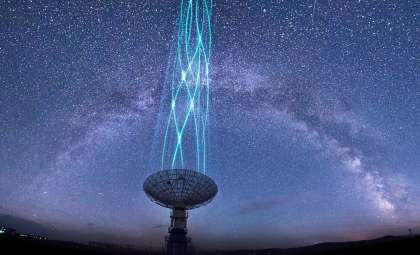
- Observing Instrument: Detected using Russia’s Large Phased Array (LPA), a highly sensitive radio telescope.
These attributes challenge current models and expand the boundaries of what is understood about fast radio bursts.
Understanding the Jansky (Jy) Unit
The jansky (Jy) serves as a measurement standard in radio astronomy for determining flux density, which describes the strength of radio emissions from cosmic sources. It equals 10⁻²⁶ watts per square meter per hertz (W/m²/Hz), allowing astronomers to compare various celestial signals, no matter how weak.
Many astronomical objects, including pulsars and distant galaxies, produce faint radio waves detectable across vast distances. The jansky unit is vital for scaling these signals effectively. For example, the 20 Jy value observed in FRB 20190203 indicates an unusually energetic burst. Instruments often use smaller metrics like milli-jansky (mJy) or micro-jansky (µJy) to register even weaker sources.
Could This Be Evidence of Advanced Extraterrestrial Intelligence?
While natural explanations like emissions from magnetars—intensely magnetic neutron stars—or remnants of supernovae are commonly proposed for FRBs, some scientists consider that this enigmatic event might be a technosignature, hinting at technology-driven origins. The non-repeating nature of FRB 20190203 makes speculation about intelligent extraterrestrial signals particularly compelling.
Further confounding the investigation is the lack of any detected gamma-ray counterparts, which are often associated with energetic cosmic events. This absence adds complexity and keeps the door open for alternative interpretations, including those involving alien activities.
Next Steps Toward Unraveling the Mystery
Scientists hypothesize that the burst could result from maser synchrotron emission processes, linked to objects with powerful magnetic fields such as magnetars. To confirm this theory, more observations and in-depth analysis are essential.
The Large Phased Array’s capacity to detect radio bursts at such low frequencies paves the way for breakthroughs in understanding FRBs. This capability might help decode their origins and, perhaps, reveal signs of extraterrestrial phenomena. For the moment, FRB 20190203 remains an intriguing enigma captivating both astrophysicists and those fascinated by the search for otherworldly life.
Source : https://arxiv.org/abs/2410.13561
- Categories:
- Space ,
- Extraterrestrial life










0 comments
Sign in to Comment