

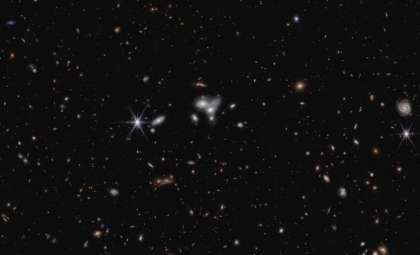
Scientists utilizing the James Webb Space Telescope (JWST) have observed a supermassive black hole nearly 12 billion light-years away actively preventing its galaxy from creating new stars.
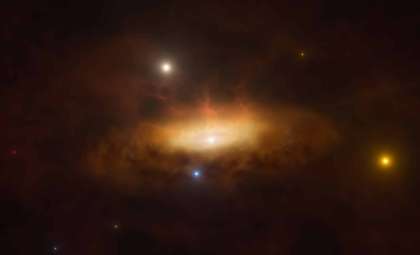
Published on September 16 in Nature Astronomy, the study presents the first direct proof that black holes can stop star formation by expelling critical gas, leaving their host galaxies inactive. The galaxy examined, known as GS-10578 or Pablo’s Galaxy, has ceased producing stars through a process called “quenching,” driven by the black hole at its center.
Mechanism Behind the Black Hole’s Starvation of Its Galaxy
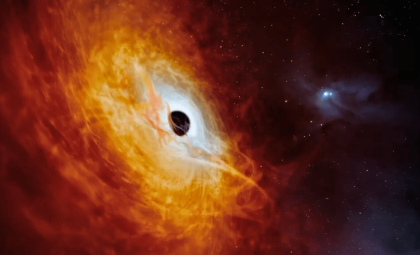
At the core of Pablo’s Galaxy lies a supermassive black hole, a common feature in large galaxies. Although black holes are understood to impact their environments, the exact way they influence star birth has not been fully clear. In this galaxy, the black hole not only devours nearby material but also ejects vast streams of gas at speeds reaching 1,000 kilometers per second. This rapid expulsion of gas essential for star formation escapes the galaxy, leaving too little left to sustain the birth of new stars.

Dr. Francesco D’Eugenio, co-lead author from the University of Cambridge, highlighted the importance of this finding: “The black hole is effectively shutting down this galaxy by cutting off its supply of material needed to form stars.” The JWST’s unique ability to detect non-luminous gas — cold, dense gas that doesn’t emit light — was crucial for observing these outflows. This gas obscures the light from galaxies behind it, allowing researchers to measure its properties and quantity. The amount of expelled gas exceeds what is necessary to keep star formation alive, proving the black hole’s active role in halting the galaxy’s development.
Significance for Understanding Galaxy Evolution in the Early Universe
Pablo’s Galaxy is located in the early universe, about 2 billion years after the Big Bang, an era characterized by rapid star formation in most galaxies. Finding such a large “dead” galaxy in this period surprises astronomers. Professor Roberto Maiolino from the University of Cambridge remarked, “Since most early galaxies were bursting with star creation, seeing a massive dormant galaxy so early suggests the quenching must have happened quickly.”
This discovery challenges prior assumptions about galaxy evolution, which often posited that star formation stops due to chaotic, destructive events disrupting the galaxy. However, Pablo’s Galaxy maintains a well-ordered, disk-like shape with smoothly rotating stars despite the lack of new star birth, indicating that star formation can cease without the galaxy becoming structurally disturbed.
Investigating Black Hole-Driven Suppression of Star Formation
The research supports theories that supermassive black holes can halt star formation within their host galaxies, but until JWST, strong observational data was missing. With its advanced technology, JWST detected ejections not only of hot gas seen in active black holes before but also of colder, denser gas crucial for star formation. This previously unseen component of galactic winds emphasizes JWST’s revolutionary role in probing the early cosmos.
The expelled material is pushed out at such high velocities that it leaves the galaxy, preventing remaining gas from cooling and condensing into stars. This starvation process effectively disables the galaxy’s star-forming potential, providing fresh insights into how black holes influence galaxy growth.
As Dr. D’Eugenio restated, “We have identified the mechanism killing this galaxy — by cutting off its star-forming fuel, the black hole keeps the galaxy dormant.” This discovery resolves a puzzle about how massive galaxies like Pablo’s Galaxy stop producing stars yet stay so large and structurally intact.

Prospects for Further Exploration of Black Hole and Galaxy Dynamics
This breakthrough enables more detailed investigations into how black holes shape their galaxies, especially during the early universe. While JWST has provided unprecedented insights into the quenching mechanism in Pablo’s Galaxy, astronomers plan to study the environment around it to identify any remaining star-forming gas or other influencing factors. Upcoming observations with the Atacama Large Millimeter/submillimeter Array (ALMA) will target the coldest and most hidden gas not detected by JWST, offering a fuller understanding of the galaxy’s condition and the black hole’s reach.
Beyond Pablo’s Galaxy, these results will guide analysis of other galaxies hosting supermassive black holes. Grasping how black holes suppress star formation will improve models of galaxy evolution and explain how black holes contribute to the growth and eventual “shutdown” of galaxies.
In the words of Professor Maiolino, “Black holes have a huge impact on galaxies, and while it was suspected they could stop star formation, Webb is the first to confirm it directly. This marks another major stride in our ability to study the early universe and its evolution.”
This finding marks significant progress in understanding the cosmic lifecycle of galaxies and highlights the pivotal role black holes play in shaping the universe. The JWST, with its unmatched precision and sensitivity, continues to transform our perspective of the cosmos, revealing new details about the early universe and the development of galaxies like our Milky Way billions of years ago.
- Categories:
- Astronomy ,
- News ,
- Space ,
- Nasa ,
- Physics





0 comments
Sign in to Comment