
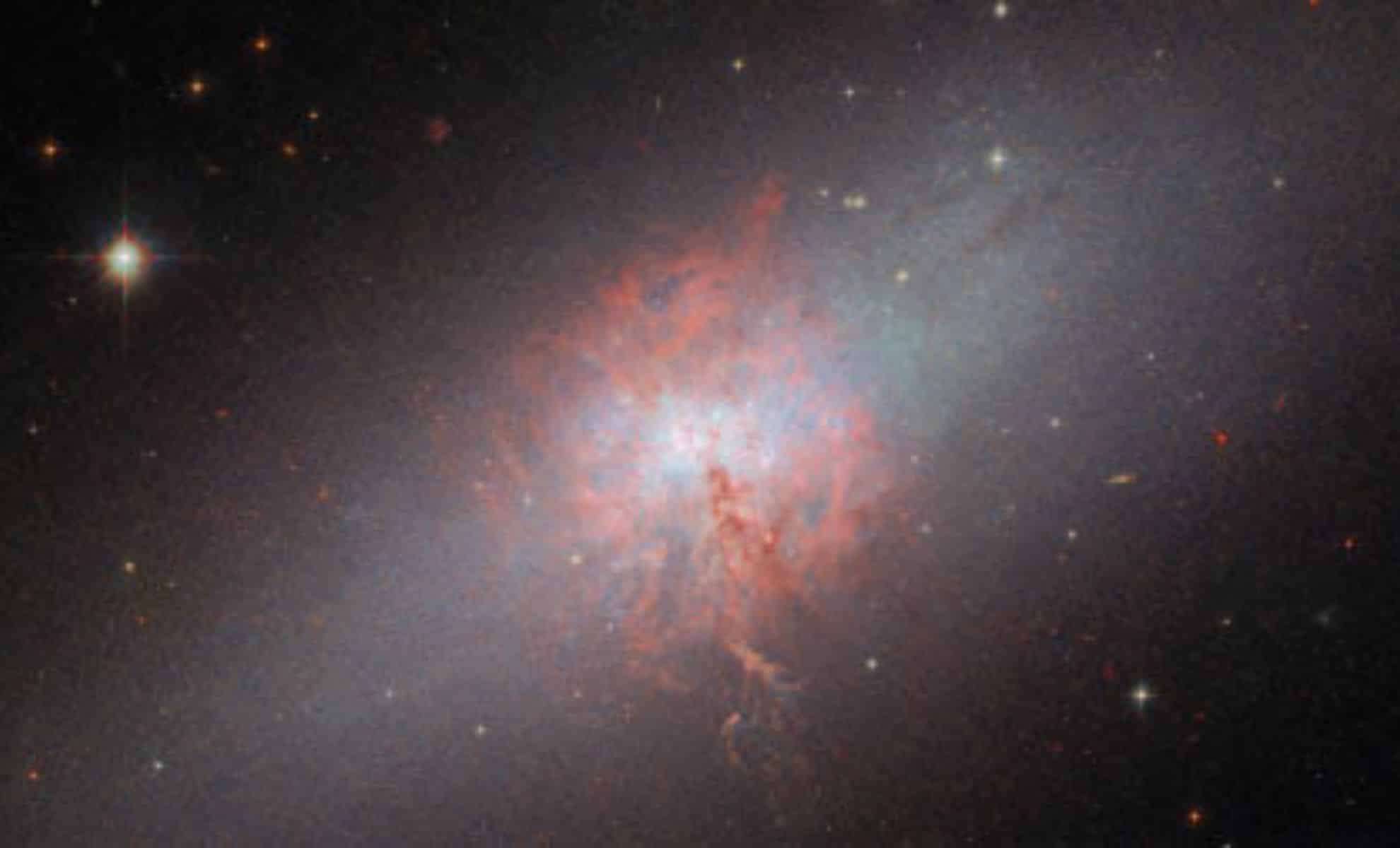
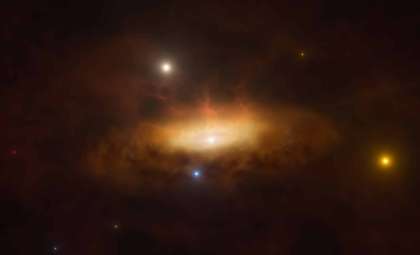
The Hubble Space Telescope has captured detailed images of NGC 5253, a vibrant blue compact dwarf galaxy, uncovering essential information about its intense bursts of star creation.
Situated around 11 million light-years from Earth in the constellation Centaurus, NGC 5253 serves as an exceptional subject for studying both how stars develop and how galaxies form over time.
Insights from NASA’s Hubble Observations
NGC 5253 is classified as a dwarf starburst and blue compact dwarf galaxy, signifying its rapid production of massive, luminous star clusters. It belongs to the Centaurus A/Messier 83 galaxy group, which includes prominent members like the radio galaxy Centaurus A and the spiral galaxy Messier 83. Hubble’s imagery highlights the dense clouds of gas fueling new star births within this galaxy, making it an invaluable case for exploring star composition, formation, and cluster dynamics.

Dwarf galaxies attract astronomers’ attention because they resemble primordial galaxies, offering clues about the cosmic history of stars and galaxies. As noted by Hubble researchers, “What has interested us so much about this galaxy that three of Hubble’s instruments were used to study it in depth over ten years? It turns out to lie at the focus of a few areas of research where Hubble’s capabilities are essential.”
Explosive Star Formation and Super Star Cluster Development
The rate of star formation within NGC 5253 is remarkably rapid, resulting in several prominent star clusters. Within a confined section of the galaxy’s core, the star birth is so vigorous that it hosts at least three super star clusters (SSCs). These SSCs are intensely bright, massive clusters believed to be the precursors of globular clusters. Understanding their formation is key to unraveling the mystery of how massive star clusters emerge.
“A tremendously high rate of star formation is a recipe for star clusters, but NGC 5253 goes beyond that: in a small region of the core, the star formation is so intense that the galaxy contains no less than three super star clusters,” the Hubble team explained. These clusters offer valuable perspectives into star formation and lifecycle within densely populated stellar environments.
Advanced Instrumentation and Imaging Techniques
The recent visual data of NGC 5253 comes from observations made with Hubble’s Advanced Camera for Surveys (ACS) and its earlier Wide Field and Planetary Camera 2 (WFPC2). One of the images merges observations from the High Resolution Channel (HRC) of ACS, fine-tuned to capture intricate details in regions crowded with stars.
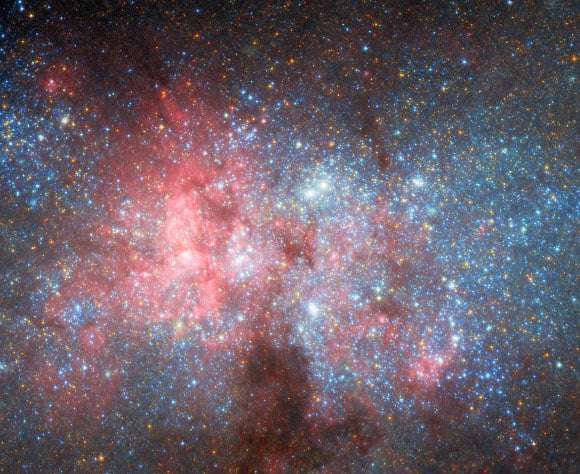
These findings demonstrate the exceptional capabilities of Hubble’s instruments in producing sharp, high-resolution images that deepen our understanding of intricate astrophysical processes. The detailed views of NGC 5253 expose its vivid star-forming zones and enrich knowledge about the mechanisms driving star cluster formation and stellar evolution.
Looking Ahead: Continuing the Exploration of NGC 5253
Research on NGC 5253 remains a priority for astronomers seeking to unlock the secrets of star and galaxy development. Upcoming studies are expected to include detailed spectroscopy and comparative analysis with other starburst and dwarf galaxies. These efforts will help clarify the environments that spark such intense star formation and the birth of massive star clusters.
Ongoing exploration of NGC 5253 and analogous galaxies will broaden our understanding of the universe’s early eras and the complex processes behind star and galactic formation. Hubble’s work continues to be pivotal in uncovering these astronomical mysteries.
- Categories:
- Astronomy ,
- News ,
- Nasa ,
- Aircraft





0 comments
Sign in to Comment