
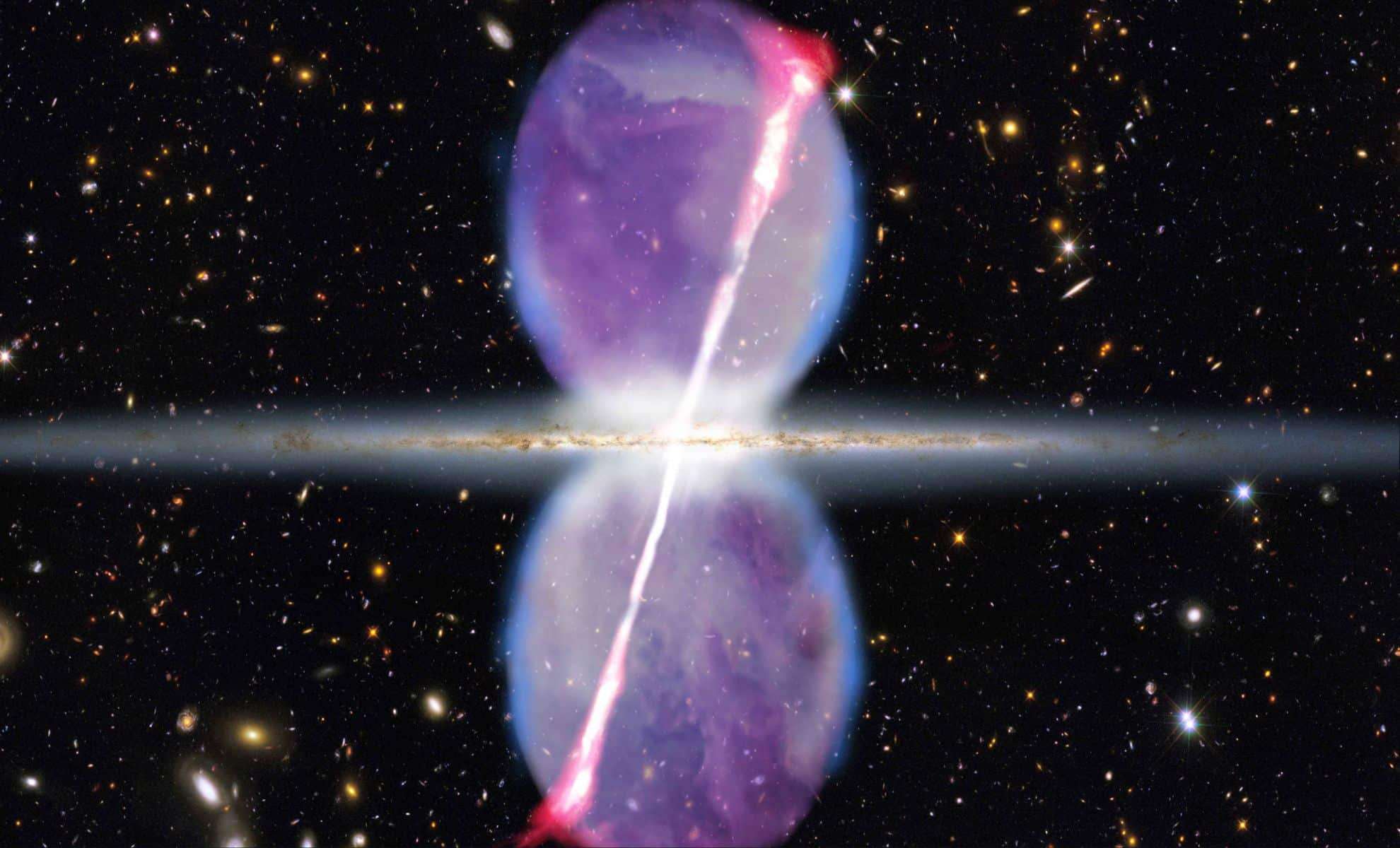
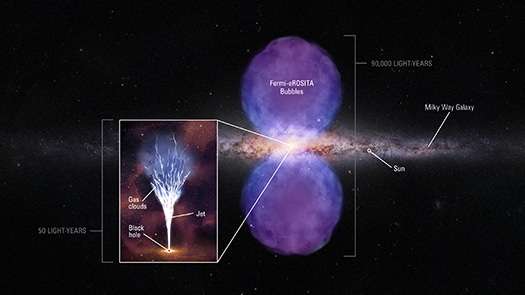
Astronomers have long been intrigued by the discovery of two enormous, energetic "bubbles" extending roughly 50,000 light-years above and below the Milky Way’s core. Initially spotted by NASA’s Fermi Gamma-ray Space Telescope in 2010 and later observed by the eRosita X-ray telescope in 2020, these colossal formations—dubbed the Fermi and eRosita Bubbles—point to a dramatic event that unfolded in our galaxy's center millions of years ago.
Recently, a cutting-edge investigation from the University of Michigan has delivered compelling support that these immense structures resulted from a powerful eruption driven by Sagittarius A*, the supermassive black hole anchoring the Milky Way. This breakthrough not only revises our narrative of the galaxy’s history but also enriches our understanding of the influence black holes exert on their cosmic neighborhoods.
What sparked this intense event? And what secrets do these colossal bubbles reveal about the energetic processes deep within our galaxy? Scientists are beginning to decode the answers.

Understanding the Fermi and eRosita Bubbles
Back in 2010, astronomers identified the Fermi Bubbles when the Fermi Gamma-ray Space Telescope revealed two enormous, balloon-shaped structures symmetrically ascending and descending tens of thousands of light-years from the galactic center. These lobes primarily emit high-energy gamma radiation, indicating a highly energetic source at their root.
A decade subsequently, the eRosita X-ray telescope uncovered an even larger pair of bubbles detected in X-ray wavelengths. The eRosita Bubbles span nearly twice the scale of the Fermi Bubbles, raising an important question:
- Are these two bubble systems products of distinct phenomena, or do they represent layered remnants of a single explosive event?
Current evidence strongly favors the idea that both sets of bubbles arose from one intense outburst by Sagittarius A*, where a black hole-driven jet emitted vast quantities of cosmic rays and X-rays.
Decoding Black Holes’ Galactic Interactions
While black holes are popularly seen as cosmic vacuums, sucking in nearby matter, they can also unleash tremendous energy back into the cosmos. This phenomenon, known as an Active Galactic Nucleus (AGN) eruption, is believed to have occurred in the Milky Way about 2.6 million years ago.
Scientists at the University of Michigan performed detailed simulations to investigate whether a jet propelled by the supermassive black hole could reproduce the observed bubble formations—and their findings were remarkable.
Lead researcher Mateusz Ruszkowski highlighted the importance of this insight:
“Our findings are important in the sense that we need to understand how black holes interact with the galaxies that they are inside, because this interaction allows these black holes to grow in a controlled fashion as opposed to grow uncontrollably.”
This suggests that Sagittarius A* might not be just a passive black hole calmly nestled at our galaxy’s center—it very likely underwent a tremendous energy discharge that significantly influenced the Milky Way’s architecture.
Modeling the Bubble-Forming Explosion
To unravel the formation of the Fermi and eRosita Bubbles, the team used sophisticated numerical models recreating the dynamics among cosmic rays, surrounding interstellar gas, and jets from the black hole.
The simulations helped dismiss prior ideas such as the starburst hypothesis, which attributed the bubbles to bursts of star creation. Conversely, the results confirmed that the black hole jet scenario accurately matches the size, shape, and energy properties observed in the bubbles.
“We not only can rule out the starburst model, but we can also fine-tune the parameters that are needed to produce the same images, or something very similar to what’s in the sky, within that supermassive black hole model,” said Ruszkowski.
The research further establishes that the energetic episode from Sagittarius A* spanned roughly 100,000 years—an astonishingly brief duration by cosmic standards.
“On the other hand, our active black hole model accurately predicts the relative sizes of the eRosita X-ray bubbles and the Fermi gamma-ray bubbles, provided the energy injection time is about one percent of that, or one tenth of a million years,” explained astrophysicist Ellen Zweibel.
In essence, this was an intense and swift burst, rather than a slow accumulation, that dramatically remodeled the region around our galaxy’s core.
Highlights from the Study
Implications for the Milky Way’s Destiny
These discoveries offer more than historical insight—they also hint at potential future occurrences. Since Sagittarius A* experienced such a powerful eruption once, it may be prone to repeat similar outbursts.
Although this black hole is currently in a calm state, astronomers suggest that an incoming gas cloud or star pulled into its gravitational field could ignite another grand eruption. Such an event would likely result in the formation of new bubbles, once again reshaping the Milky Way’s structure.
Moreover, this research carries broader significance, as similar bubble-like formations observed in other galaxies suggest this explosive black hole-driven process might be a widespread cosmic phenomenon.
Ongoing studies of the Fermi and eRosita Bubbles continue to unravel mysteries about the evolutionary cycles of galaxies, black hole behavior, and the invisible forces sculpting the universe.
- Categories:
- News




0 comments
Sign in to Comment