
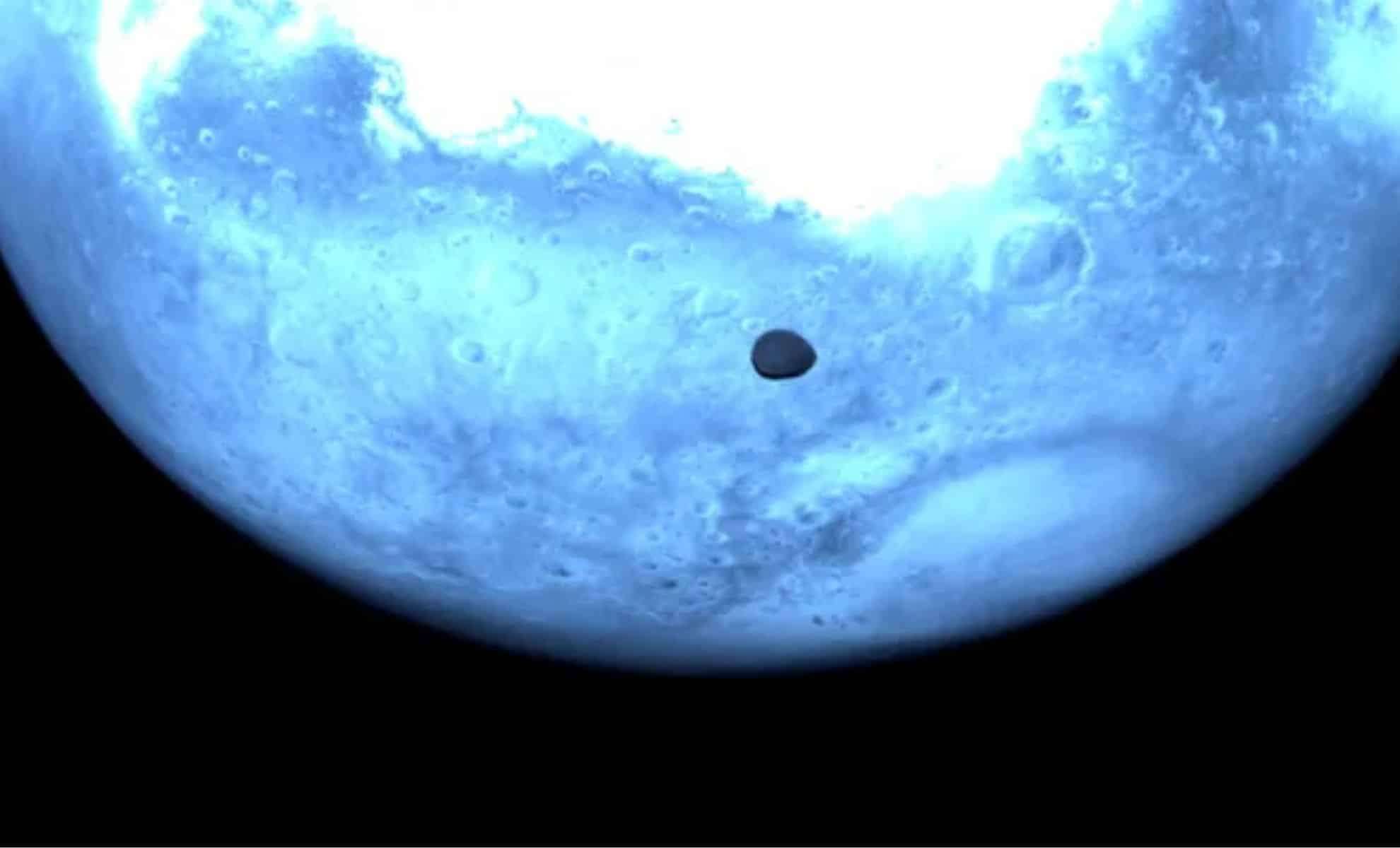
On March 12, 2025, the European Space Agency’s Hera mission captured an exceptional near-infrared photograph of Mars’ lesser-known moon, Deimos, during a close journey past the Red Planet. This marked the inaugural deployment of Hera’s scientific instruments, delivering a striking silhouette of Deimos against the Martian surface, offering an unusual and detailed glimpse of this small satellite.
Launched in 2024, Hera’s chief goal is planetary defense, focusing on examining the effects of NASA’s DART spacecraft colliding with the asteroid Dimorphos. To approach its target asteroid, Hera utilized Mars’ gravity for a boost, presenting an opportunity for mission scientists to test the spacecraft’s hyperspectral imaging apparatus for the first time.
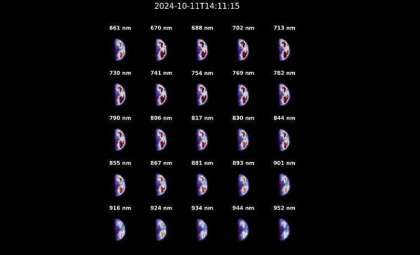
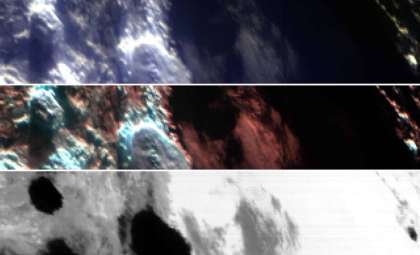
During the flyby, Hera passed within 620 miles (1,000 km) of Deimos, which orbits Mars at roughly 14,600 miles (23,500 km). The image, captured by the Hyperscout H camera, unveiled detailed surface features across 25 spectral bands, enabling researchers to gain new insights into the moon’s make-up and possibly its origins.

Unraveling the Enigma of a Small Martian Moon
Deimos is the smaller counterpart to Mars’ two moons, spanning just 7.7 miles (12.4 km) in diameter, and remains an intriguing body within our solar system. Unlike its sibling Phobos, which is expected to spiral inward toward Mars over millions of years, Deimos occupies a stable orbit. Its origin has long been questioned, with theories suggesting it could be a captured asteroid or debris from an ancient collision involving Mars.
Instruments aboard the Hera spacecraft are specifically designed to study the moon’s surface composition, offering potential clues to solve the mystery of its true nature. The hyperspectral imaging technology onboard expands scientists’ vision beyond visible light, mapping the moon in unprecedented detail.
The Importance of This Stunning Image
The recently unveiled image presents Deimos set against the Martian landscape, illuminated in near-infrared wavelengths. Prominent Martian features visible in the background include:
- Terra Sabaea, an ancient highland area along Mars’ equator.
- Huygens Crater, a significant impact site.
- Hellas Basin, one of the solar system’s largest impact basins.
Because Deimos is tidally locked with Mars, always showing the same hemisphere to the planet, this particular view of its far side is rare. Hera’s encounter allowed an unprecedented close-up examination of areas of Deimos rarely seen before.
Instrument Validation Ahead of Major Mission Goals
While Hera’s primary focus is not Mars, this flyby acted as a critical systems check for its instruments prior to arriving at Dimorphos, the asteroid under study following NASA’s DART impact. Successfully using the Hyperscout H imager during this maneuver demonstrated that Hera’s tools are functioning optimally and ready for upcoming tasks.
With its cutting-edge imaging technologies, Hera is expected to advance planetary defense science by providing essential data on asteroid deflection. Nonetheless, its valuable observations of a Martian satellite add an unexpected layer of scientific discovery to the mission.
As the European Space Agency analyzes the flyby data, the mysteries surrounding Deimos may become clearer, bringing us one step closer to comprehending the origins of Mars’ smallest natural satellite.
- Categories:
- News







0 comments
Sign in to Comment