
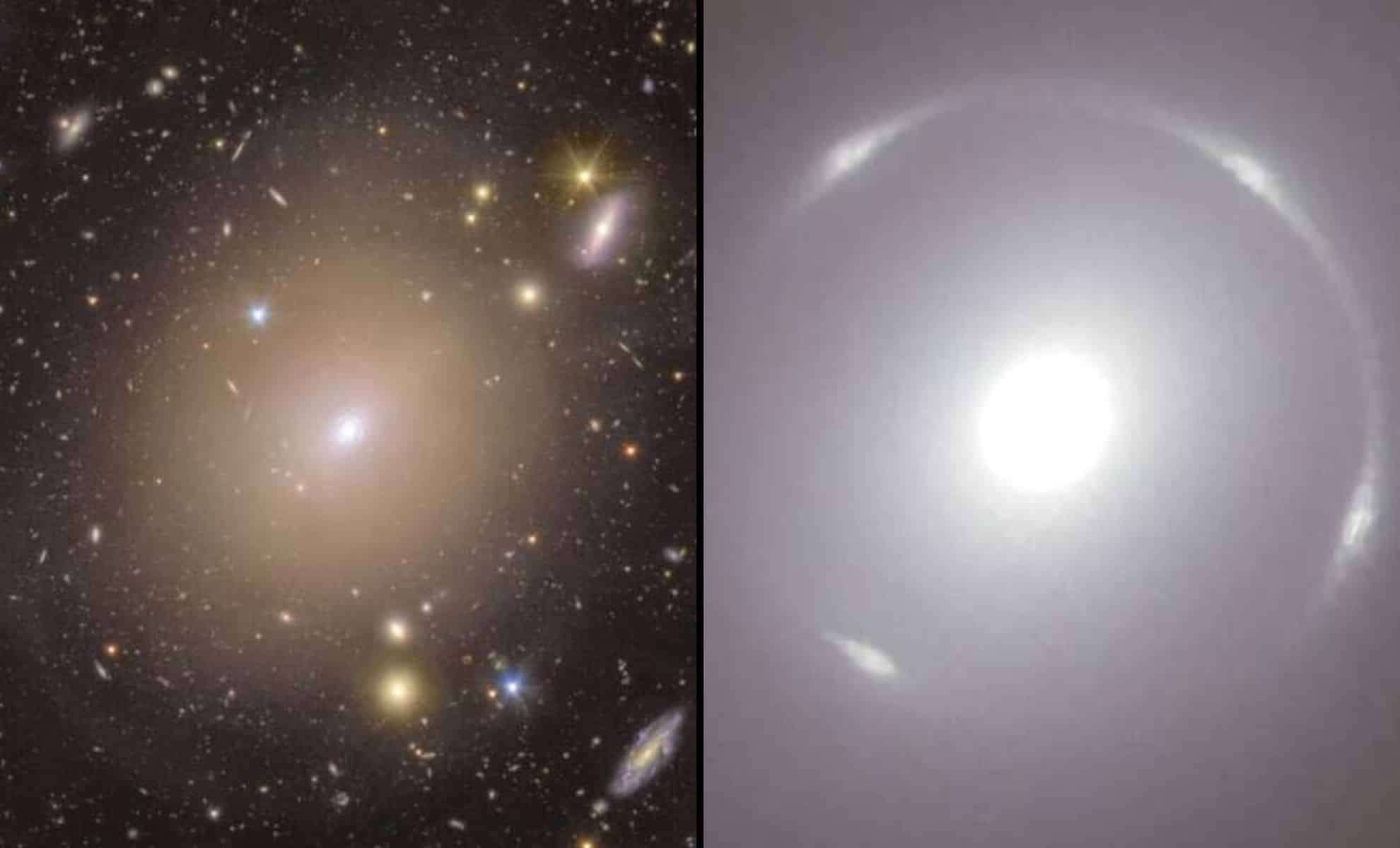
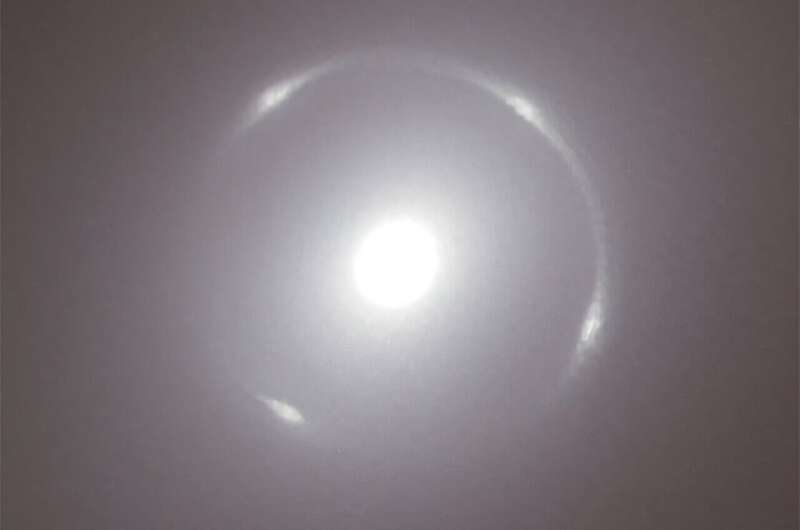
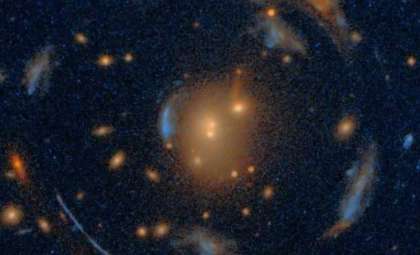
The Euclid space observatory, launched by the European Space Agency (ESA) in 2023 to investigate the dark components of the universe, has revealed a breathtaking discovery: an almost flawless Einstein ring surrounding the core of the NGC 6505 galaxy. Captured during the observatory’s initial survey phase, this remarkable sight exemplifies gravitational lensing, a direct consequence of Albert Einstein’s general relativity.
This Einstein ring formed as light from a remote galaxy, situated 4.42 billion light-years away, was bent and amplified by the gravitational field of the nearer galaxy NGC 6505, which lies just about 590 million light-years from Earth. Though NGC 6505 has been a familiar sight to astronomers for more than 100 years, the bright lensing ring at its heart had remained hidden until Euclid’s sophisticated instruments detected it.
Einstein Rings: Exceptional Tools for Cosmic Exploration
Such rings represent some of the most extraordinary and valuable gravitational lensing phenomena. They occur when an observer, a foreground galaxy, and a distant background galaxy line up perfectly, producing a glowing halo of light encircling the closer galaxy. These cosmic lenses serve as natural telescopes, enabling astronomers to study galaxies too faint or distant to see otherwise.

“An Einstein ring is a prime example of strong gravitational lensing,” says Conor O’Riordan, a scientist at the Max Planck Institute for Astrophysics and the lead author on the inaugural paper studying the ring. “Strong lenses are incredibly rare and hold immense scientific potential. This one stands out because it's nearby and displays a visually striking alignment.”
According to a recent publication in Astronomy & Astrophysics, this newly observed Einstein ring not only offers a stunning confirmation of Einstein’s theoretical predictions but also gives researchers vital clues about dark matter's role and cosmic expansion. By studying how light warps around NGC 6505, scientists aim to improve models of universe formation and deepen understanding of the forces shaping cosmic evolution.
Why Had This Einstein Ring Remained Hidden?
Although known to astronomers for more than a century and first registered in 1884, no previous observations had revealed this gravitationally lensed halo. This underscores the unmatched sensitivity and resolution of Euclid’s technology, which surpasses most terrestrial telescopes in exploring the deep cosmos.
“It’s fascinating that this Einstein ring was discovered inside a galaxy cataloged back in 1884,” remarks Valeria Pettorino, ESA’s Euclid Project Scientist. “While the galaxy was well-known, the ring itself had never been seen before, showcasing how Euclid uncovers new cosmic features even in familiar regions.”
Euclid’s mission extends beyond identifying rare gravitational lenses; its core aim is to chart billions of galaxies across roughly a third of the sky, constructing the most intricate three-dimensional map of the universe to date. It is anticipated to locate around 100,000 strong gravitational lenses, a dramatic increase from the current total below 1,000.
Looking Ahead: Euclid’s Promising Scientific Journey
The early detection of this breathtaking Einstein ring signals a fruitful future for Euclid’s principal scientific work. Equipped with cutting-edge instruments, Euclid can identify minute distortions in galaxy shapes, providing insights into the effects of dark matter and dark energy. These observations will guide astronomers toward resolving key mysteries in astrophysics:
- What constitutes dark matter, and how does it sculpt the cosmos?
- How has cosmic expansion progressed, and what part does dark energy play?
- Are there unseen cosmic structures still waiting to be revealed?
Despite the excitement over this Einstein ring, Euclid primarily investigates weak gravitational lensing, where distant galaxies appear subtly elongated or offset by cosmic mass. Probing these delicate distortions requires analyzing data from billions of galaxies collected over the upcoming years.
“Euclid will transform the field with this unprecedented trove of data,” adds Conor O’Riordan. Through its detailed sky mapping and high-precision imaging, the telescope promises to uncover cosmic phenomena on an unparalleled scale, helping scientists unravel the story of our universe’s growth.
- Categories:
- News





0 comments
Sign in to Comment