
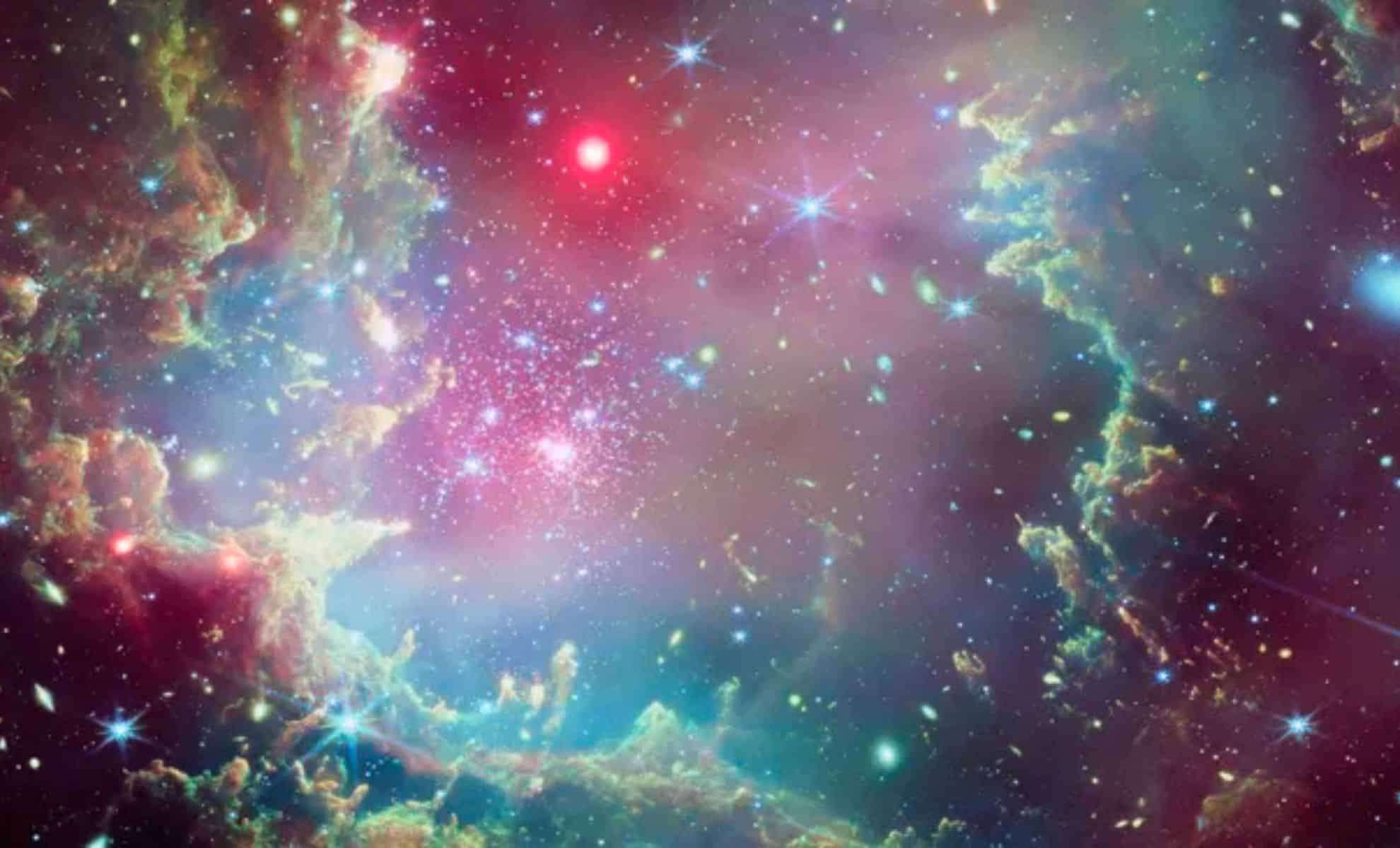
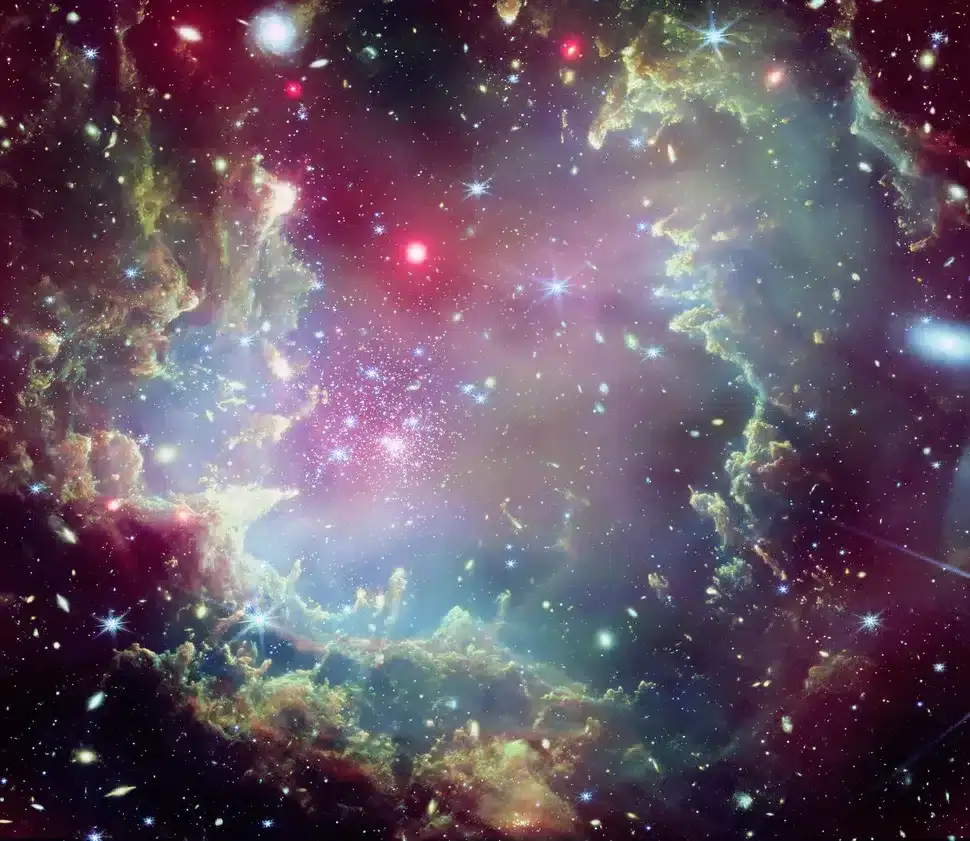
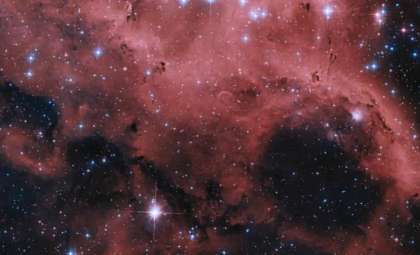
While Earth celebrates the festive season, beyond our planet lies a spectacular cosmic display resembling a sparkling holiday wreath. Located approximately 200,000 light-years away within the Small Magellanic Cloud (SMC), a satellite dwarf galaxy orbiting the Milky Way, the star cluster known as NGC 602 offers a dazzling showcase of celestial phenomena. The combined imaging power of the James Webb Space Telescope (JWST) and the Chandra X-ray Observatory merges infrared and X-ray data, revealing intricate details about stellar birth and evolution in one of our galaxy’s closest neighbors.
This observation not only enchants with its visual splendor but also advances our knowledge about star formation in environments similar to those present early in cosmic history. The radiant “wreath” stands as a striking example of how new observational technologies continue to deepen our grasp of the universe’s origins.
Young Stars Enveloped by Nebulous Gas
The cluster NGC 602 is composed of energetic, young blue stars that emerged from the gravitational collapse of a substantial gas cloud. Many of these stars remain shrouded in the gas and dust from which they formed, emitting intense radiation that sculpts the surroundings into elongated, finger-like structures pointing toward the dazzling stellar core. These formations are reminiscent of the iconic Pillars of Creation found in the Eagle Nebula and underscore the ongoing interaction between nascent stars and their natal material.

What makes NGC 602 particularly interesting is its residence in the SMC, a galaxy markedly different from our own Milky Way. The interstellar gas in the SMC contains fewer heavy elements, or “metals,” which typically accumulate through successive cycles of star formation and supernova explosions. This scarcity of metals mirrors conditions similar to those in the early universe, making NGC 602 a crucial laboratory for studying how stars originated in primordial galaxies.
- Categories:
- News


0 comments
Sign in to Comment