
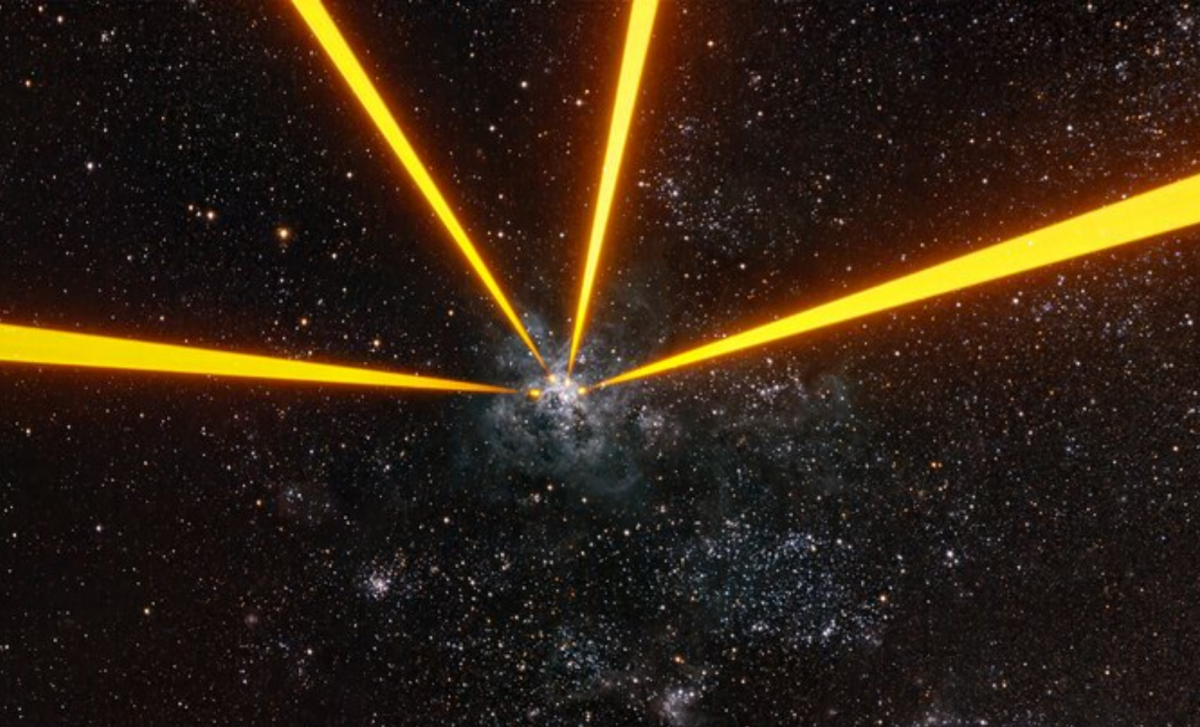
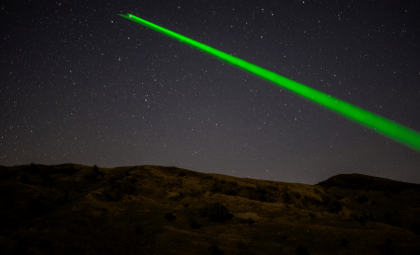
A captivating photo from the European Southern Observatory’s (ESO) Very Large Telescope Interferometer (VLTI) showcases four brilliant laser beams piercing the night sky, illustrating a groundbreaking advancement in observing the universe. These lasers are crucial tools in addressing one of astronomy’s perennial obstacles: the distortion caused by Earth's atmosphere.
An Innovative Technique That Simulates Celestial Stars
At a glance, the luminous shafts might seem like something out of a futuristic movie, but their role is scientific. These lasers generate what astronomers refer to as artificial guide stars high up in the atmosphere.
When the laser beams interact with sodium atoms approximately 90 kilometers above Earth, they induce a glowing point of light. These constructed stars act as precise references for telescopes, enabling real-time monitoring of atmospheric disturbance. As starlight or light from other celestial bodies travels through the turbulent atmosphere, these artificial points help measure how the light is distorted.

Next, sophisticated adaptive optics employ rapid-response mirrors and algorithms to adjust the telescope hundreds of times each second. This method effectively counteracts the blurring effects, yielding incredibly sharp images comparable to those from orbiting telescopes—all achieved from the ground.
The VLTI: Cutting-Edge Astronomy in Chile’s Desert
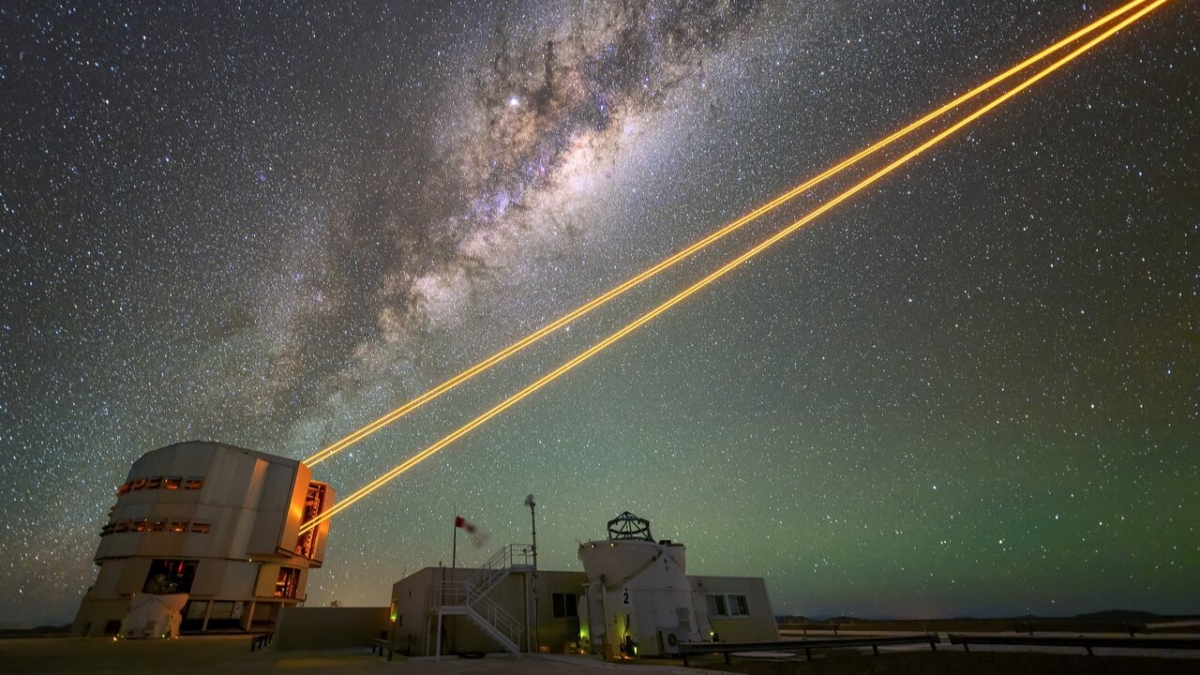
This pioneering approach is implemented at the Very Large Telescope Interferometer (VLTI), situated on Cerro Paranal in Chile’s Atacama Desert. Known for some of the clearest night skies on Earth, this locale is ideal for advanced space observation.
The VLTI integrates four individual telescopes into one giant instrument, effectively creating an enormous “virtual telescope” with significantly enhanced resolution. Since 2016, it has been enhanced by the Four Laser Guide Star Facility, which greatly improves its precision in pinpointing celestial objects.
The European Southern Observatory (ESO) highlights that this technology allows researchers to explore distant cosmic phenomena with unparalleled detail. One notable example is the Tarantula Nebula, about 160,000 light-years away in the Large Magellanic Cloud. This nebula is one of the most active star-forming regions close to our galaxy, making it a key target for high-resolution imaging.
Unlocking Sharper Views of the Universe’s Wonders
The impact of this method extends well beyond stunning photographs. By compensating for atmospheric interference, astronomers can obtain clearer, more detailed observations of stars, planets, and galaxies that were once obscured or blurred in Earth-based telescopes.
This precision is vital for examining dim or distant cosmic bodies. Astrophysicists can now better study intricate features like the structure of protoplanetary disks, the movements of stars in the vicinity of black holes, and the makeup of far-off nebulae. Such insights deepen our understanding of cosmic evolution.
Advanced adaptive optics like those used at the VLTI remain rare worldwide, placing this observatory at the forefront of ground-based astronomy. Through its laser technology, the VLTI exemplifies how engineering ingenuity and astrophysics unite to surpass natural viewing challenges.
- Categories:
- Astronomy




0 comments
Sign in to Comment