
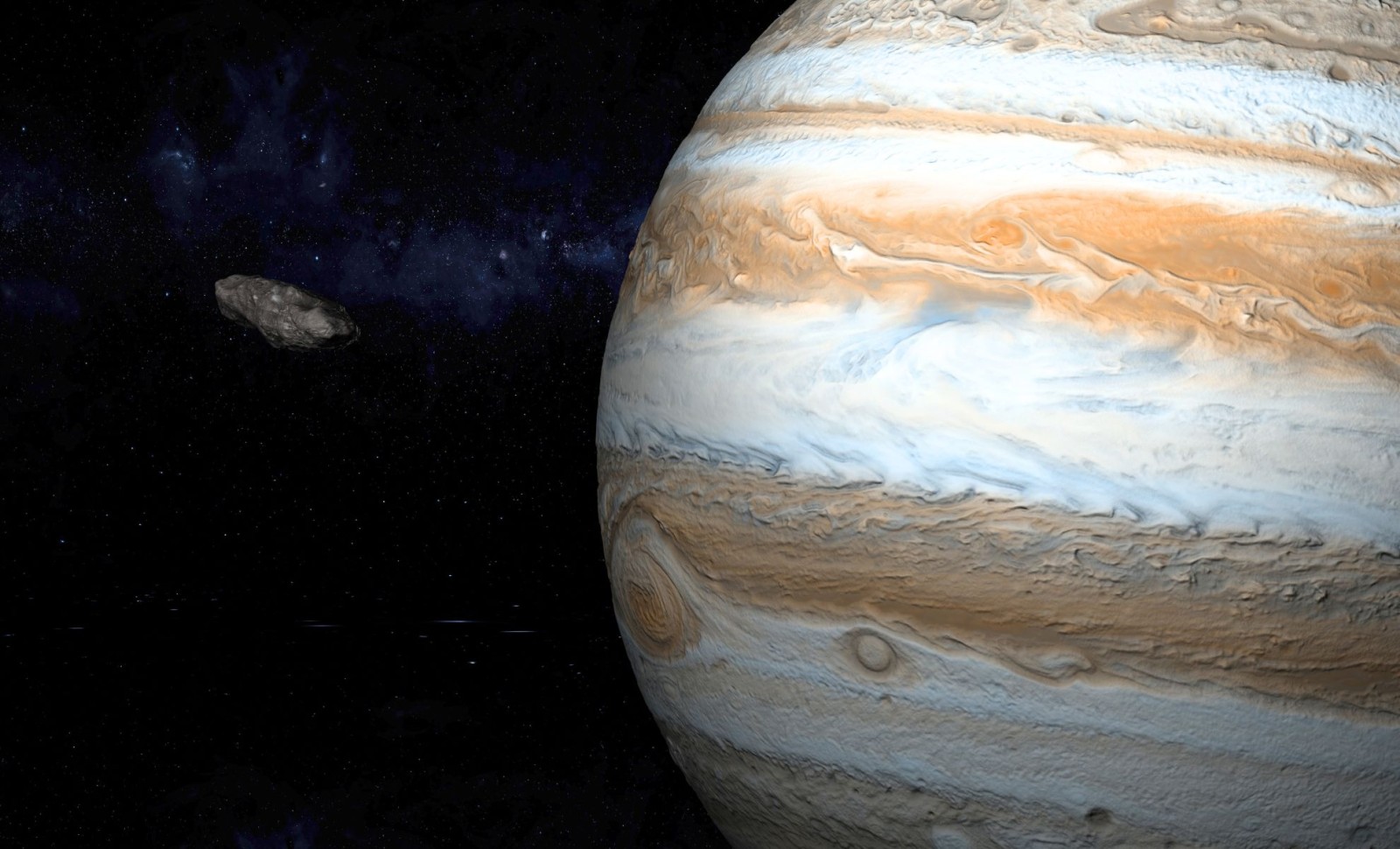
First spotted in 2017, the interstellar visitor known as 3I/ATLAS has captured significant scientific attention. Predicted to fly past Earth in early 2026, its trajectory will bring it closer to Jupiter in March 2025. Avi Loeb, a Harvard astrophysicist, has introduced an extraordinary hypothesis: 3I/ATLAS might be an extraterrestrial spacecraft instead of a typical comet.
Loeb, who has long advocated for considering the possibility of alien technology lurking within our observations of space, points to the object's odd path and acceleration patterns as evidence of potential device deployment around Jupiter. His theory has sparked debate within the scientific community.
Unusual Acceleration Raises New Possibilities
Loeb’s hypothesis stems from the atypical acceleration this object exhibits. Unlike conventional comets, which accelerate due to the release of gas and dust when heated by the Sun, 3I/ATLAS experiences “non-gravitational acceleration” that cannot be fully explained by solar radiation. Avi Loeb suggests this could signify an internal propulsion mechanism, implying the object might be an engineered artifact rather than a natural visitor from deep space.

Loeb proposes that this unexpected acceleration could indicate advanced technology. When 3I/ATLAS made its closest approach to the Sun in September 2024, its trajectory shifted unexpectedly, setting it on a course for a near encounter with Jupiter in 2025. The precision of this maneuver points to the possibility of controlled navigation, perhaps by an alien civilization interested in the gas giant.
Significance of Jupiter’s Hill Sphere in the Hypothesis
The concept of Jupiter’s Hill radius plays a vital role in Loeb’s speculation. This sphere defines the zone where Jupiter’s gravity dominates the orbit of nearby objects, shielding them from being pulled by the Sun’s gravitational force. 3I/ATLAS is forecasted to pass within approximately 160,000 miles of this zone in March 2025, a proximity that Loeb interprets as a deliberate opportunity for the object to deploy “technological satellites” or “monitors” around Jupiter.
This theory conjures vivid scenes common in science fiction, where alien devices might be strategically placed around planets to study or influence them.
“If we find technological satellites of Jupiter that we did not send, it would imply that Jupiter is of interest to an extraterrestrial civilization,” he wrote in his blog post. That possibly indicating that Jupiter has been a target for alien interest long before humanity arrived on the scene.
Scientific Community Weighs In on Loeb’s Theory
Loeb’s proposal has been met with a mix of intrigue and skepticism. NASA and many astronomers continue to view 3I/ATLAS as a natural comet composed of ice and dust. They attribute its unusual acceleration to solar radiation pressure and the gases released as it warms.
Nasa associate administrator Amit Kshatriya has openly dismissed the notion of the object being artificial, labeling such ideas as speculative. Still, he advises caution against dismissing unconventional views outright within scientific discourse.
At Harvard, Professor Loeb champions an open-minded approach to analyzing such phenomena, especially given the unexplained aspects of 3I/ATLAS’s motion.
“Perhaps this is because the human species arrived late to the party — only a few million years ago, whereas Jupiter — the biggest planet in the Solar system, was visible to the senders of 3I/ATLAS when the mission was launched billions of years ago,” he noted.
- Categories:
- Space








0 comments
Sign in to Comment