
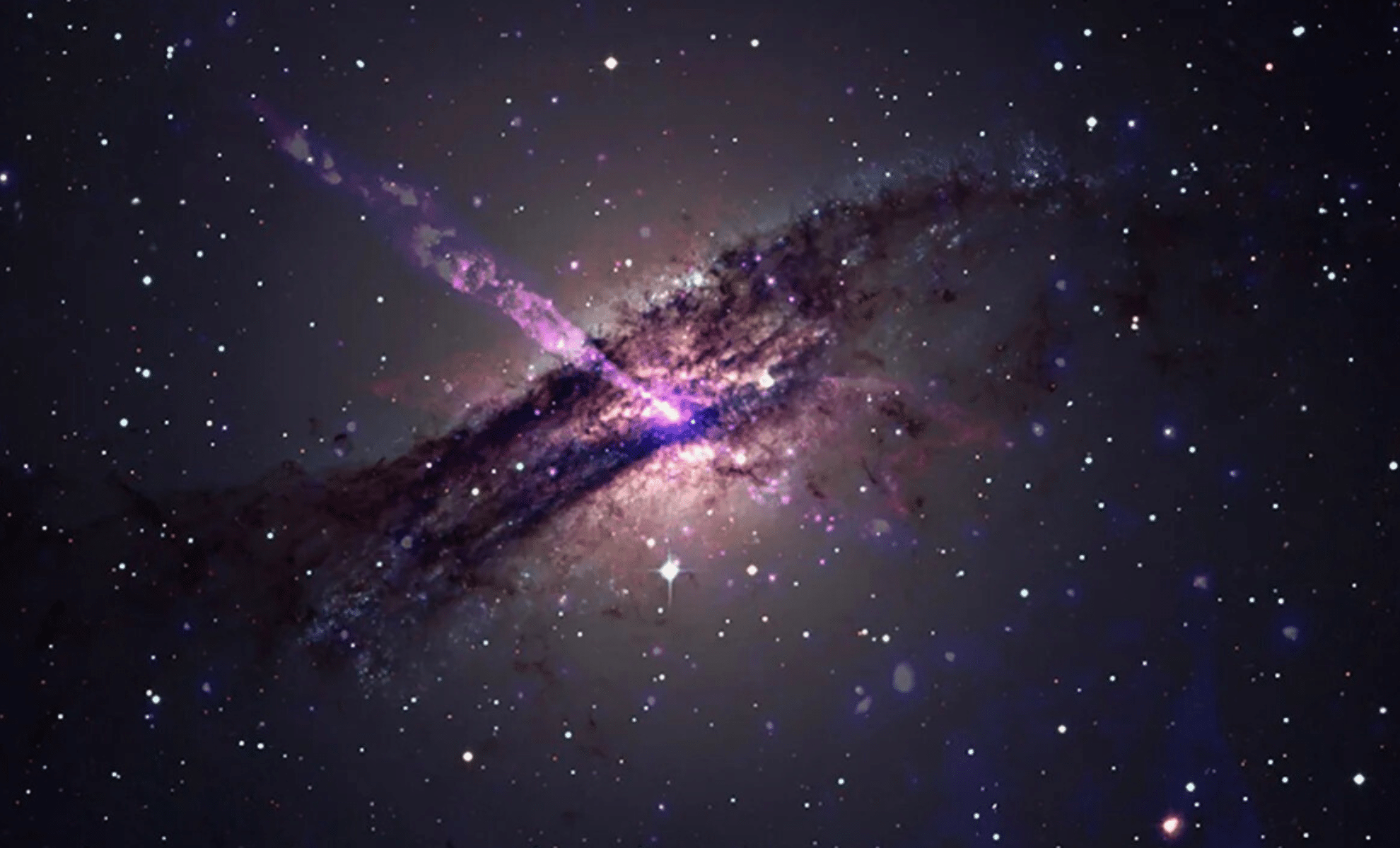
A remarkable new finding in astrophysics has captured the attention of scientists: an energetic jet produced by a supermassive black hole in the Centaurus A galaxy has collided with an unidentified object, producing a distinctive V-shaped signature in X-ray images captured by NASA’s Chandra X-ray Observatory. What implications does this discovery hold for our understanding of cosmic phenomena?
The Power of the Black Hole Jet
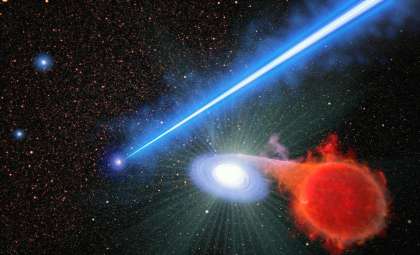
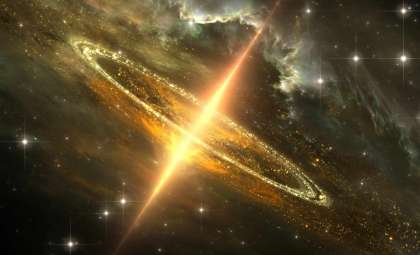
At the center of the Centaurus A galaxy lies a supermassive black hole that propels a jet of matter nearing the speed of light. This jet extends for thousands of light-years, transporting extremely energetic particles through space.
With an estimated mass of roughly 55 million Suns, this black hole is positioned around 12 million light-years from Earth in a universe region known for its intense jets and cosmic interactions.

Scientists Behind the Discovery
Data for this breakthrough came from the Chandra X-ray Observatory, which observes the cosmos in X-ray wavelengths far beyond the reach of optical telescopes. Leading the investigation were:
- Dr. Michael Wise, an astrophysicist at the Harvard-Smithsonian Center for Astrophysics (CfA), who oversaw the research.
- Dr. Joan Schmelz, an expert in black hole jet phenomena and X-ray astronomy, who helped interpret the findings.
The Enigmatic Object “C4” and Its V-Shaped Signature
The interaction between the jet and object C4 generated a turbulent region characterized by a striking V-shaped feature in X-ray emissions. This unique pattern, described by scientists as “never observed before,” remains a mystery. Researchers hypothesize that C4 could be a massive star or alternatively an exotic cosmic entity such as a dark matter structure.
“Unprecedented” Astronomical Phenomenon
In the words of Dr. Michael Wise:
“The V-shaped pattern has never been observed in such a collision. This phenomenon could be a key to understanding how black hole jets interact with unusual celestial objects.”
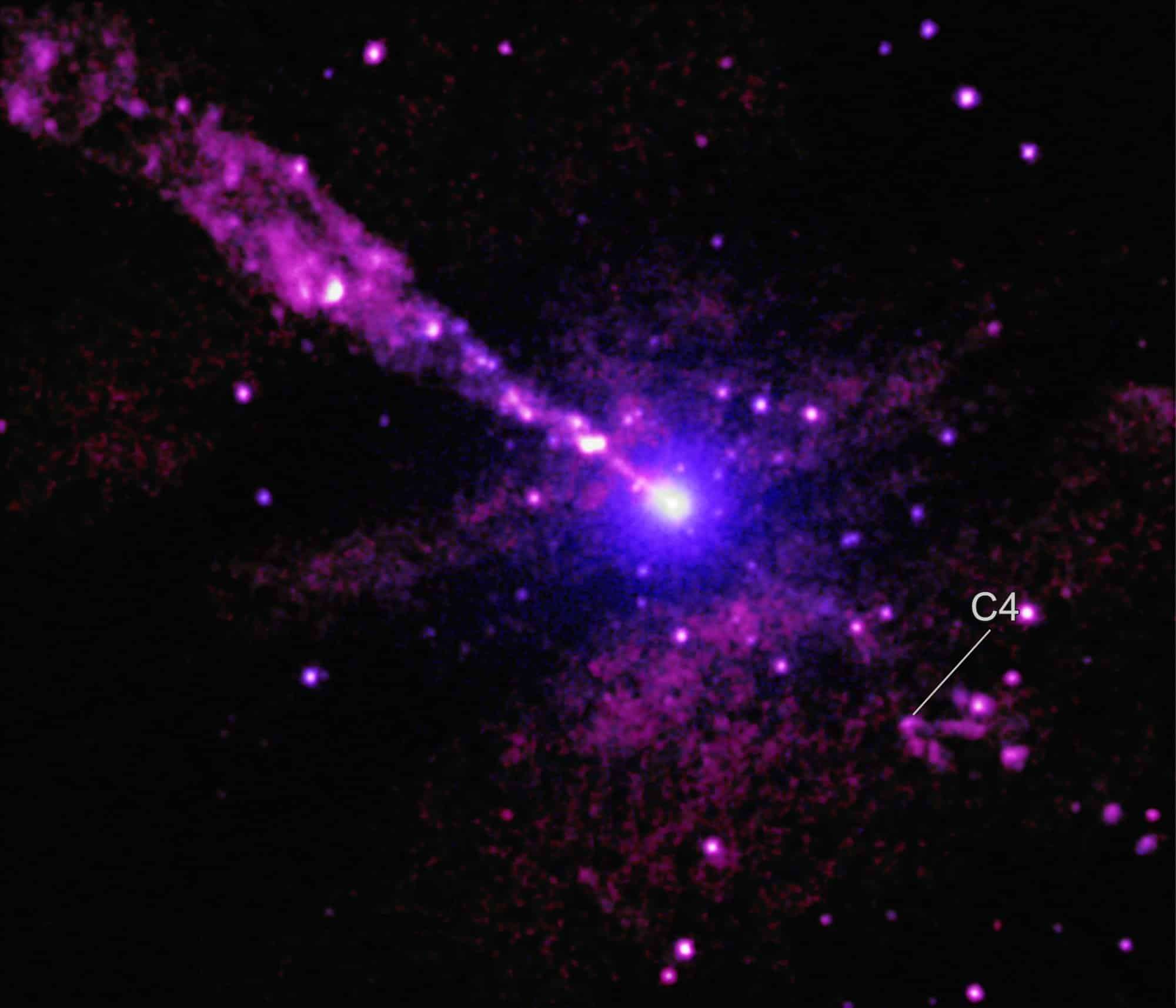
Is C4 a Massive Star or Something More Mysterious?
Although C4 seems to be a massive star, experts have not eliminated the possibility that it could be a rare or hidden cosmic body, such as a compact object or a dark matter candidate. One tantalizing theory suggests C4 might be an inconspicuous companion or an unseen mass embedded in the galaxy.
The X-ray radiation emitted during the collision reveals a substantial energy discharge, yet many details remain unclear. This unique event has eluded detection by other instruments, amplifying scientific interest.
Important Insights About the Jet and Its Astronomical Significance
- Speed and Reach: The jet travels at almost 99% the speed of light, spanning about 30,000 light-years. While known as a feature of supermassive black holes, its role in shaping galactic environments is increasingly under scrutiny.
- X-ray Impact: A high-energy zone forms where the jet collides, significantly increasing the density of gas and particles.
- Galactic Context: Centaurus A serves as a key example in studying supermassive black holes and their jets, with observations from NASA’s Hubble Space Telescope and Chandra Observatory providing valuable data.
Additional Observational Data
What does this cosmic interaction reveal for astronomy? Although the full consequences of this collision are not yet known, it poses new challenges to our comprehension of black holes and their energetic jets. By delving deeper into the intriguing environment of Centaurus A, scientists are uncovering increasingly complex and captivating cosmic puzzles. What started as a routine galactic study has now sparked a wave of scientific questions and discoveries.
The comprehensive study appears in The Astrophysical Journal.
- Categories:
- Astronomy ,
- Space ,
- Nasa





0 comments
Sign in to Comment