
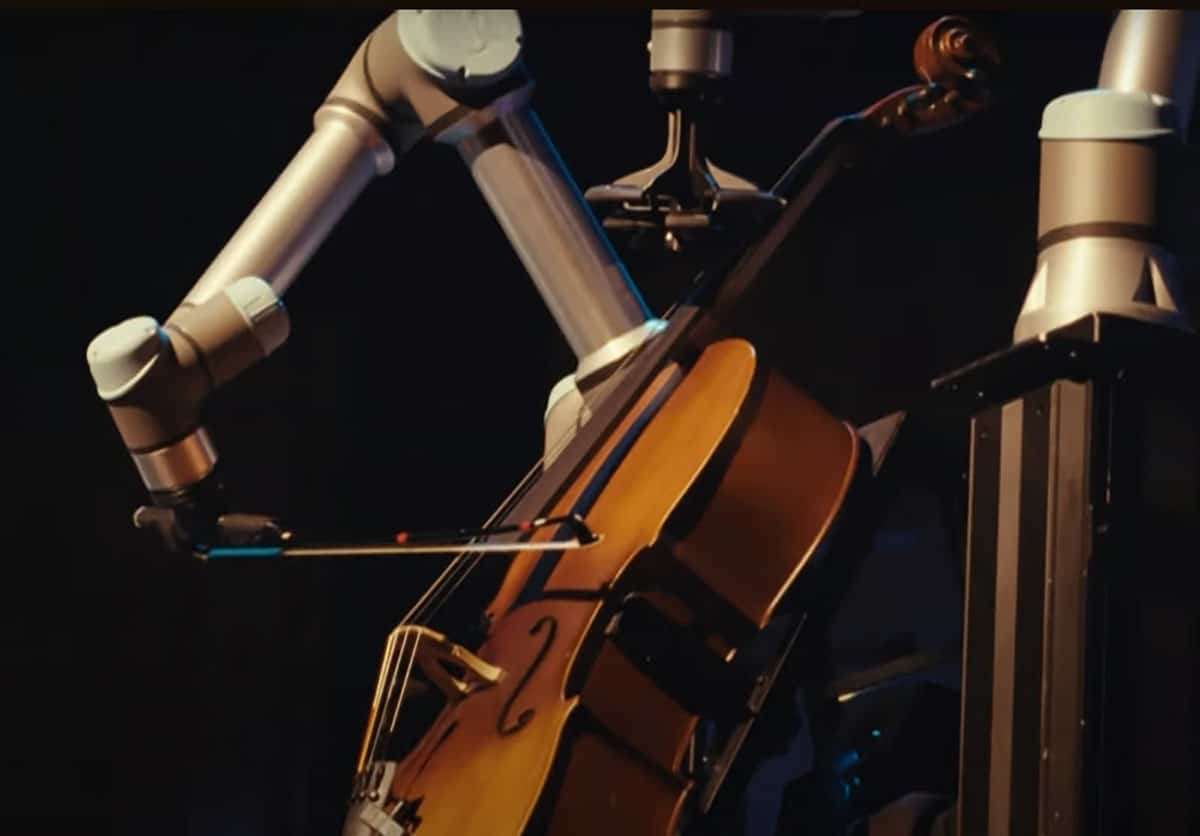
On October 31, 2024, an extraordinary event took place when a robotic cello player performed live alongside an orchestra of human musicians. This groundbreaking presentation featured a piece composed by Swedish artist Jacob Mulrad, showcasing how artificial intelligence is beginning to intersect with classical music performance.
The innovative robotic cellist was engineered by composer and scientist Fredrik Gran, utilizing two industrial robotic arms tailored for this performance. One arm skillfully guided the bow across the strings with motions resembling a human player, while the other employed a specially crafted 3D-printed tool to press the strings accurately on the fingerboard.
Mastering a string instrument like the cello is particularly challenging due to the need for precise finger positioning to achieve the correct pitch. Unlike piano keys, whose notes are fixed, the cello demands nuanced control. This robot’s successful navigation of these complex controls marks a major step forward in AI and robotics research.

A cello-playing robot performed with the Malmo Symphony Orchestra in Sweden last week, marking the first-ever collaboration between a robotic cellist and a full symphony orchestra pic.twitter.com/m1nBEwRRAz
— Reuters (@Reuters) October 24, 2024
Obstacles and Current Boundaries in Robot Musicianship
Though the robot’s orchestral debut impressed many, this area remains fraught with significant challenges:
- Inability to convey emotional depth
- Restricted scope for musical interpretation
- Difficulty responding to subtle shifts in tempo and dynamics
- Missing the human nuance that enlivens performances
Fredrik Gran admitted that despite the technical sophistication, the robot’s performance lacked the emotional resonance of human musicians. The execution was somewhat average, highlighting the hurdles AI faces in emulating the expressive complexity unique to humans.
Nonetheless, Gran is hopeful about future enhancements: integrating cutting-edge AI could allow robots to interpret and perform music with greater emotional richness.
Prospects for AI Within Classical Music
With ongoing advancements in technology, AI’s role in classical music is poised to expand. While robots are unlikely to fully replace human artists, they could complement orchestras or act as valuable assets for composers and educators.
Below is a comparison between human and robotic musicians:
Factor Human Musician Robotic Musician Emotional Expression Extensive Minimal Technical Accuracy Variable Highly Consistent Flexibility High Limited Creativity Innovative Programmed
The fusion of AI with traditional classical music presents thrilling opportunities for new styles and performances that blend human ingenuity with mechanical perfection. As scientists continue advancing AI and robotics, we can anticipate robots capable of expressing music with greater subtlety and emotional power.
What This Means for Music’s Evolution
The introduction of a robot cello soloist performing with a full orchestra marks not only a technical breakthrough but also prompts reflection on the essence of creativity and musicianship in the era of AI. As these technologies evolve, our understanding of artistry may shift.
It’s important to remember that music’s core is its ability to stir emotions and foster human connection. While machines can imitate technical execution, the years of personal experience and emotional depth that shape a human’s interpretation remain irreplaceable.
Looking ahead, partnerships between human musicians and intelligent instruments might open up novel avenues for artistic expression, expanding the boundaries of classical music and beyond.
- Categories:
- Tech











0 comments
Sign in to Comment