
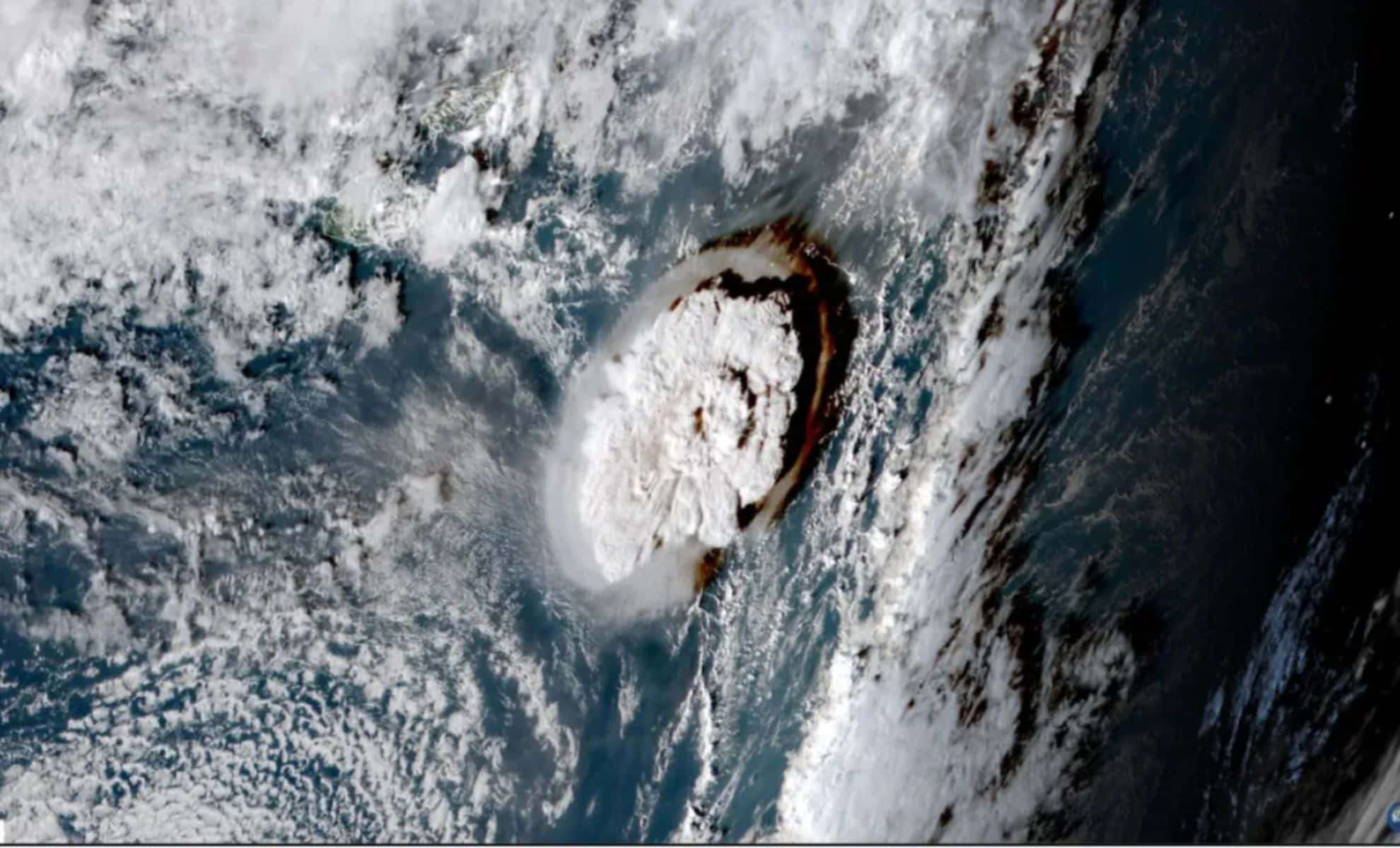
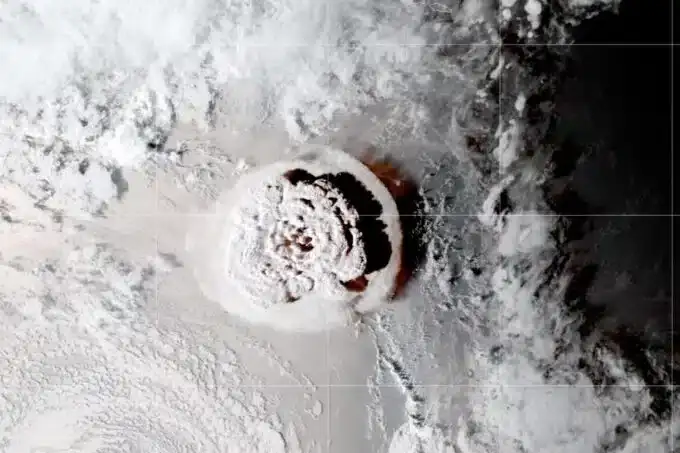
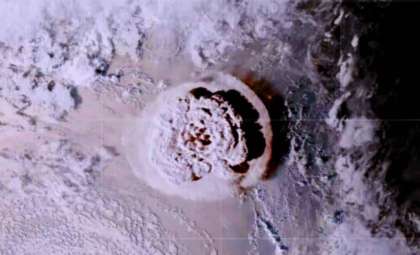
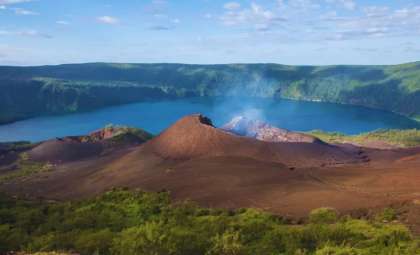
In 2022, the Hunga Tonga-Hunga Ha‘apai volcano unleashed one of the most intense eruptions recorded in recent times.
The blast propelled ash and gases to altitudes exceeding 31 miles (50 kilometers), soaring well beyond typical flight paths of commercial planes and the usual layers where weather forms.
What truly fascinated scientists, though, was how this eruption influenced atmospheric layers extending to the orbiting environment of satellites.
The Volcanic Eruption’s Reach to Near-Space Regions
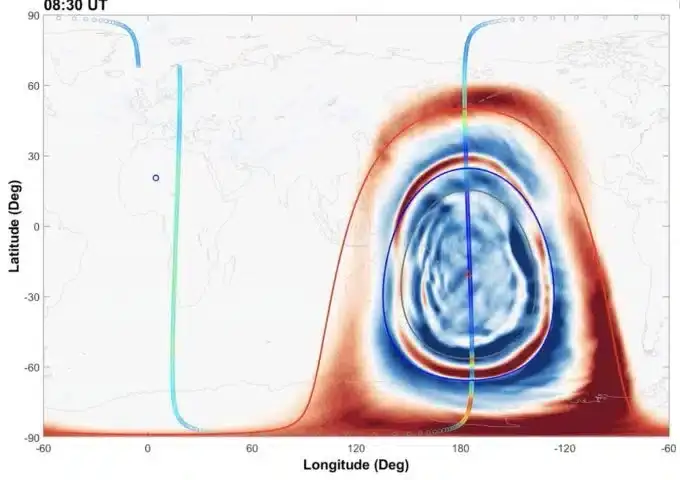
The colossal explosion generated an enormous shockwave that circled the planet.

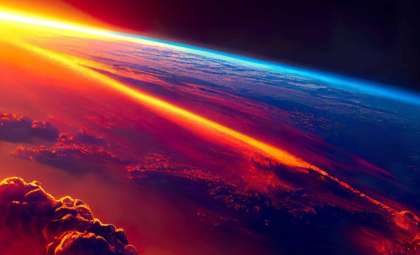
Researchers have discovered that this disturbance wasn’t confined locally; instead, it penetrated the upper atmosphere significantly.
A recent publication in AGU Advances combined satellite observations with atmospheric models to explore how the eruption produced extraordinary wave patterns.
The primary drivers behind these extended impacts were identified as secondary gravity waves.
These secondary gravity waves arise when primary pressure waves, which closely follow Earth’s surface, disintegrate at higher altitudes.
The research revealed that these gravity waves moved swiftly with considerable strength through the atmosphere, disturbing the zones where satellite systems function.
In essence, the eruption not only shook the Earth but also sent powerful shockwaves skyward, momentarily disrupting satellite-reliant airspace.
Using Atmospheric Clues to Predict Volcanic Activity
This eruption wasn’t the first large volcanic event to imprint signs in the atmosphere.
Previous research documented that before the Hunga Tonga-Hunga Ha‘apai explosion, a faint seismic ripple known as a Rayleigh wave could be detected.
Although invisible to people, seismographs positioned over 400 miles (644 kilometers) away picked up these signals, serving as early indicators of an impending eruption.
Combined with recent findings on atmospheric disturbances, these observations reveal how volcanic events leave distinct "signatures" on both seismic and atmospheric levels.
Scientists aim to deepen their understanding of such precursors, potentially enhancing forecasts of major volcanic outbreaks.
The Worldwide Influence of Volcanic Blasts
The Hunga Tonga-Hunga Ha‘apai blast highlighted how volcanic eruptions can significantly impact not just terrestrial environments but also the layers of sky above.
In particular, volcanic events can interfere with satellite operations that play vital roles in communications, weather monitoring, and navigation.
This awareness is driving scientists to reevaluate how volcanic phenomena may affect Earth's technological systems.
The research emphasizes the vast knowledge still to be uncovered regarding volcano-atmosphere interactions.
The Hunga Tonga-Hunga Ha‘apai eruption offered a rare glimpse into the links between seismic activity and atmospheric disturbances, shedding light on how such formidable natural forces extend their influence well beyond their point of origin.
- Categories:
- Science



0 comments
Sign in to Comment