
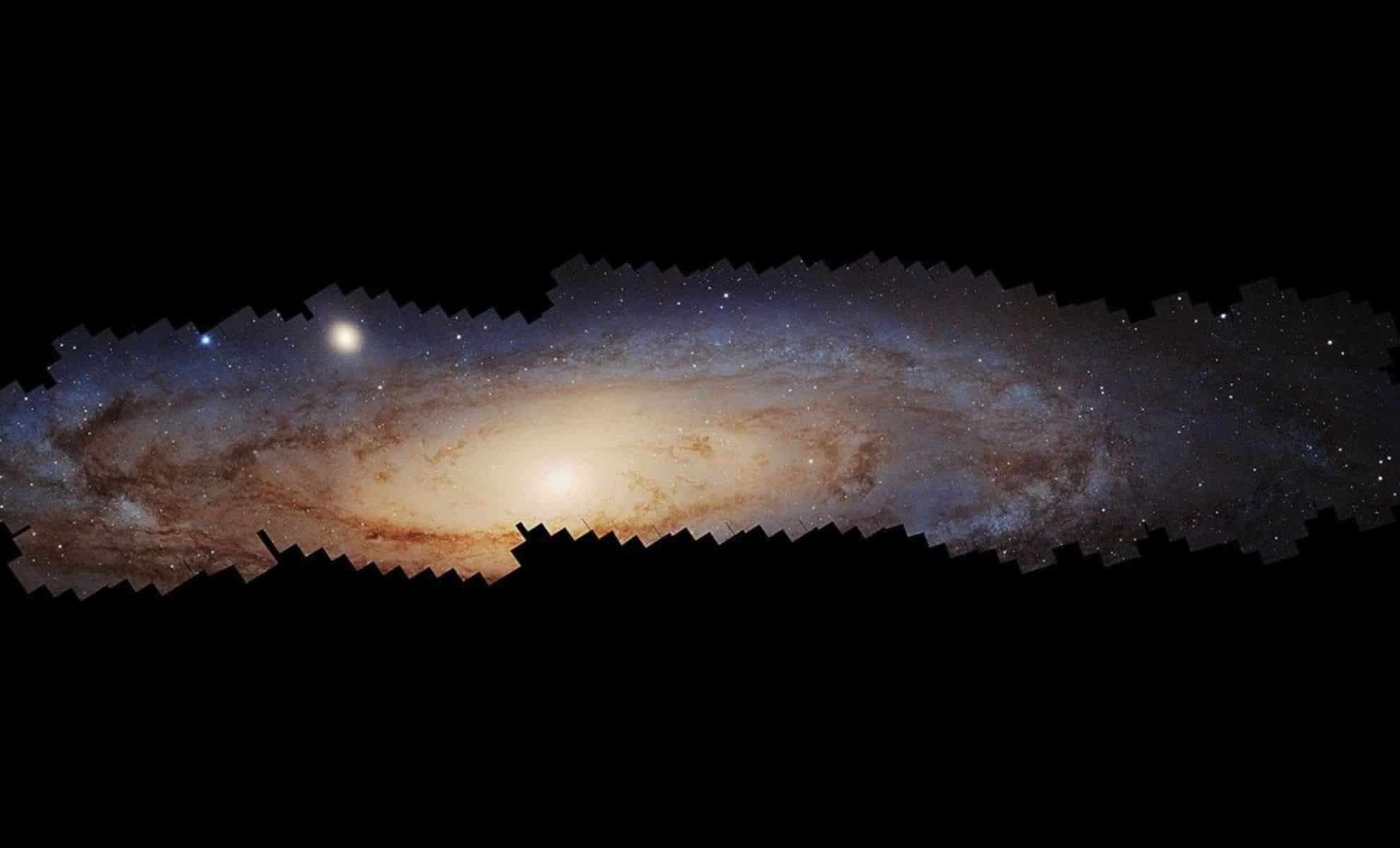
The Andromeda galaxy, our closest prominent galactic neighbor and a staple of the night sky, has fascinated astronomers and sky watchers for generations. Also known as Messier 31, this sprawling spiral galaxy is located around 2.5 million light-years away from Earth, often seen as a faint, slender glow on clear nights. While it seems well-known, Andromeda hides fascinating secrets that have only recently become visible through the extraordinary imaging power of NASA’s Hubble Space Telescope.
Over more than ten years, Hubble has assembled an exquisite photomosaic of Andromeda, pushing the boundaries of galactic imaging. Crafted from over 600 separate images and totaling an astonishing 2.5 billion pixels, this mosaic unveils the galaxy’s complex structures, dynamic evolution, and the cosmic events that have shaped it over billions of years.
An In-Depth Look at Andromeda’s Stellar Landscape
Andromeda, also identified as Messier 31, lies 2.5 million light-years from us, appearing as a faint, elongated smudge in the night sky. Despite its proximity, fully deciphering the mysteries of this colossal galaxy has been a significant observational challenge. Stretching six times the diameter of the Moon in the sky and containing over a trillion stars, it is an enormous and complex astronomical subject.

Hubble’s detailed 2.5-billion-pixel mosaic reveals the light from around 200 million stars, painting an unprecedented picture of Andromeda’s galactic disk. “Hubble allows us to examine the galaxy in extraordinary detail across its entire disk, something that is impossible to achieve for any other large galaxy,” explained Ben Williams, principal investigator at the University of Washington.
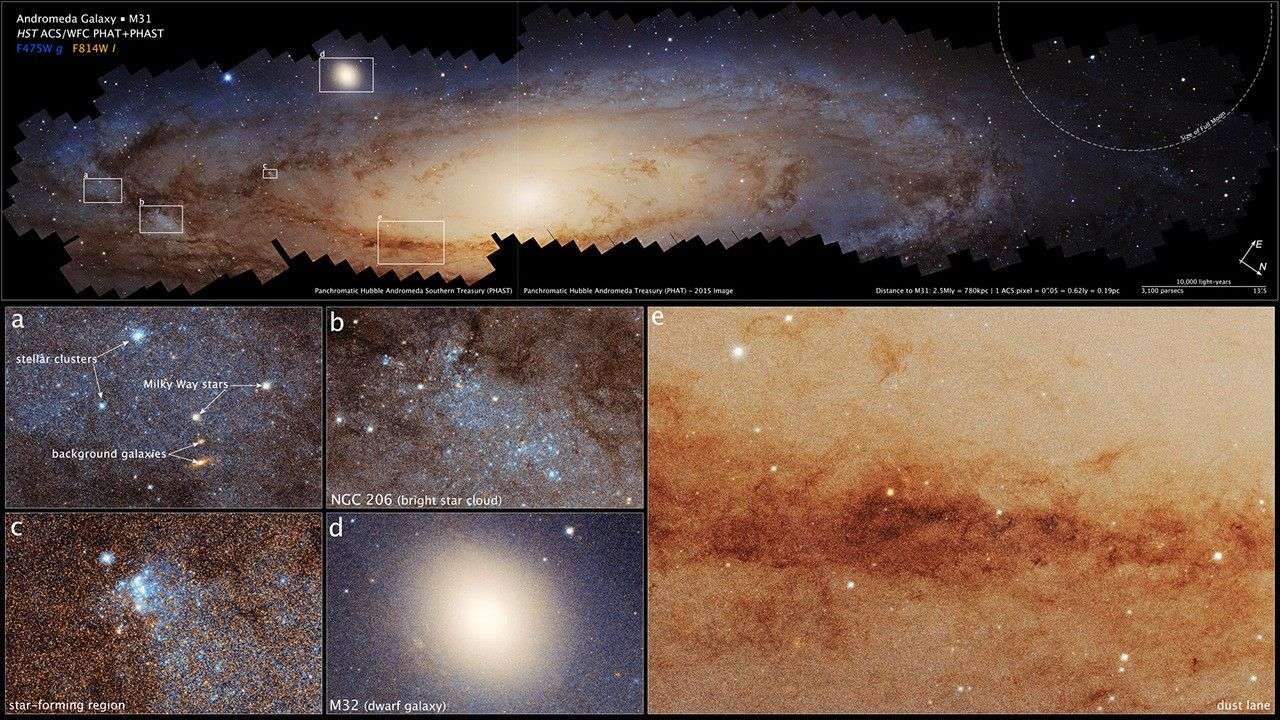
This mosaic is part of the Panchromatic Hubble Andromeda Treasury (PHAT) initiative, which took over 1,000 Hubble orbits and many years to complete. Together with the more recent Panchromatic Hubble Andromeda Southern Treasury (PHAST) survey, scientists have successfully covered the full disk of Andromeda. Examining light across wavelengths from ultraviolet to near-infrared, researchers have painted a rich portrait of the galaxy’s age distribution, star formation activity, and chemical makeup.
A Galaxy Molded by Cosmic Collisions
One of the most enlightening discoveries from Hubble’s observations is Andromeda’s tumultuous history. In contrast to the relatively steady development of the Milky Way, Andromeda displays signs of violent galactic interactions. These events include mergers with smaller galaxies, leaving behind star streams and clusters of bright blue stars dispersed throughout its disk.
“Andromeda resembles a cosmic train wreck. It appears to have undergone an event that sparked significant star formation which later ceased abruptly,” noted Daniel Weisz from the University of California, Berkeley. “This likely stems from a collision with another galaxy in its vicinity.”
Evidence for these ancient impacts includes Messier 32, a satellite galaxy believed to be the dense core of a spiral galaxy stripped by a merger with Andromeda. These interactions have dramatically influenced Andromeda’s shape and star formation, positioning it as a transitional galaxy between an active spiral and an elliptical system dominated by older stars.
“It looks as though Andromeda is in a transitional phase from a star-forming spiral to an elliptical-like galaxy with a central bulge full of aging red stars,” added Weisz. “We observe a substantial older stellar population at its core and a less vibrant star-forming disk than might be expected given its size.”
Decoding Andromeda’s Past Through Stellar Clues
Hubble’s high-resolution imaging not only reveals Andromeda’s current properties but also offers a detailed archive of its evolutionary timeline. By resolving individual stars, scientists can investigate their ages, distribution, and chemical fingerprints to reconstruct the galaxy’s formation history.
“This granular view enables us to unravel the sequence of mergers and interactions the galaxy has undergone,” explained Williams. The data suggest periods of intense starburst activity likely triggered by mergers, followed by quieter epochs. This has created a layered structure with older stars concentrated in the center and younger stars scattered in the outer disk.
The PHAST survey of Andromeda’s southern disk has been essential for understanding its merger past. This region, especially sensitive to the remnants of collisions, has helped astronomers refine evolutionary models by distinguishing between competing formation scenarios.
Paving the Way for Next-Generation Studies
Hubble’s groundbreaking Andromeda survey marks just the beginning of our detailed understanding of this nearby galaxy. Its discoveries will underpin upcoming missions such as the James Webb Space Telescope and Nancy Grace Roman Space Telescope, which will expand on Hubble’s legacy with even wider and deeper observations.
For instance, the Roman telescope’s wide-field imaging at Hubble-like resolution promises detailed views of Andromeda’s outer regions and satellite galaxies, illuminating how it interacts with its galactic surroundings.
Showcasing Hubble’s Lasting Impact on Astronomy
After more than thirty years, the Hubble Space Telescope continues to revolutionize our cosmic perspective. Its detailed portraits of Andromeda reflect Hubble’s unmatched ability to address ambitious scientific questions, contributing profoundly to our knowledge of galactic evolution.
As scientists analyze the treasure trove of data collected by Hubble, Andromeda remains a cornerstone for understanding galaxy formation and development throughout the universe. This colossal neighbor, with its rich and turbulent history, serves as a cosmic laboratory for exploring the forces that shape galaxies across cosmic time.
- Categories:
- News



0 comments
Sign in to Comment