
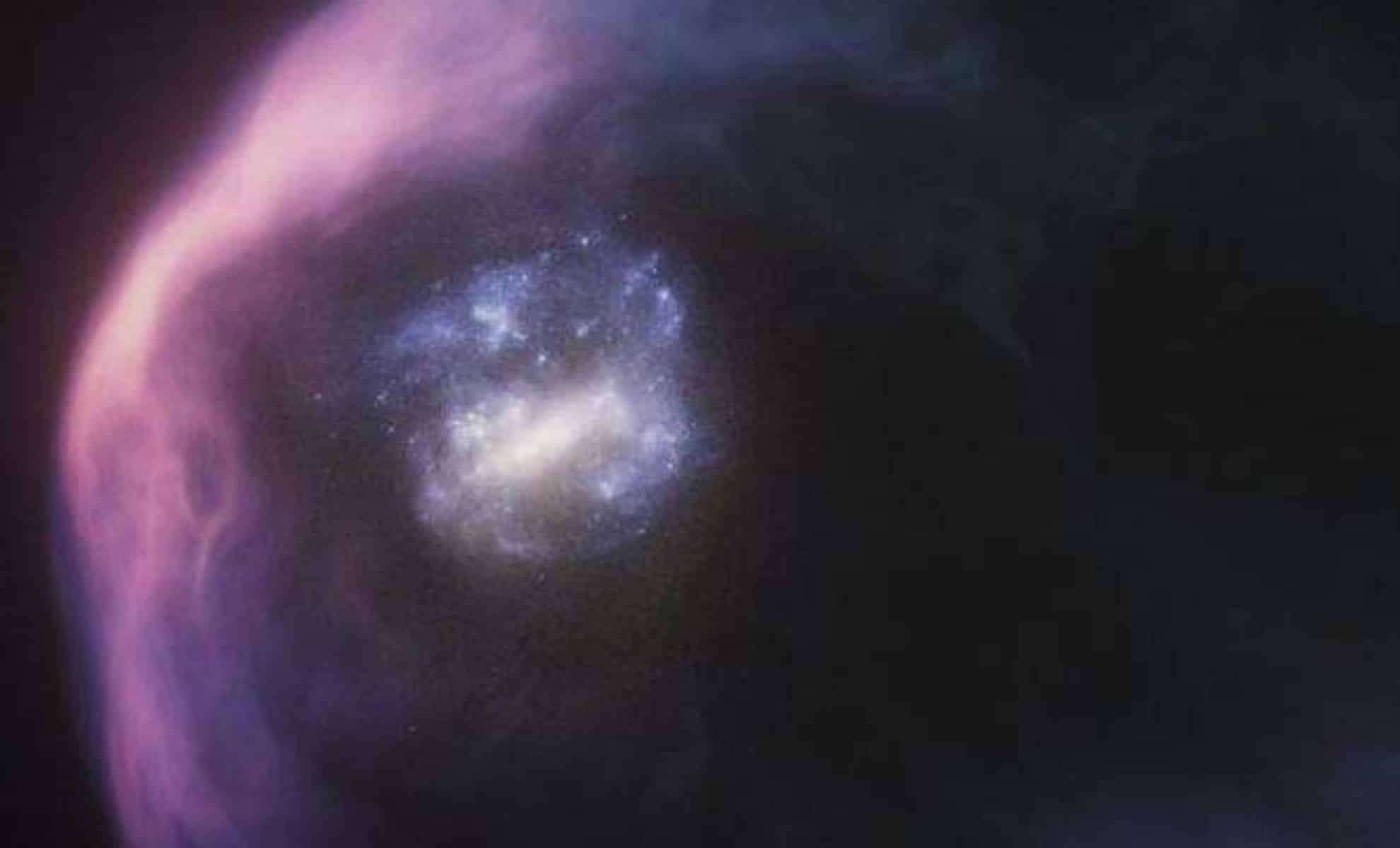
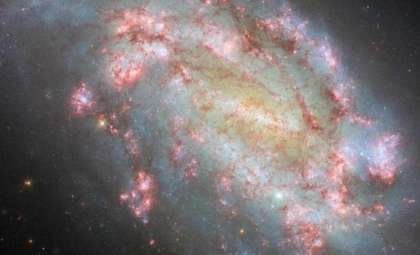
The Hubble Space Telescope, a collaboration between NASA and ESA, has unveiled remarkable details about the consequences of a close cosmic encounter between the Large Magellanic Cloud (LMC) and the gaseous halo enveloping the Milky Way. This intense interaction removed a significant portion of the LMC's surrounding gas, yet enough remained to continue nurturing star formation. As one of the Milky Way’s nearest galactic companions, the LMC provides an exceptional window into the complex dynamics of galaxy interactions. The observations underscore the dwarf galaxy’s endurance and shed light on the mechanisms that influenced galaxy formation in the early universe.
A Pivotal Encounter with Galactic Impact
The Large Magellanic Cloud, a bright dwarf galaxy visible in the southern hemisphere, recently traversed the dense outskirts of the Milky Way. This rare and transformative event, characterized by astronomers as a close flyby rather than a permanent orbit, significantly altered the LMC. The encounter triggered ram-pressure stripping, a process where the Milky Way's dense medium forces gas from the passing galaxy.
Ram-pressure stripping happens when a galaxy moving through a denser environment loses gas due to overwhelming pressure. “I picture the Milky Way like a gigantic hairdryer,” explains Andrew Fox, the study’s lead investigator. “As the LMC enters, it’s blowing gas away from it.” This interaction creates a vast, comet-like stream of gas following the LMC, which will eventually integrate into the Milky Way’s halo, enriching its material content.

Although the LMC shed much of its gaseous envelope, it managed to preserve a compact halo spanning about 50,000 light-years. This size is remarkably small compared to typical galactic halos of comparable mass, which are generally ten times larger. The LMC’s capacity to withstand this stripping illustrates the significance of its notable mass—approximately 10% that of the Milky Way.
Strength Amid Cosmic Disruption
Despite substantial gas loss, the LMC’s ability to maintain a dense halo speaks to its resilience and mass. Researchers caution that such endurance is exceptional. “The LMC is tough,” notes Fox. “Though a large amount of gas is gone, enough remains to sustain star creation. Smaller galaxies wouldn’t survive such loss—they’d only have old stars left.”
Preserving even a fraction of its halo offers critical clues about how galaxies cope with intense gravitational and environmental forces. Sapna Mishra, the study’s lead author, remarks, “Because of the Milky Way's vast halo, the LMC’s gas is compressed and quenched. Yet, due to its mass, the LMC still holds on to 10% of its halo.”
As the LMC moves further from the Milky Way, the gas it shed may eventually fall into our galaxy, potentially supplying fresh matter that could influence the Milky Way's star formation and other activities.
Hubble’s Vital Contribution to These Insights
The unique sensitivity of the Hubble Space Telescope to ultraviolet wavelengths was crucial for these discoveries. By observing 28 distant quasars, scientists were able to analyze how the LMC’s halo filtered this light, allowing them to measure the halo’s extent and characteristics precisely. Using Hubble’s sophisticated Cosmic Origins Spectrograph, astronomers gained an unprecedented perspective on the LMC’s structure and its interaction with the Milky Way.
As highlighted by Phys.org, this research provides vital new understanding of galaxy interactions, revealing how smaller galaxies can endure harsh cosmic events and continue evolving. “Hubble’s exclusive capabilities continue to drive cutting-edge discoveries,” states Carole Mundell, ESA’s director of science.
Looking Ahead to Further Galactic Studies
Following this breakthrough, astronomers plan to explore uncharted parts of the LMC’s halo, especially where it collides with the Milky Way’s halo. These regions, likened to “two balloons pushing against each other,” are sites of intense pressure and turbulence that could unlock additional knowledge about galactic interactions.
“Our new project targets five sightlines in the compressed area where the LMC’s and Milky Way’s halos meet,” shares Scott Lucchini, a co-author. “This will deepen our comprehension of the forces shaping these encounters.”
- Categories:
- News




0 comments
Sign in to Comment