

A global team of astronomers has utilized South Africa’s MeerKAT radio telescope to uncover a delicate, ring-shaped radio emission near the heart of the Milky Way.
This intriguing structure, named Kýklos—inspired by the Greek term for “circle”—stands out as a unique cosmic feature not previously documented. Its presence adds another perplexing phenomenon to the expanding catalog of unusual celestial formations and prompts fresh inquiries into their origin and properties.
Unveiling Kýklos: Discovery and Attributes
The team stumbled upon Kýklos unexpectedly while conducting a survey of the area surrounding the Galactic center. Positioned roughly six degrees off the Galactic plane near the center, the ring spans approximately 80 arcseconds in diameter and is about six arcseconds thick. MeerKAT's radio imaging reveals it as a near-perfect circular shell with a patchy, faint appearance and an empty interior, resembling a limb-brightened bubble.

Astronomers were captivated by Kýklos’s distinctive features. Lead author Cristobal Bordiu from the Catania Observatory in Italy remarked, “We report the serendipitous identification of a new radio-continuum ring-like object dubbed Kýklos (J1802–3353) using MeerKAT observations in the UHF and L-band.” This achievement was made feasible through MeerKAT’s exceptional sensitivity and resolution, enabling detection of subtle, diffuse radio sources previously inaccessible with older instruments.
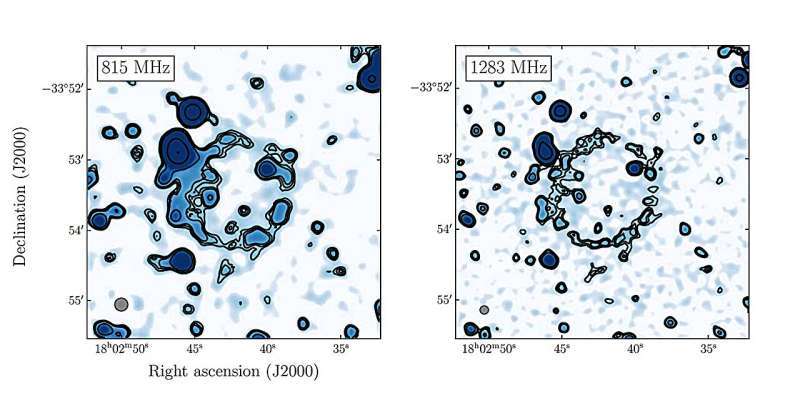
Although Kýklos shares superficial traits with other ring-like radio structures such as Odd Radio Circles (ORCs), it differs notably in key aspects. It appears closer to the Galactic plane compared to known ORCs and is considerably dimmer at 1.0 GHz with a flatter spectral profile. These distinctions hint that Kýklos may belong to a separate category of astronomical objects, offering potential new insights into the development and characteristics of such rings.
Exploring Potential Origins
The true genesis of Kýklos remains uncertain, sparking several theories among researchers. One idea proposes it as a supernova remnant, the expanding debris from a stellar explosion. Another possibility is that it could be a planetary nebula, created by the ejection of ionized gas as an aging star nears the end of its lifecycle. Additional scenarios include it being a nova remnant or a circumstellar shell surrounding a mature massive star.
Current data most strongly supports the hypothesis that Kýklos is a circumstellar shell encasing a Wolf-Rayet (WR) star. These stars are massive, emitting intense stellar winds that remove their outer layers. “Based on available observations, the morphology and spectral characteristics of Kýklos align most closely with those expected from a WR shell,” noted the research team. This theory is further bolstered by the lack of a visible central point source in the L-band data, consistent with WR shell characteristics.
The researchers emphasized Kýklos’s distinctive nature compared to previously detected objects: “Morphologically, Kýklos resembles an odd radio circle but resides at a much lower Galactic latitude than known ORCs. It’s also an order of magnitude fainter at 1.0 GHz and has a significantly flatter spectral index than the typical ORC population,” the study explains. This suggests that despite surface-level similarities, Kýklos may represent a distinct class of astrophysical object.
Future Research Plans
To clarify the origins of Kýklos and evaluate its potential link to a Wolf-Rayet star, astronomers intend to carry out extensive follow-up observations across various wavelengths. These studies will aim to detect any central source and provide deeper insight into its structure, composition, and formation mechanisms. The team underscores that continued research is vital for comprehending Kýklos and its broader implications for stellar life cycles and the Milky Way’s architecture.
The unveiling of Kýklos contributes to the growing roster of puzzling radio objects that challenge existing stellar evolution models and cosmic formation theories. As Cristobal Bordiu and colleagues forge ahead with their investigation, they aspire to unravel more about this captivating ring. “Follow-up multiwavelength observations are essential to fully characterize Kýklos and to detect a possible central engine that would validate the WR shell scenario,” the team concluded.
The discovery also accentuates the powerful capabilities of instruments like MeerKAT in advancing radio astronomy and paves the way for future breakthroughs that could redefine our view of the universe.
- Categories:
- Astronomy ,
- News













0 comments
Sign in to Comment