

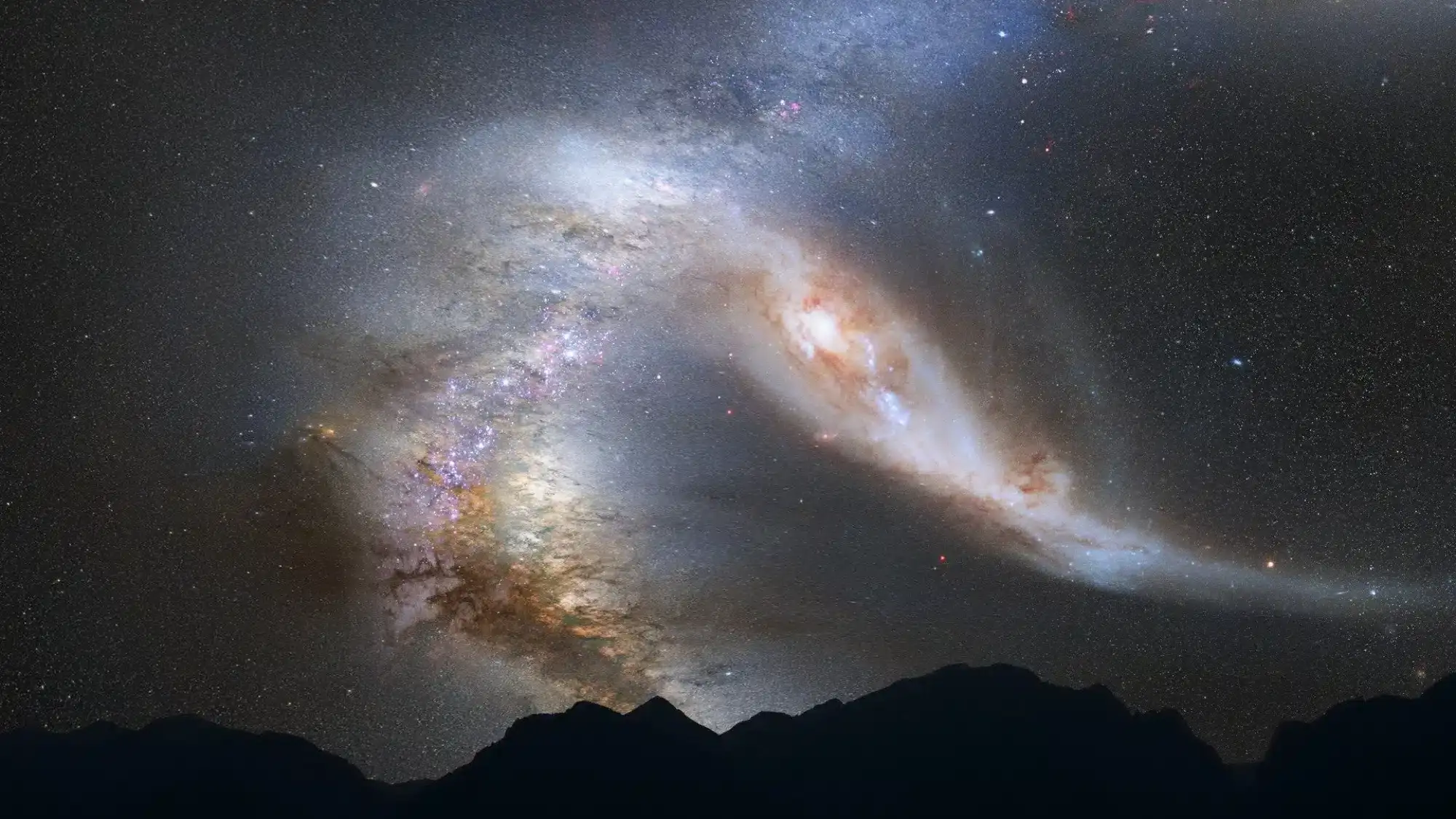
For years, scientists have anticipated that the Milky Way and Andromeda galaxies are set on a collision path, expected to occur in around 5 billion years.
This monumental galactic encounter was thought to be unavoidable, ultimately merging the two galaxies into an enormous elliptical galaxy often called Milkomeda.
Yet, new findings introduce a surprising possibility that this merger might not be a foregone conclusion.

Recent studies indicate there is now roughly a 50% probability that the Milky Way and Andromeda could narrowly miss each other instead of colliding. This uncertainty sparks fresh inquiries about the ultimate future of our galaxy and the consequences for Earth.
Approaching Andromeda: Collision or Near Encounter?
The Andromeda galaxy, situated approximately 2.5 million light-years from us, is hurtling toward the Milky Way at an impressive speed of about 68 miles per second (110 kilometers per second). Earlier projections indicated this speed would lead to a collision in nearly 5 billion years, merging both galaxies into a large, oval-shaped elliptical galaxy, changing cosmic structures and our night sky dramatically. However, recent simulations have challenged this expectation.
A recent publication headed by Till Sawala from the University of Helsinki suggests this collision might not be guaranteed. The gravitational influence of nearby galaxies like the Triangulum Galaxy (M33) and the Large Magellanic Cloud could alter the paths of the Milky Way and Andromeda enough to prevent them from merging completely. "There’s now approximately a 50% chance they will not combine," Sawala stated. Instead of colliding, these massive galaxies might just come close and continue on separate courses, rearranging their forms without fusing.
This unexpected conclusion highlights how complex galactic dynamics are and how subtle gravitational effects from neighboring galaxies can change the destiny of these vast systems. Astrophysicist Diego Muñoz of Northern Arizona University emphasized, "Minor errors or incorrect assumptions can grow over time, causing large deviations from our original forecasts."
Implications of a Galactic Collision on Earth
Should the Milky Way and Andromeda collide, what impact might this have on Earth? Thankfully, on the scale of such enormous cosmic events, our solar system would likely experience little disruption. Galactic space is mostly empty, and the vast distances between stars make direct impacts exceedingly rare. Sally Dodson-Robinson, a planetary scientist from the University of Delaware, assures that "The solar system will probably remain nearly unaffected." She explained that stars and their planetary systems would largely continue their orbits undisturbed despite the galaxies merging, due to the immense voids separating them.
Nevertheless, the merger would cause dramatic internal changes in both galaxies. Colliding clouds of gas could ignite new waves of star formation, illuminating patches of the merged galaxy. These stellar nurseries might produce breathtaking celestial spectacles potentially visible on Earth if life endures billions of years from now. According to Nelson Caldwell, an astronomer at the Center for Astrophysics Harvard & Smithsonian, "There will definitely be some cosmic fireworks" accompanying this galactic union.
Importantly, gravitational forces during the merger could shift the position of the solar system within the new galaxy. Our Sun and planets might be relocated from their current place in the Milky Way’s spiral arm. "The Sun could be situated much farther from the core of the newly formed elliptical galaxy," Muñoz explained. While this repositioning would modify our cosmic surroundings, the solar system’s internal structure should remain stable.
Galactic Destiny and Earth's Cosmic Journey
While the idea of a Milky Way-Andromeda collision may be alarming, it’s worth remembering this process will take billions of years—well beyond the span of humanity’s existence. By that time, Earth itself might no longer support life. In roughly 5 billion years, the Sun is anticipated to swell into a red giant, possibly engulfing Earth or evaporating its waters, making it uninhabitable. As Muñoz observed, "The aging Sun will be the bigger concern then."
Still, the long-term interaction between these two galaxies remains a subject of intense scientific interest. Being the largest members of the Local Group of galaxies bound by gravity, decoding their merger dynamics informs astronomers about galactic evolution across the cosmos.
The new research currently undergoing peer review estimates a 50% likelihood that Milky Way and Andromeda galaxies might never collide. Should this occur, they’ll likely continue on separate paths, narrowly avoiding the cataclysmic event once expected. This uncertainty serves as a reminder of the universe’s ever-changing nature and Earth’s modest role within it.
- Categories:
- Astronomy ,
- Science ,
- Space





0 comments
Sign in to Comment