
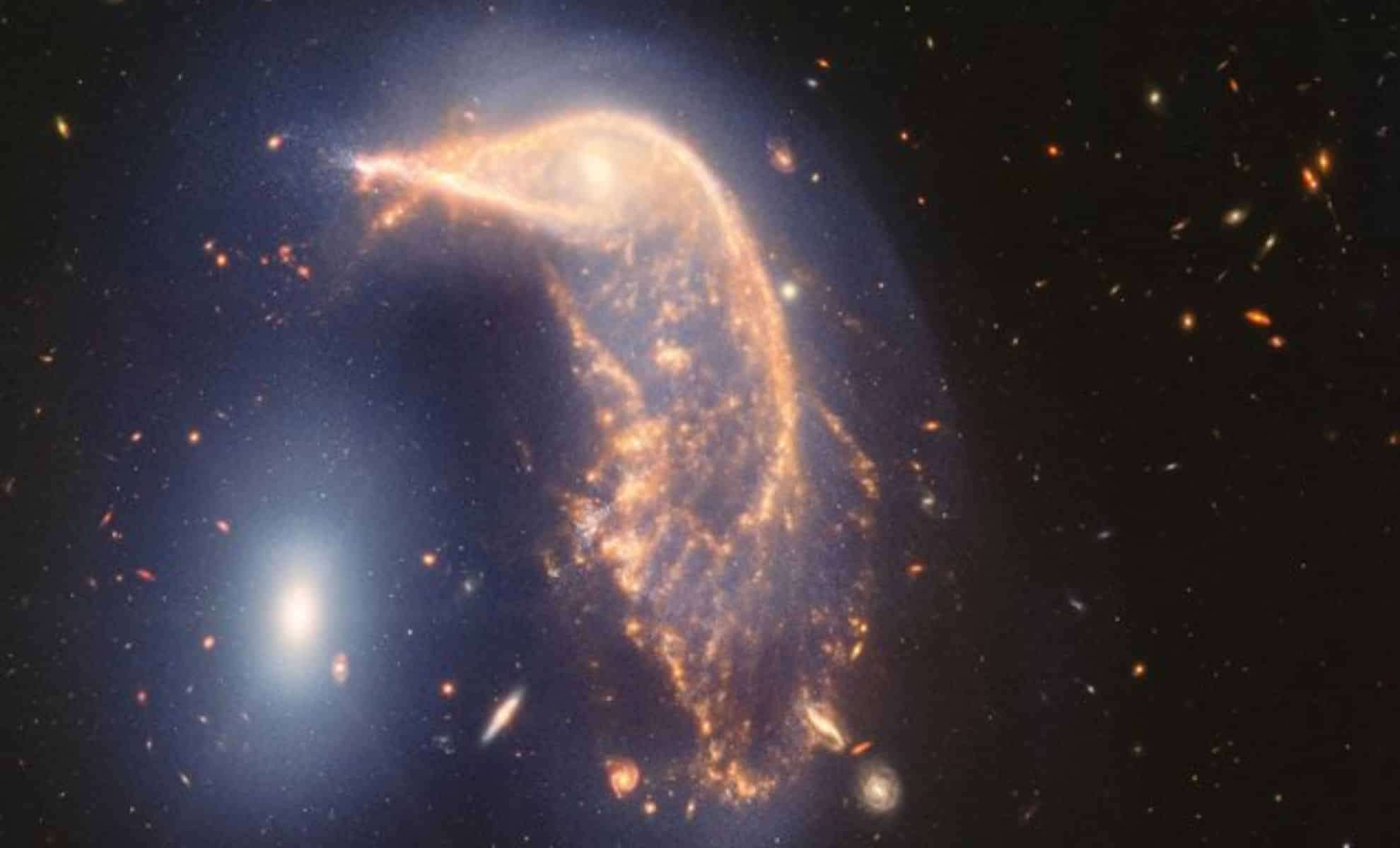
NASA’s James Webb Space Telescope has delivered a striking image capturing the merging of two galaxies, collectively known as Arp 142, in a magnificent celestial collision.
Released to celebrate the telescope’s second year of operation, this remarkable photo highlights Webb’s extraordinary ability to explore the depths of the cosmos and unravel its secrets.
The Penguin and the Egg: A Galactic Encounter
The snapshot showcases two galaxies affectionately dubbed "the Penguin and the Egg" because of their distinctive formations. The Penguin, a warped spiral galaxy, seems to be shielding the Egg, an elliptical companion positioned closely adjacent. These galaxies reside approximately 326 million light-years away in the Hydra constellation. According to NASA, their interaction started between 25 and 75 million years ago, with a full merger predicted to occur over the span of several hundred million years.

We’re celebrating two years of science for @NASAWebb! 🎉
The second anniversary image from the largest telescope in space shows two interacting galaxies called the Penguin (NGC 2936) and the Egg (NGC 2937), entwined in a slow cosmic dance: https://t.co/x4GImWwTRw pic.twitter.com/po60sNkQQN
— NASA (@NASA) July 12, 2024
Webb’s Near-Infrared Camera (NIRCam) and Mid-Infrared Instrument (MIRI) have exposed fine details of this cosmic interaction. The Penguin’s spiral arms, once orderly, have been gravitationally stretched and contorted due to its interaction with the Egg, producing an arresting and dynamic visual panorama. NASA Administrator Bill Nelson remarked, “Webb’s extraordinary images from the far reaches of the universe, nearing the dawn of time, illuminate our cosmic environment and ignite the curiosity of astronomers, scientists, and future explorers.”
Why Galactic Collisions Matter to Science
The union of the Penguin and the Egg galaxies offers more than just an awe-inspiring spectacle; it opens a window into the processes behind how galaxies evolve and stars form. The gravitational tug-of-war causes gas and dust in the galaxies to collide, triggering intense periods of star birth.
These new stars glow brightly across the galaxies, especially within the Penguin’s extended spiral arms and trailing features. Moreover, these interactions foster stellar nurseries where dense regions rich in carbon molecules nurture the emergence of fresh stars.
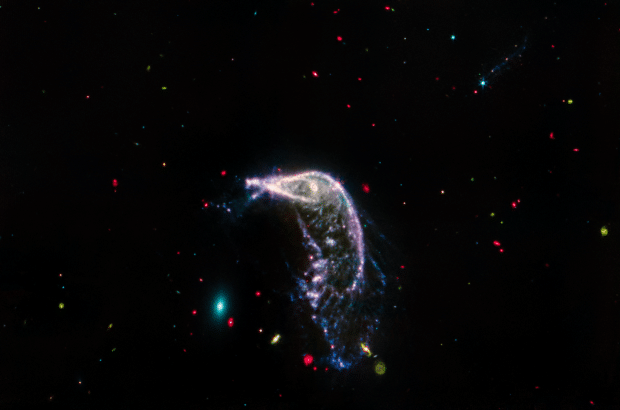
The Egg galaxy, which harbors older stars along with relatively sparse amounts of gas and dust, maintains its structural integrity with less alteration. This contrast with the more disturbed Penguin provides a fascinating lens on how varying galactic compositions respond to cosmic collisions. NASA’s immersive visualization lets viewers virtually explore this extraordinary interaction. In the image, a blueish glow signifies a blend of stars and interstellar gas, highlighting the physical connection between these two galaxies.
Revolutionizing Space Insight with Webb
The James Webb Space Telescope, an international initiative involving NASA, the European Space Agency, and the Canadian Space Agency, has transformed our cosmic perspective since launching on December 25, 2021. Orbiting roughly 1 million miles from Earth, Webb surveys the universe in infrared wavelengths, invisible to the naked eye. This allows it to see through cosmic dust clouds that obscure other observatories, unveiling hidden objects and intricate formations.
Mark Clampin, director of NASA’s Astrophysics Division, noted, “Webb brings new understanding to longstanding mysteries about the early cosmos, opens pathways to exploring distant worlds, delivers images that captivate global audiences, and ignites new scientific questions.”
With its remarkable sensitivity and precision, Webb can identify molecules in exoplanet atmospheres and detail the elaborate mechanisms of star and galaxy formation. Its ongoing observations—including the comprehensive study of the Penguin and the Egg galaxies—promise to deepen human knowledge of the universe for decades to come.
- Categories:
- Astronomy ,
- News ,
- Space ,
- Nasa ,
- Aircraft




0 comments
Sign in to Comment