
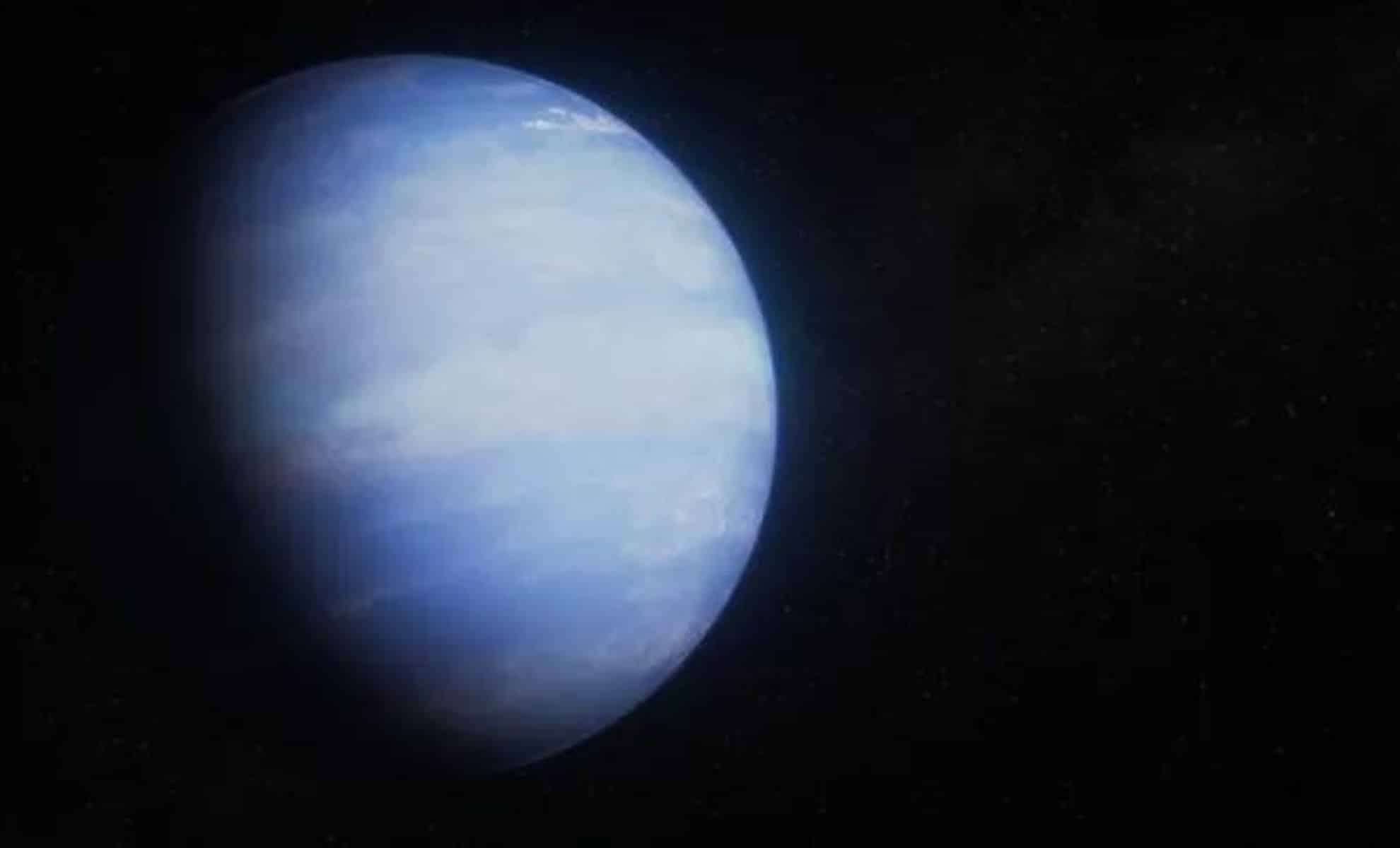
Data from the James Webb Space Telescope (JWST) has revolutionized our comprehension of the peculiar exoplanet WASP-107 b, exposing the causes behind its remarkably low density.
This revelation represents a major advance in unraveling the processes behind planet development and structural changes, prompting revisions to existing models while providing fresh explanations for the planet’s extraordinary traits.
Unraveling the Enigma of WASP-107 b
WASP-107 b has captured scientific interest ever since its identification in 2017 by the Wide Angle Search for Planets (WASP) project. Situated around 210 light-years away within the constellation Virgo, this so-called “warm Neptune” orbits its host star at an incredibly close 5 million miles, completing one revolution every 5.7 days. Despite this tight orbit, WASP-107 b experiences moderate temperatures alongside an exceptionally low density, likened to that of a fluffy marshmallow warmed in a microwave.

The planet’s anomalously low density defies classical planetary formation theories. While its size approaches 80% of Jupiter’s volume, its mass is under 10% of Jupiter’s, ranking it among the least dense exoplanets discovered. This odd combination raised a critical question: How could WASP-107 b sustain such an enormous gaseous layer with a modest rocky core, and remain so inflated without a continual energy source?
Revolutionary Findings from New Observations
Two separate research groups have addressed this puzzle by analyzing observations from the JWST alongside earlier measurements from the Hubble Space Telescope. Their key discovery was the markedly low abundance of methane gas in WASP-107 b‘s atmosphere—approximately one-thousandth of the expected amount based on temperature models.
Methane generally becomes unstable under elevated temperatures, indicating that the planet’s interior heat is far higher than earlier estimations suggested. This points to tidal heating—generated by gravitational forces caused by the planet’s slightly elliptical orbit—as the main contributor to its bloated state. Similar to how the Moon’s gravitational influence induces tides on Earth, the varying distance between WASP-107 b and its star continuously flexes and heats the planet internally.
Advanced Atmospheric Composition Studies by JWST
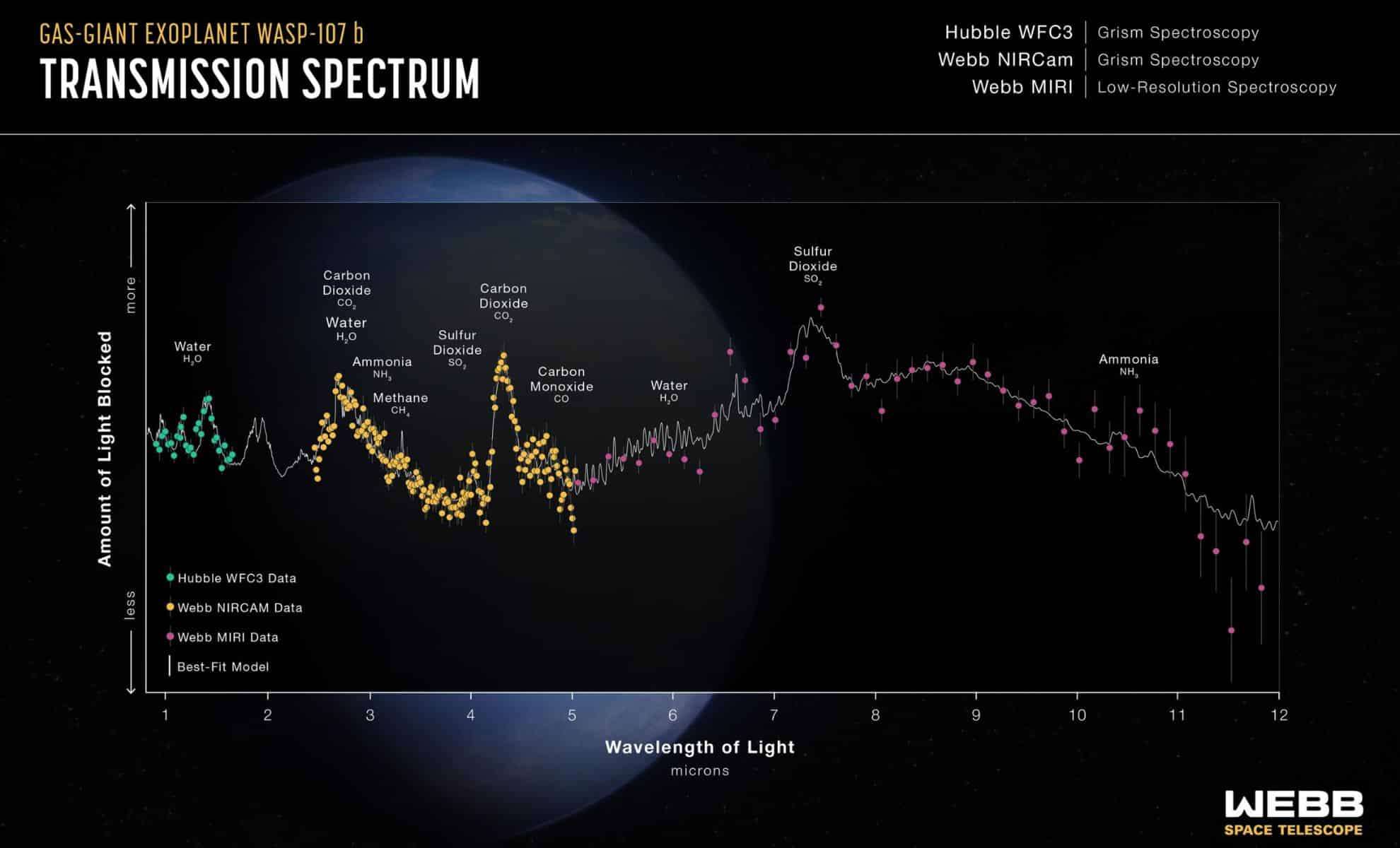
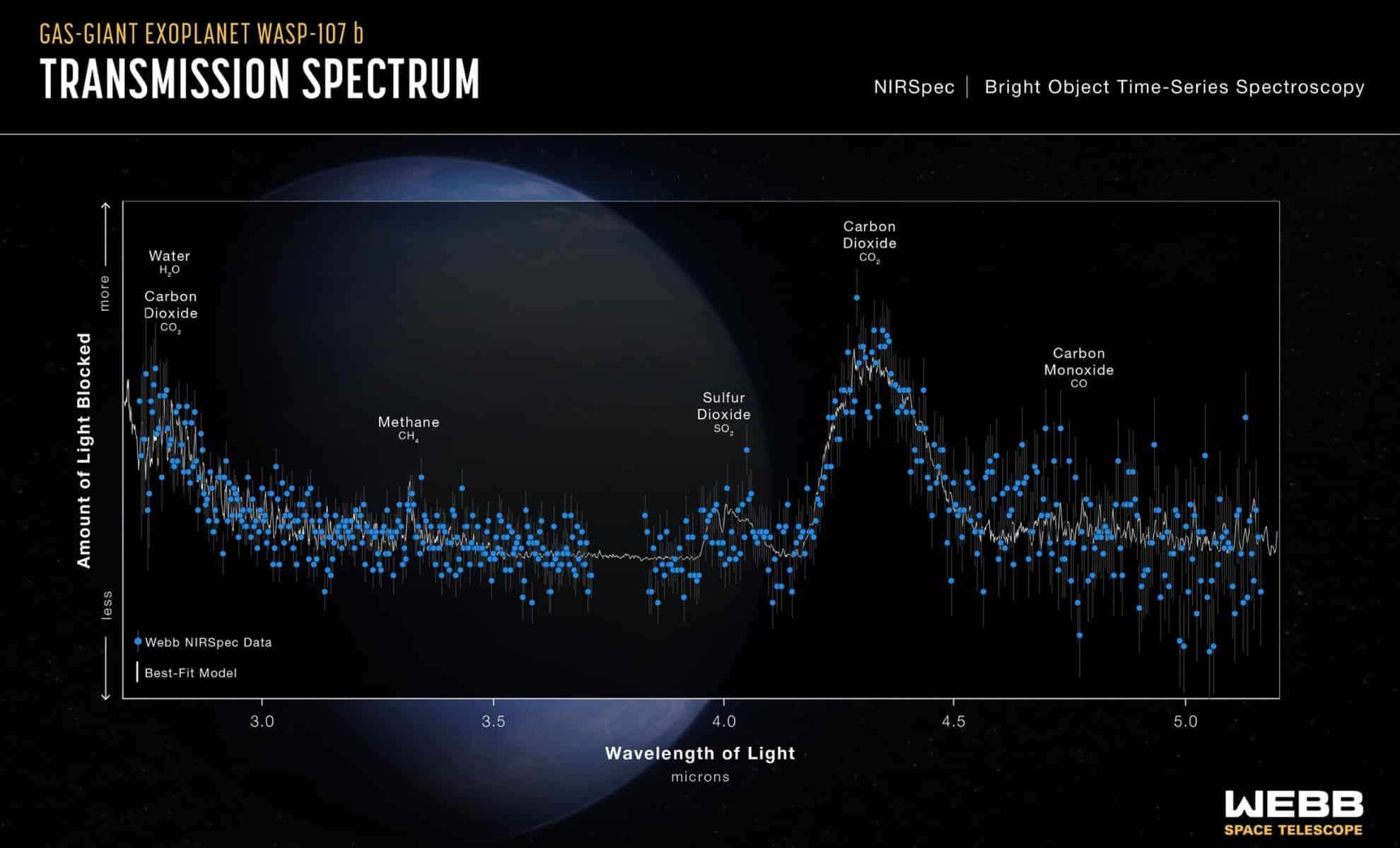
The JWST instruments facilitated an unprecedentedly detailed examination of WASP-107 b’s atmospheric composition through transmission spectroscopy. By observing the system before, during, and after the planet transits the star, scientists measured light filtering through the atmosphere, identifying gases via their unique absorption fingerprints.
Combining JWST data with Hubble’s coverage, the resulting transmission spectrum revealed clear signatures of water vapor (H2O), carbon dioxide (CO2), carbon monoxide (CO), sulfur dioxide (SO2), and ammonia (NH3). This broad spectral range, from optical to mid-infrared wavelengths, represents the most comprehensive atmospheric characterization yet achieved for any exoplanet, with ammonia detected in an exoplanet for the first time by a space telescope.
The Role of Tidal Heating Explained
The research highlights tidal heating as a critical factor sustaining WASP-107 b’s extended atmosphere. The planet’s elliptical orbit leads to constant gravitational deformation, producing significant internal thermal energy that blocks atmospheric contraction. This heat also impacts chemistry by suppressing methane while elevating other carbon-containing compounds.
This mechanism offers a new perspective for interpreting the inflated sizes of many low-density exoplanets, removing the need for extraordinary formation scenarios and suggesting tidal heating might widely influence atmospheric structures.
Revised Insights on Core Mass and Origin
Another notable result is the adjusted estimation for WASP-107 b’s core mass. The presence of strong internal heating and atmospheric mixing implies the planet’s core is heavier than initially estimated.
These findings imply that WASP-107 b likely formed similarly to Neptune—with a sizable rocky nucleus and a moderate gaseous envelope—rather than forming with an unusually small core that somehow attracted a massive gas layer. Its current swollen atmosphere is probably a consequence of subsequent tidal heating.
Looking Ahead: The Future of Exoplanet Exploration
The insights from WASP-107 b underscore JWST’s profound capabilities for probing distant worlds’ atmospheres and internal properties. Precise detection of a wide variety of gases enables researchers to reconstruct temperature profiles, compositions, and evolutionary histories with unprecedented detail.
As the JWST mission continues, more groundbreaking revelations about exoplanet features and origins are anticipated. Observations such as those of WASP-107 b represent just the opening chapter in a major leap forward for exoplanet science.
- Categories:
- Astronomy ,
- News ,
- Space ,
- Physics












0 comments
Sign in to Comment