
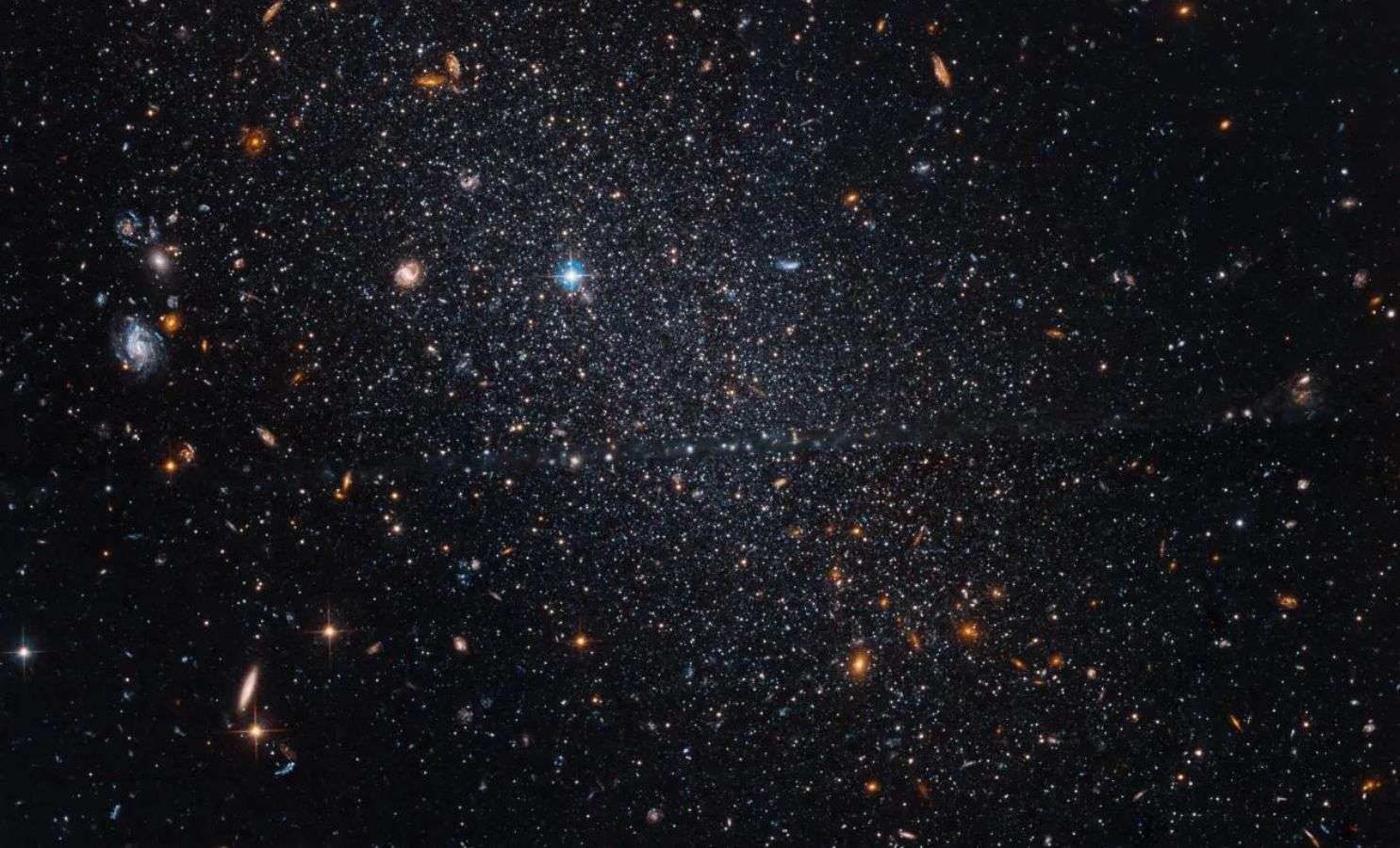
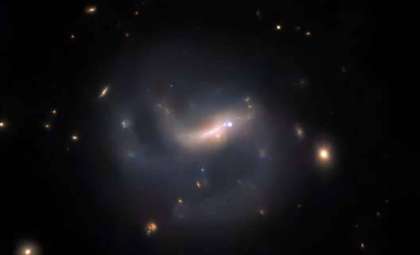
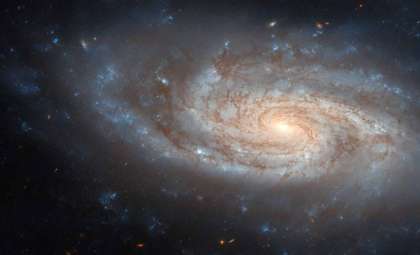
NASA’s Hubble Space Telescope has once again expanded the horizons of space observation by capturing an intricate image of the Tucana Dwarf galaxy, a dim and solitary galaxy within our Local Group, which also contains the Milky Way.
Situated around 3 million light-years away from our planet, the Tucana Dwarf galaxy was first identified in 1990 by astronomer R.J. Lavery. It stands out due to its remarkable isolation, residing on the outskirts of the Local Group at about 3.6 million light-years from the cluster’s center of mass.
Because of its remote location, the Tucana Dwarf has been nicknamed a “solitary beacon in the vast darkness,” an apt title for a galaxy largely free from the gravitational disturbances experienced by more centrally situated galaxies.

Peering Into a Pristine Cosmic Relic
The Tucana Dwarf galaxy holds special importance for astronomers due to its seclusion and largely unaltered nature. Unlike many galaxies that have experienced frequent mergers and stellar mixing through interactions, the Tucana Dwarf has remained mostly undisturbed.
In this way, it acts as a cosmic time capsule, maintaining features that provide clues about the dawn of galaxy formation and development. Classified as a dwarf spheroidal galaxy, Tucana Dwarf is significantly smaller and less bright than its neighbors, hosting predominantly old stars that give it a faint, subdued glow.
NASA explains, “Dust is sparse, and the stellar population skews towards the older range, giving them a dimmer look.” This composition enables researchers to explore a galaxy that has developed in isolation, offering a clearer understanding of the early universe’s mechanisms.
The far-flung position of the Tucana Dwarf within the Local Group likely results from a dramatic past event. Researchers suggest that it was propelled to its current remote orbit following a close interaction with the Andromeda galaxy roughly 11 billion years ago.
Through this gravitational encounter, the Tucana Dwarf could have been flung away from the dominant celestial forces of bigger galaxies, leading its independent evolution on the fringes of the Local Group. This seclusion has helped preserve its original characteristics, making it an extraordinary subject for studying early cosmic conditions.
Revealing the Universe’s Formative Epoch
The Hubble team is eager about the potential of the Tucana Dwarf galaxy to illuminate the epoch of reionization, a defining era in the universe’s timeline when the first stars and galaxies ignited, emerging from the primordial fog left after the Big Bang.
This transformative period, around 13 billion years ago, marked the shift from a dark, obscured cosmos to one brightened by nascent starlight. By examining the composition, structural details, and star formation of the Tucana Dwarf, astronomers aim to trace back galaxy evolution to these foundational moments, enriching our knowledge of how galaxies like the Milky Way were born.
The detailed images captured by Hubble’s Advanced Camera for Surveys and Wide Field and Planetary Camera 2 reveal the distant stars of Tucana Dwarf with great clarity. These observations not only uncover its ancient past but also suggest how dwarf galaxies such as Tucana contributed to the birth and growth of larger galaxies over cosmic epochs.
Dwarf galaxies are believed to be fundamental units that merged over billions of years to create massive galaxies. Studying Tucana provides valuable insights into this building-block role and the broader narrative of galactic assembly.
An Enduring Instrument of Discovery
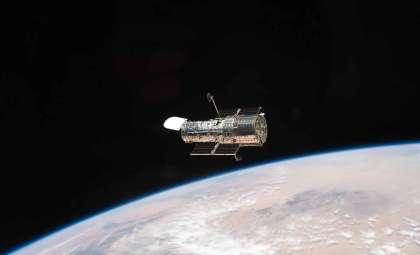
Since its debut in 1990, the Hubble Space Telescope has led astronomical discoveries, generating over 1.6 million observations and supporting more than 21,000 scientific papers. It has transformed our cosmic perspective, from detecting exoplanets to advancing knowledge of galaxy formation and universal expansion.
John Grunsfeld, an astronaut who took part in several Hubble maintenance missions, emphasized the telescope’s impact: “Hubble is not just a satellite. It’s a symbol of humanity’s quest for knowledge.”
Even with the launch of the more sophisticated James Webb Space Telescope, Hubble remains crucial in astronomical research. NASA anticipates Hubble will continue functioning into the 2030s before eventually reentering and burning up in Earth’s atmosphere.
Until that time, Hubble will persist in capturing the faint illumination of remote galaxies like the Tucana Dwarf, expanding our understanding of the cosmos. Its extraordinary ability to observe distant, isolated galaxies ensures it will be a vital scientific tool for years ahead.
Ongoing research on Tucana and similar lonely galaxies promises to deepen our grasp of the early universe, refining galaxy formation theories. As Hubble perseveres in its mission, it stands as a testament to the remarkable achievements of space exploration and the boundless frontiers awaiting discovery.
- Categories:
- Astronomy ,
- News ,
- Space ,
- Nasa




0 comments
Sign in to Comment