
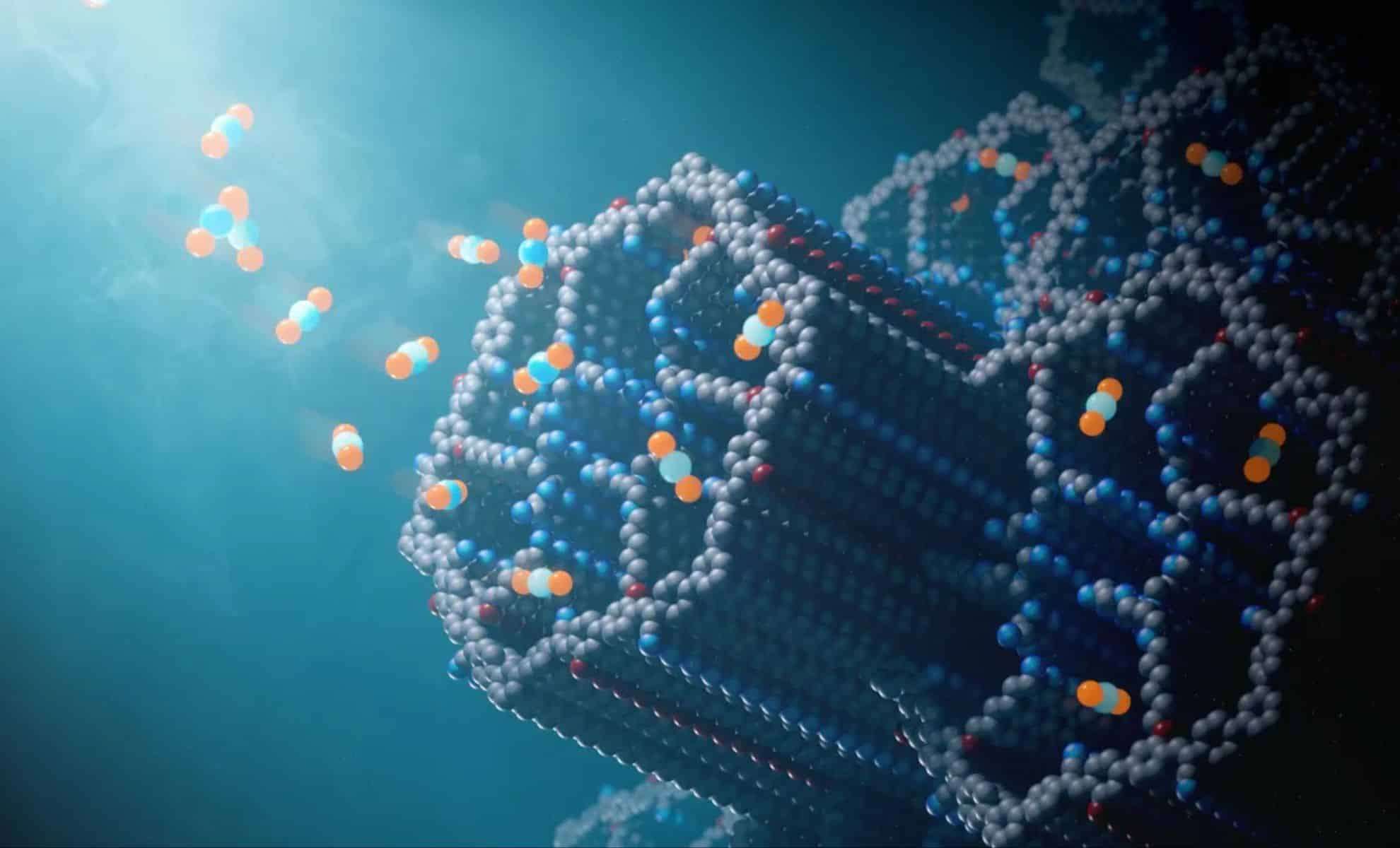
Researchers at UC Berkeley have unveiled a novel material that could revolutionize carbon dioxide capture methods.
Termed covalent organic framework-999 (COF-999), this substance is designed to extract CO2 directly from the atmosphere, tackling one of the key challenges in mitigating climate change. Unlike current technologies optimized for environments with high CO2 levels, COF-999 operates effectively in normal air conditions, representing a significant leap toward curbing greenhouse gas emissions.
The Mechanism Behind COF-999’s Carbon Capture
COF-999’s success lies in its distinctive porous architecture that enables CO2 adsorption at ambient temperatures. It features hexagonal channels lined with amine groups, which bind CO2 molecules as air circulates through the material. This mechanism seizes carbon dioxide without requiring the high temperature or pressure conditions typical of conventional carbon capture technologies.

Professor Omar Yaghi, a principal investigator on the project, shared, “We simply placed a powder of this material inside a tube and passed outdoor air from Berkeley through it, and the results were remarkable. It removed all detectable CO2.” He emphasized, “Its performance is unprecedented, setting a new benchmark for addressing climate change.”
Experimental data indicates that 200 grams of COF-999 can capture as much as 20 kilograms of CO2 annually, roughly matching the carbon absorption capacity of a mature tree. This capability positions the material as a valuable tool in direct air capture efforts aimed at returning atmospheric CO2 levels to conditions seen a century ago.
Durability and Performance of COF-999 in Carbon Removal
COF-999 is notable for its exceptional resilience and recyclability. According to Yaghi, it can endure over 100 cycles of CO2 uptake and release without performance degradation. In contrast to other materials that deteriorate or require significant energy for regeneration, COF-999 maintains its efficiency across many uses.
The team devoted two decades to developing COF-999, ensuring it withstands aggressive conditions including exposure to moisture, sulfur compounds, nitrogen oxides, and other contaminants that often degrade porous materials. This toughness makes it viable for deployment in real-world carbon capture systems that face diverse environmental stressors.
Zihui Zhou, the study’s lead author and a UC Berkeley graduate student, stressed the importance of this innovation in combating the climate emergency. “While capturing emissions at their source helps slow climate change, direct air capture enables us to actively reduce excess atmospheric CO2, potentially reversing over a century of accumulation,” Zhou remarked.
Due to its stability and low energy requirements, COF-999 is well-suited for large-scale carbon capture initiatives. Professor Yaghi noted, “This framework possesses a chemically and thermally robust backbone, requiring minimal energy input, and stands out as unmatched in retaining its capacity after numerous cycles.”
Addressing the Hurdles of Direct Air Capture
Removing CO2 from ambient air poses a significant technical challenge because of the gas’s relatively low concentrations outside industrial emissions. Most carbon capture solutions are tailored to power plants or factories where CO2 is concentrated in exhaust streams. Capturing carbon from open air has traditionally demanded much greater energy and expense.
Atmospheric CO2 is currently around 420 ppm, roughly 50% above pre-industrial levels. Zhou pointed out that by the time direct air capture is widely adopted, levels may reach 500 to 550 ppm. Developing scalable technologies like COF-999 is crucial not only to slow the rise but to actively draw down existing CO2 concentrations.
COF-999 offers a cost-efficient and scalable approach to atmospheric carbon removal. Integrating this material into current carbon capture systems could enable industries to help reverse global warming trends.
Prospects for Scaling and Future Research
While COF-999 marks an important milestone, further development is needed before widespread adoption. Key tasks include scaling up production for industrial use and enhancing carbon capture efficacy. The research team plans to apply machine learning to optimize the material’s design and lower manufacturing costs.
The Intergovernmental Panel on Climate Change (IPCC) underscores the growing necessity of carbon removal technologies. Though emission reduction remains critical, direct air capture could be a vital complement to lower present atmospheric CO2 levels.
Professor Yaghi concluded, “COF-999 is currently the most promising material for direct air capture, but continual innovation and improvements will be essential to realize its full potential in mitigating climate change.”
- Categories:
- News ,
- Science ,
- Climate change ,
- Physics











0 comments
Sign in to Comment