
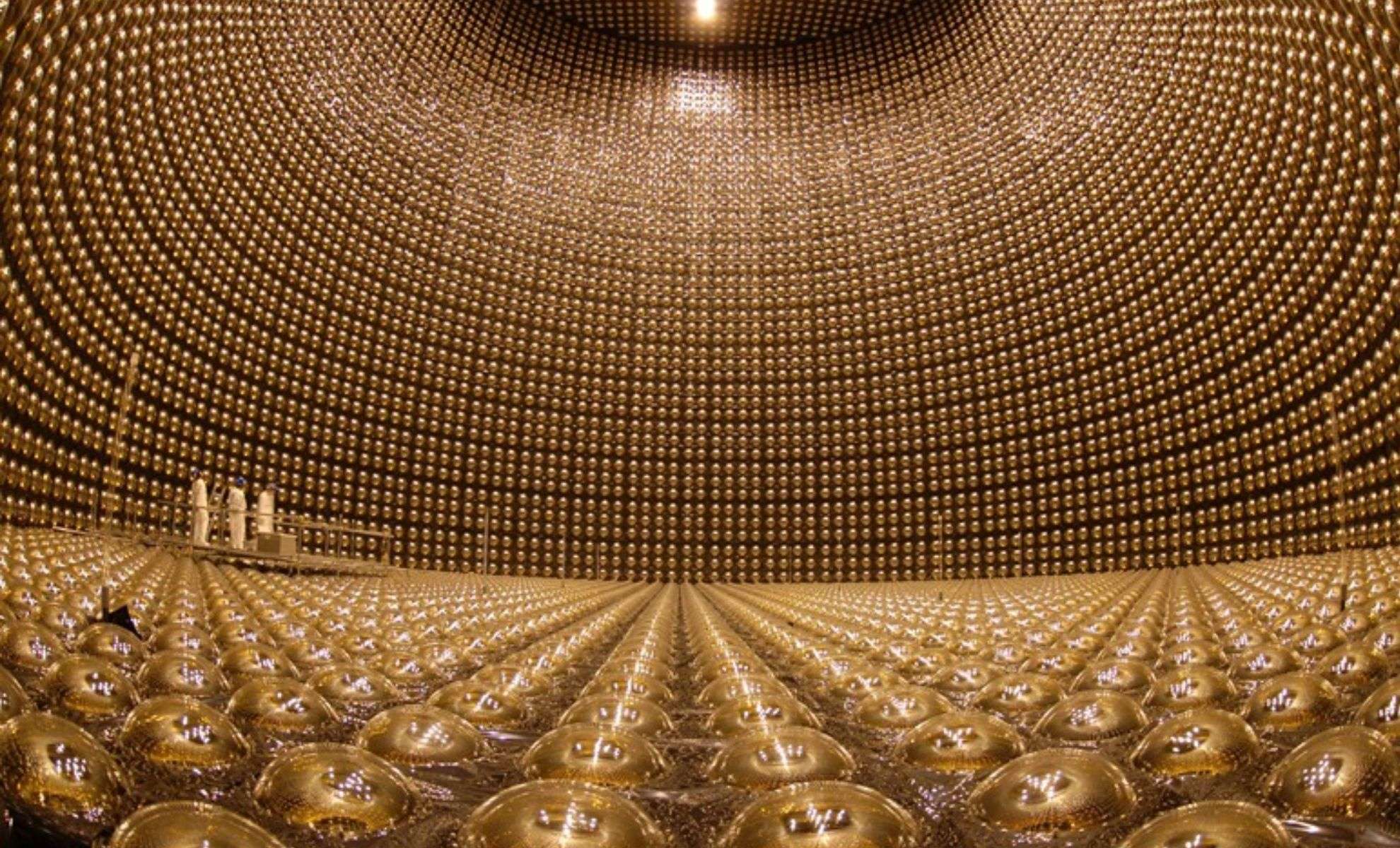
Deep beneath Mount Ikeno in Japan lies the remarkable Super-Kamiokande detector, an enormous facility rivaling the size of a 15-story building. This groundbreaking instrument is designed to identify some of the universe’s most elusive particles – neutrinos.
Exploring the Mysterious Neutrino
Neutrinos are tiny subatomic particles that speed through space almost at light speed and effortlessly pass through solid objects without interaction.
Astrophysicist Neil deGrasse Tyson famously described these particles as “the most elusive prey in the cosmos.”

Their elusive nature makes detecting neutrinos an extraordinary challenge, as they leave almost no trace when traveling through matter.
Tyson also highlights, “Matter is virtually transparent to neutrinos. They can journey uninterrupted through a hundred light-years of steel without losing speed.”
Despite their invisibility, neutrinos provide invaluable insights into some of the universe’s most violent occurrences, such as supernova explosions, marking the catastrophic ends of massive stars.
Dr. Yoshi Uchida of Imperial College London explains, “In the event of a supernova where a star collapses and forms a black hole, instruments like Super-Kamiokande are among the few capable of detecting the neutrinos emitted.”
Prior to a stellar collapse, stars emit a flood of neutrinos, which Super-Kamiokande can detect, serving as an early alert system for such cosmic phenomena.
The neutrino is the most abundant particle in the universe – but also the most elusive. Finding neutrinos requires large, complicated experimental set-ups like the Super-Kamiokande detector, which is located beneath Mount Ikeno in Japan and the result of an international… pic.twitter.com/R7AVFVnVuX
— The Nobel Prize (@NobelPrize) March 9, 2025
A Closer Look at the Super-Kamiokande Facility
Super-Kamiokande is more than just a gigantic underground chamber. Positioned 1,000 meters below ground, it provides an optimal environment specifically designed for neutrino detection.
The detector holds approximately 50,000 tons of ultra-purified water, which plays an essential role in capturing neutrino interactions.
As neutrinos travel faster than light’s speed in water, they generate a distinctive flash of light called Cherenkov radiation while passing through.
The core of Super-Kamiokande’s detection power lies in its lining of nearly 11,000 advanced Photo Multiplier Tubes (PMTs). These sensitive devices detect the faint Cherenkov light signals.
Dr. Uchida illustrates this effect: “When an aircraft exceeds the speed of sound, it creates a shockwave; similarly, a particle moving faster than light’s speed in water produces a light shockwave.”
The Critical Importance of Ultra-Pure Water
The water inside the Super-Kamiokande tank is extraordinarily clear and chemically pure to a remarkable degree.
Dr. Uchida warns that this water is highly reactive, possessing qualities of both acids and bases.
Its extreme purity allows it to dissolve metals readily, and even minimal contamination can disrupt the precise measurements needed for accurate neutrino detection.
The ultra-pure water is so aggressive that it can strip nutrients from organic materials over time.
Dr. Matthew Malek, a scientist at the University of Sheffield, recounts a personal experience during maintenance: “At 3 a.m., I woke up with the most intense scalp itch I have ever experienced. It was unbearable.”
He later realized the water had absorbed nutrients from his hair, explaining, “It had drawn out nutrients from the tips of my hair.”
Super-Kamiokande’s Role in Stellar and Particle Physics
The capabilities of Super-Kamiokande are not limited to capturing neutrinos from supernovae. It is central to the T2K experiment, where neutrinos are shot across Japan to investigate oscillation behavior as they interact with matter.
Dr. Morgan Wascko from Imperial College London comments, “According to big bang predictions, matter and antimatter should have been formed equally, yet most antimatter has vanished.”
Super-Kamiokande has provided the strongest experimental evidence to date showing that matter and antimatter behave differently, shedding light on why matter dominates the cosmos.









0 comments
Sign in to Comment