
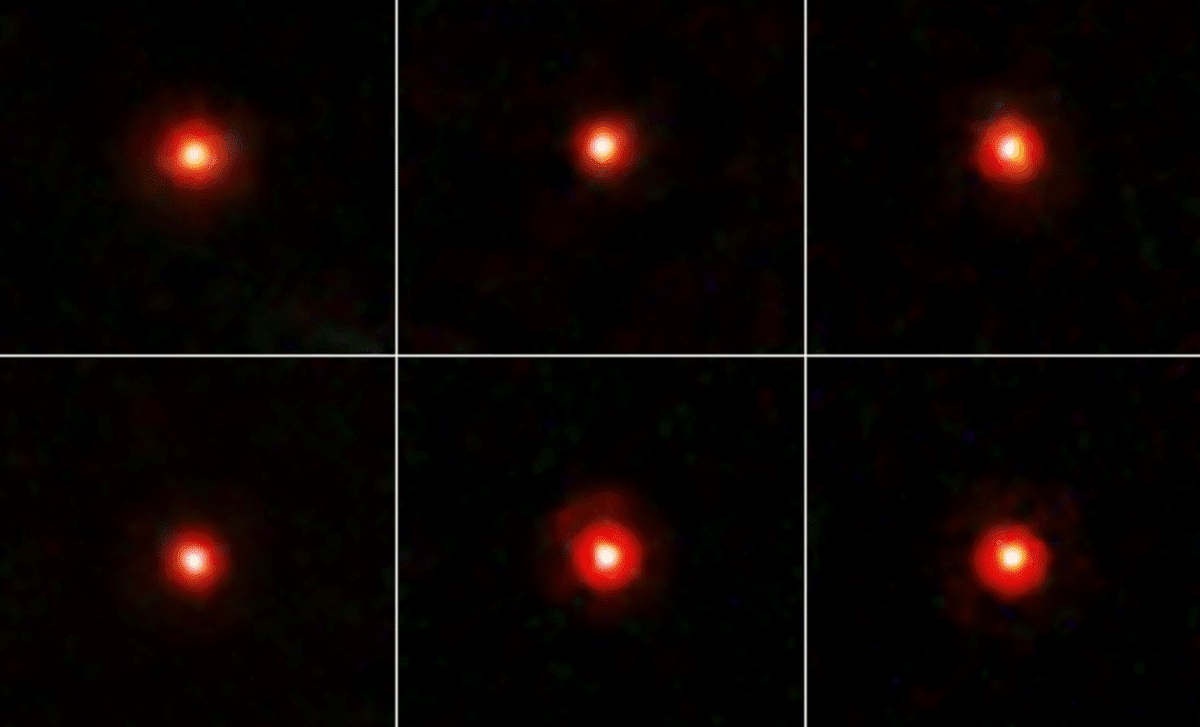
The James Webb Space Telescope (JWST) is transforming our understanding of the cosmos, uncovering galaxies from the Universe’s infancy. Among its remarkable discoveries are tiny, vibrantly red points known as “Little Red Dots” (LRDs). These compact celestial bodies have sparked diverse hypotheses regarding their composition and origin. While some researchers believe they might be a new class of galaxies, others suggest they could be the precursors to black holes. In this article, we explore the scientific discussions and investigations about these intriguing cosmic features.
A Window into the Universe’s Dawn
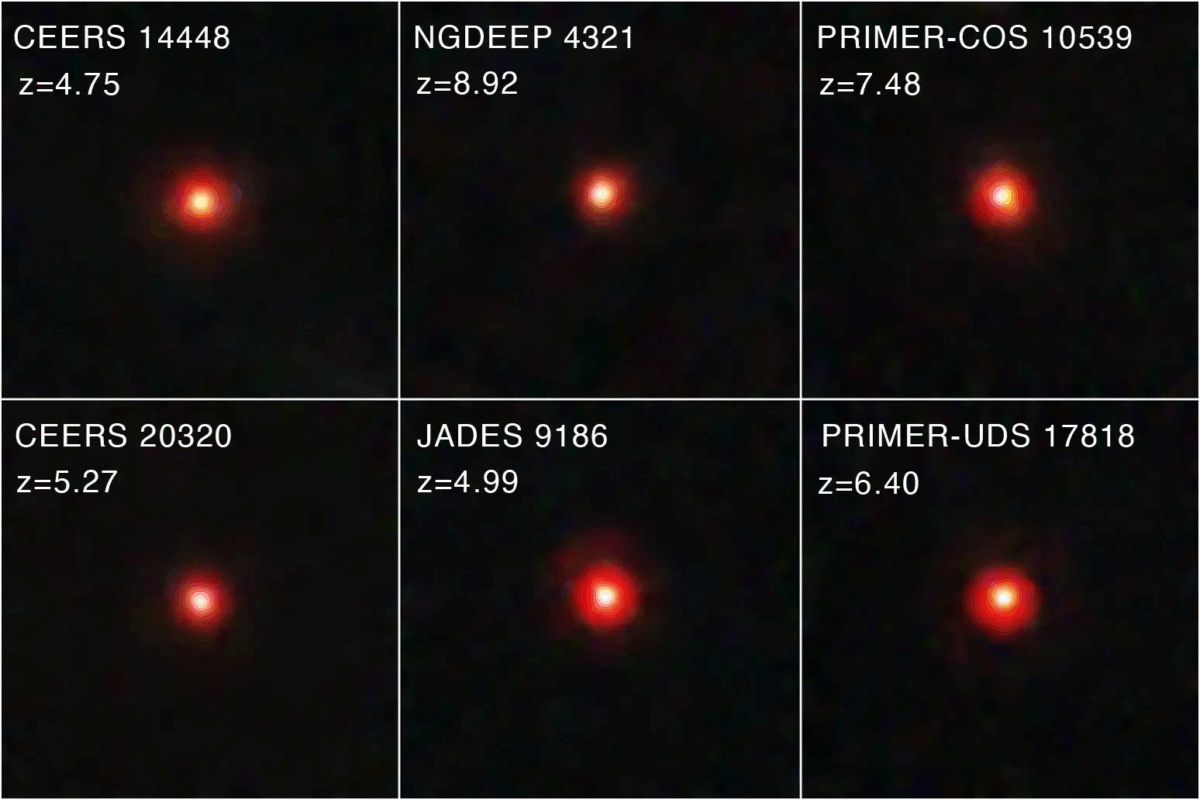
At the start of its mission, the James Webb Space Telescope (JWST) focused on exploring distant galaxies and uncovered unexpected phenomena. In late 2022, astronomers identified faint, small red spots dubbed “Little Red Dots” that appeared notably different within the low redshift range. Their diminutive size and distinctive red hue led scientists to question if they represented primordial building blocks of galaxies or entirely new cosmic entities.
This discovery ignited a scientific debate: were the red colors caused by intense stellar formation, or could there be a more enigmatic source like black holes involved? Research presented on arXiv, titled On the Fate of Little Red Dots, outlines two main possibilities: LRDs might either be compact, starburst galaxies teeming with stars or embryonic galaxies forming massive black holes. This study sheds light on how galaxies develop and how black holes emerge in the early Universe.

Galaxies Dominated by Stars: Compact and Intense
The first theory proposes that LRDs are densely packed galaxies undergoing rapid star formation, brimming with stars and cosmic dust. These galaxies are much smaller than typical galaxies found today but possess a surprisingly high mass. If accurate, LRDs could be considered young galaxies wrapped in dust, on the cusp of evolving into the galactic forms we recognize. Similar objects observed in the nearby cosmos share some traits but are generally more diffuse and less tightly bound than these compact red dots.
Nevertheless, Professor Andres Escala, a principal investigator of LRD research, notes that the elevated velocity dispersions observed make these objects unstable over longer durations. The broad hydrogen emission lines suggest vigorous star formation occurring within them. According to Escala in an interview with Universe Today, “Their core instability implies these systems may eventually transition into different types of galactic structures.”
Black Hole Formation Theory: Seeds of Cosmic Giants
Alternatively, some scientists propose that these red dots could be early galaxies housing nascent massive black holes (MBHs) at their centers. This hypothesis draws from the familiar presence of supermassive black holes at the centers of contemporary galaxies. The detection of broad Balmer emission lines in certain LRDs, typically linked to active galactic nuclei (AGNs), suggests these objects might be undergoing the initial phases of black hole growth.
However, LRDs do not exhibit all the traits expected of current AGNs. Notably, they lack the strong X-ray emissions associated with quasars, which are characteristic of many active galactic nuclei. Additionally, the implied size of black holes within LRDs appears disproportionately large compared to their host galaxies, presenting a puzzling inconsistency.
Escala’s paper considers that rather than opposing ideas, these two frameworks might be components of a larger evolutionary progression. He proposes that LRDs are likely at an early stage in black hole development, with their cores eventually stabilizing to form galaxies featuring supermassive black holes.
Linking Stellar Formation and Black Hole Growth
Escala and his team introduced a unified evolutionary scenario suggesting that LRDs might originate as stellar-dominated, compact starbursts and subsequently transition toward housing massive black holes. This progression aligns with the extremely dense nature of LRDs, which could naturally lead to black hole formation over time.
Escala elaborates, “The absence of X-rays in these objects aligns with the idea that most LRDs are caught in the earliest evolutionary phases.” The researchers highlight the fleeting presence of LRDs—visible primarily between redshifts z=8 and z=4—as supporting evidence for their transient, youthful nature. Over epochs, these dwarfed galaxies could evolve into well-structured systems akin to AGNs with fully developed supermassive black holes.
This evolutionary interpretation also explains why LRDs are scarce in the current Universe. They likely represent a brief phase in the cosmic timeline, gradually maturing into galaxies with conventional features and central black holes observable at lower redshifts.
- Categories:
- News






0 comments
Sign in to Comment