
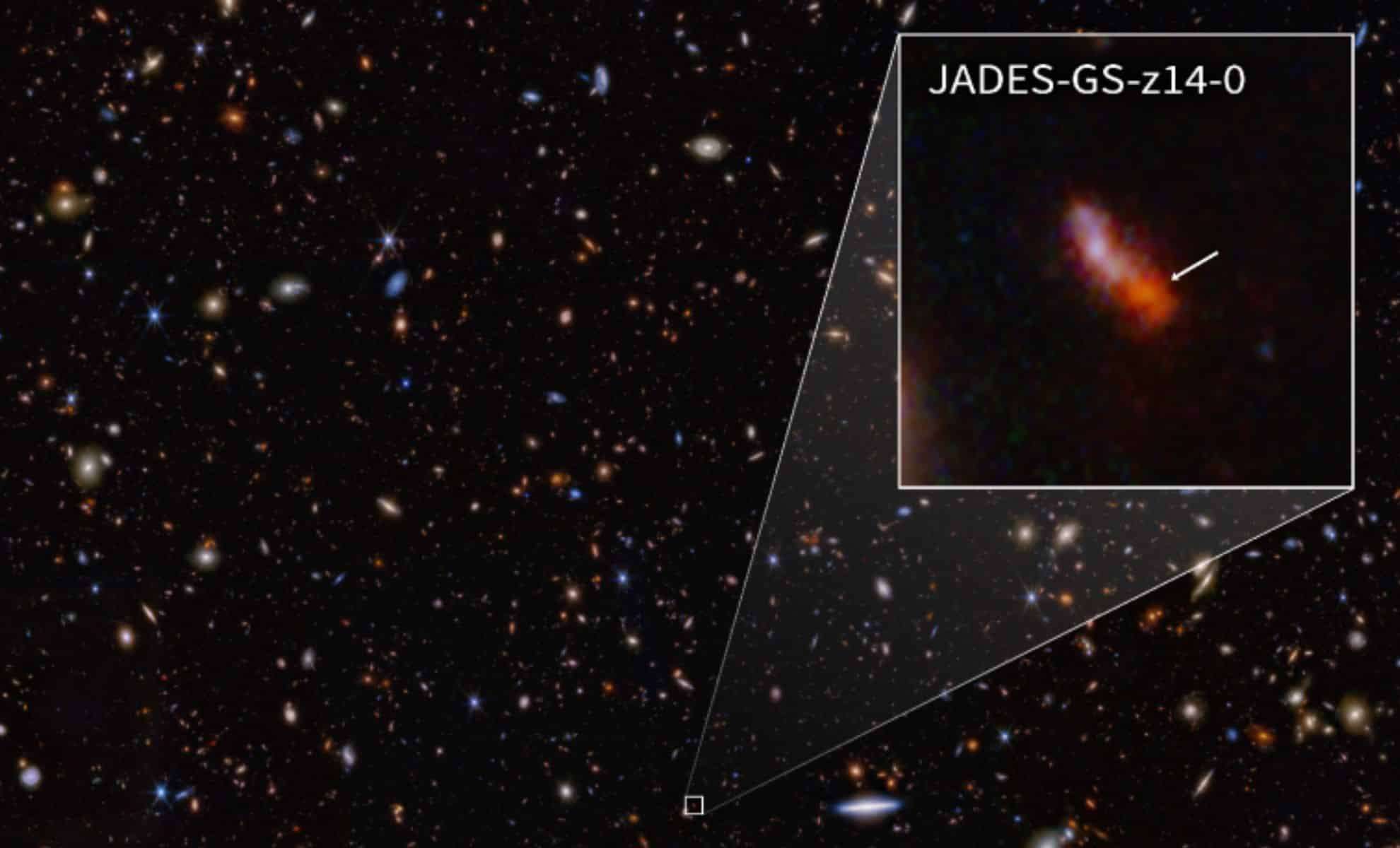
The James Webb Space Telescope (JWST) has once again pushed the boundaries of cosmic observation by identifying the farthest galaxy ever detected—MoM-z14—formed a mere 280 million years post-Big Bang. Leveraging its exceptional infrared technology, this discovery brings researchers closer to observing the universe’s earliest stellar and galactic formations.
Unveiling the Universe’s Formative Epochs
Prior to JWST’s launch, instruments like the Hubble Space Telescope and Spitzer lacked the capacity to peer so deeply into the cosmic past. Hubble, with its 2.4-meter primary mirror, could trace light from roughly 500 million years after the Big Bang. Spitzer’s 85 cm mirror, despite specializing in infrared wavelengths, was restricted by its smaller size. The extensive mirror and cutting-edge sensors on JWST now enable observations of galaxies that existed within the universe’s first few hundred million years.
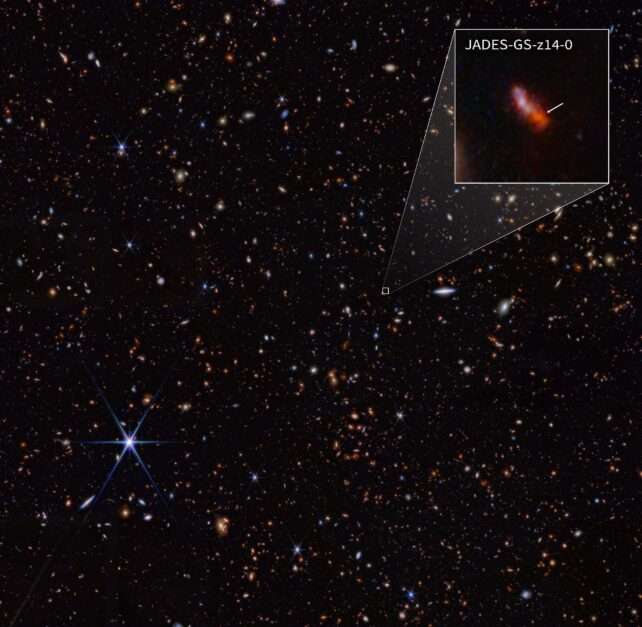
Exploring how galaxies formed remains a top objective for JWST, a pursuit yielding groundbreaking results. Since commencing comprehensive observations in July 2022, the telescope has uncovered numerous luminous, high-redshift galaxies from the universe’s infancy. Previously, the record holder was JADES-GS-z14-0 at redshift z=14.32. The new find, MoM-z14, surpasses this with a redshift of z=14.44, expanding the limits of our visible cosmic horizon.

The Unexpected Revelation of MoM-z14
MoM-z14 was identified as part of the Mirage (also called Miracle) spectroscopic survey, targeting validation of galaxies with ultra-high redshifts. The detection of such a bright galaxy at redshift z>14 exceeded expectations and posed exciting questions for astronomers.
According to the study A COSMIC MIRACLE: A REMARKABLY LUMINOUS GALAXY AT zspec = 14.44 CONFIRMED WITH JWST, led by Rohan Naidu and his team at MIT’s Kavli Institute for Astrophysics and Space Research, JWST is revealing "a striking population of radiant galaxies emerging at extraordinarily early times."
Spectral examination indicates that MoM-z14’s light mostly originates from stars, rather than an active galactic nucleus (AGN) driven by a supermassive black hole. This suggests that the galaxy might be home to supermassive stars, entities theorized to exist during the universe’s formative stellar nurseries. Additionally, its nitrogen-to-carbon ratio is significantly elevated compared to the Sun, reminiscent of the chemical traits observed in globular clusters surrounding the Milky Way.
Linking JWST’s Discovery to Our Galactic History
The parallels between MoM-z14 and ancient globular clusters hint at a shared evolutionary path. The authors propose that "we may be witnessing the birth of such stars within dense stellar clusters," suggesting a continuous evolutionary chain spanning the universe’s timeline. This discovery bridges the gap between the universe’s earliest stars and the ancient star populations present in our galaxy.
JWST data also reveals two distinct types of bright early galaxies — compact point sources and more spread-out extended forms. This morphological classification corresponds with chemical differences; compact galaxies typically show pronounced nitrogen emissions, whereas extended ones do not. MoM-z14 fits into the category of nitrogen-rich compact galaxies, providing strong "support for a size-chemistry duality at redshifts greater than 10," the paper states.

A Window into Galactic Relics
The identification of MoM-z14 highlights JWST’s transformative capabilities. Beyond spotting ancient galaxies, it enables galactic archaeology by connecting primordial cosmic structures to those found in the nearby universe. The elevated nitrogen levels, luminosity, emission of ionizing radiation, and structure of MoM-z14 all suggest environments where runaway stellar collisions may have generated exceptionally massive stars. These phenomena likely resemble the formation conditions of globular clusters, linking cosmic history from the dawn of time to the present day.
The study concludes that JWST is "set to open vast new windows on the cosmic frontier," bringing astronomers ever closer to understanding the universe’s first stars. With forthcoming missions such as the Nancy Grace Roman Space Telescope promising deeper and wider sky surveys, discoveries like MoM-z14 could soon multiply, illuminating the universe’s earliest moments.
- Categories:
- Space





0 comments
Sign in to Comment