
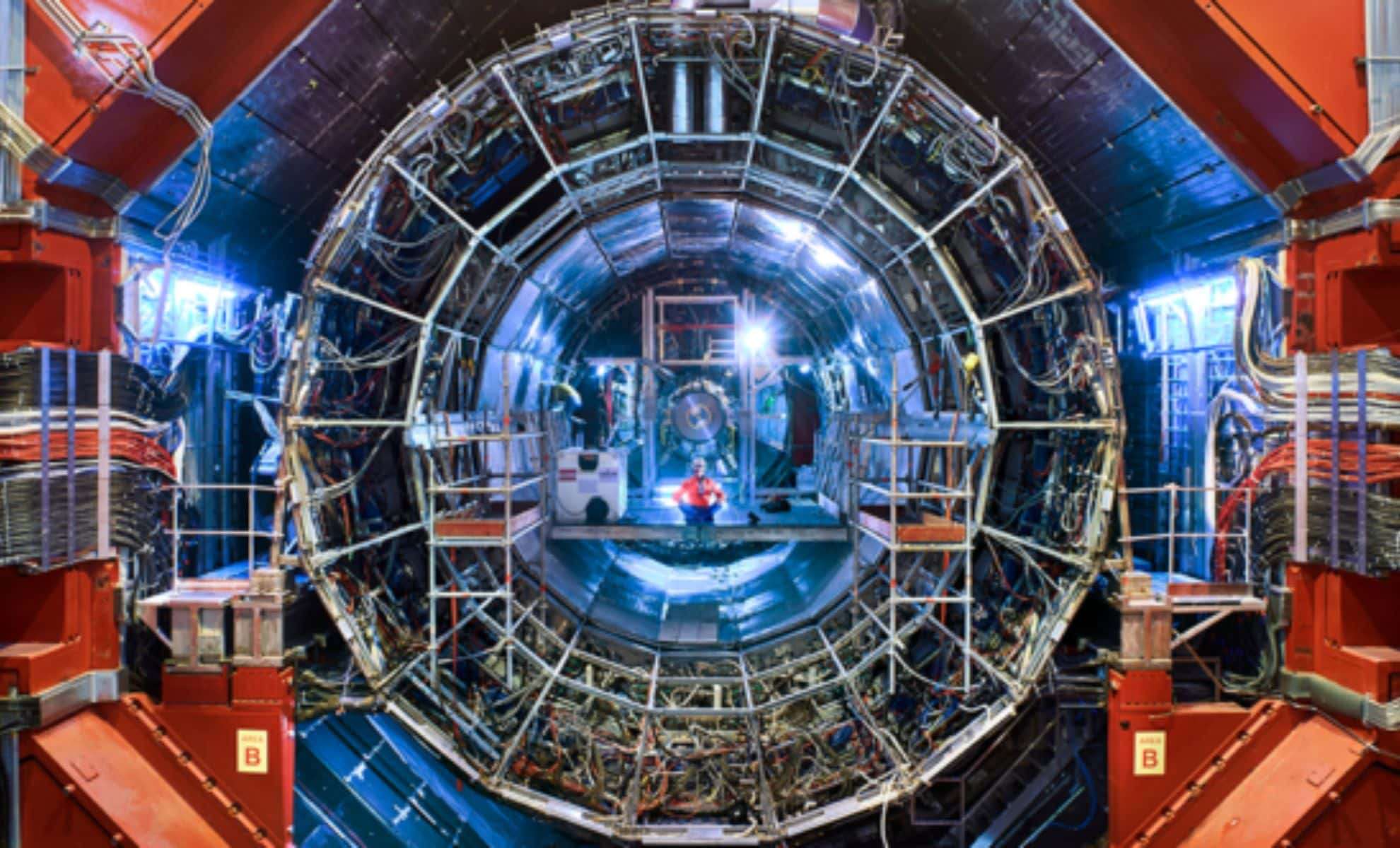
The Large Hadron Collider (LHC) at CERN, the world's most powerful particle accelerator near Geneva, has achieved a remarkable feat once thought to be the realm of ancient alchemists — transforming lead into gold.
This revolutionary milestone was accomplished by the ALICE (A Large Ion Collider Experiment) team, demonstrating that high-speed collisions of lead ions can yield trace amounts of gold. Details of this discovery were recently published in a study.
The Science Behind Turning Lead into Gold
Central to this experiment is nuclear transmutation, a phenomenon where atomic nuclei are altered to become different elements. The LHC accelerates lead ions to velocities close to 99.999993% of the speed of light, causing powerful collisions that modify nuclear structures by either shedding or absorbing protons and neutrons.

Gold, which has 79 protons, can be formed when three protons are removed from a lead nucleus (which contains 82 protons). Although the total gold created is incredibly tiny—about 29 trillionths of a gram—this provides proof of concept. However, these newly formed gold nuclei exist only fleetingly before being obliterated by the enormous energy of the collisions.
Capturing the Transformation: The Role of ALICE Detectors
Despite the ephemeral nature of gold creation, the sophisticated ALICE detectors successfully recorded these extraordinary occurrences. Instruments like the Zero Degree Calorimeters (ZDCs) can identify minute particles produced in the dense particle showers generated every second within the collider. This allowed the detection of gold nuclei amid billions of collision events.
Marco van Leeuwen, spokesperson for ALICE, highlighted the detectors' precision, explaining they “manage collisions that produce thousands of particles simultaneously, while also being sensitive enough to observe rare electromagnetic ‘nuclear transmutation’ events involving just a few particles.”
From Alchemy to Modern Physics
Historically, alchemists aimed to convert common metals such as lead into gold using mystical methods like the Philosopher’s Stone. While those ancient beliefs were largely mythical and unscientific, the idea of transforming one element into another wasn’t entirely far-fetched. Lead and gold neighbors on the periodic table, differing by only three protons.
This latest experiment revisits these old concepts under rigorous scientific conditions. Instead of magic, the LHC relies on the immense energies from accelerating lead nuclei close to light speed to induce nuclear transmutation. This transformation occurs within fractions of a second and without reliance on any supernatural means.
Unlocking New Physics Potential with Gold Production
Even though the amount of gold formed is minuscule, the discovery holds significant promise for future physics exploration. Nuclear transmutation provides insight into the behavior of atomic nuclei in extreme environments, information critical for optimizing the LHC and designing future particle accelerators.
Uliana Dmitrieva, a physicist with the ALICE collaboration, stated, “Thanks to the unique capabilities of the ALICE ZDCs, this is the first experimental study to consistently detect and analyze evidence of gold formation at the LHC.”
As the LHC continues pushing energy boundaries, the generation of even more gold is expected. In the current third run, production rates have nearly doubled to 89,000 gold nuclei per second, greatly enhancing efficiency and opening fresh pathways for exploring high-energy particle physics.
- Categories:
- Science










0 comments
Sign in to Comment