

Deep within the dense jungle of southeastern Mexico, researchers have accidentally uncovered an ancient Maya city that remained hidden for centuries. This extensive urban center, named Valeriana, is now considered one of the most remarkable archaeological finds in recent years, potentially home to tens of thousands at its height.
Uncovering History Through an Unexpected Google Search
Remarkably, the breakthrough did not come from a field expedition but rather from an online search. Luke Auld-Thomas, a PhD candidate at Tulane University, discovered a lidar dataset buried deep within Google’s search pages—around page 16.
“I stumbled upon a laser survey conducted by a Mexican environmental agency,” he recalled.
Originally intended for environmental observation, the lidar technology employed emits laser pulses to create detailed topographic maps. When Auld-Thomas applied archaeological analysis to this data, he identified what others had overlooked: evidence of a sprawling ancient city.
“It appears the region was densely populated just before drought conditions worsened, leaving little room for adjustment, which may have led to societal collapse as people dispersed,” he explained.

Valeriana: An Intricate Urban Center of the Maya
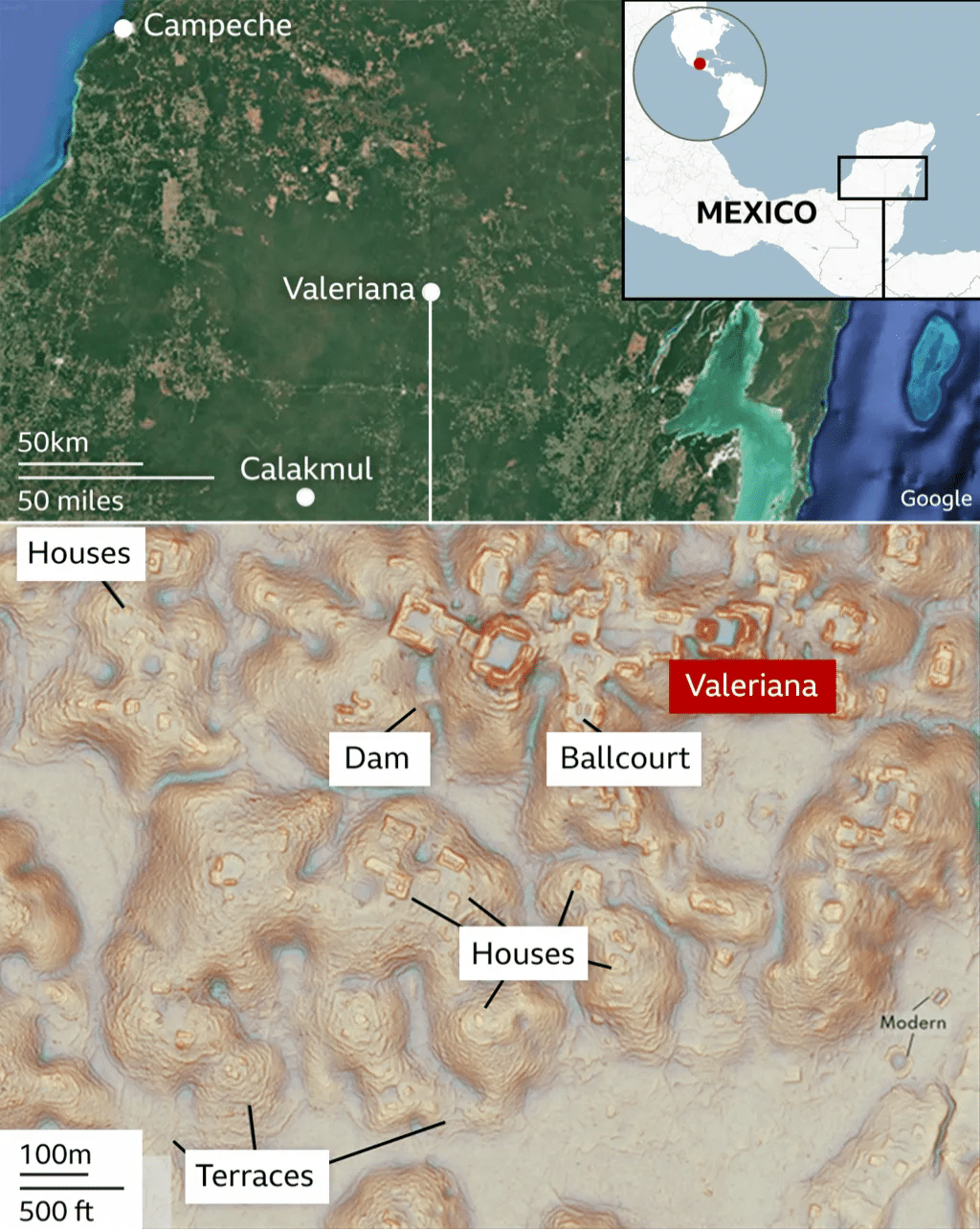
Valeriana, named after a nearby lagoon, spans an impressive 16.6 square kilometers. At its peak between 750 and 850 AD, it is believed to have supported a population ranging from 30,000 to 50,000 people, exceeding the current population in the area.
What sets this site apart is its architectural sophistication: two main hubs, temple pyramids, amphitheaters, plazas, a ballgame court, and a reservoir, all signifying advanced landscape management to sustain a large urban population.
The city layout features densely packed residential zones connected by causeways, reminiscent of a central capital. Scholars say that, density-wise, Valeriana ranks just behind the famed Calakmul, located about 100 kilometers away.
Co-researcher Professor Marcello Canuto emphasized that this discovery challenges outdated Western perspectives that tropical regions were cultural backwaters. Instead, he argued, “this area was home to vibrant and sophisticated civilizations.”
An Overlooked City Finally Comes to Light
Despite its vastness and location a mere 15-minute trek from a principal road near Xpujil, Valeriana remained unnoticed for generations. Researchers have found no photographs because, as they put it, “no one has ever been here.” While locals might have suspected something beneath the earth mounds, no formal excavation had taken place until now.
The team documented an astonishing 6,764 structures. Professor Elizabeth Graham from University College London, not involved in the study, underscored that this supports emerging views that the Maya civilization was organized into complex urban centers rather than scattered villages.
“The evidence shows that the landscape was densely settled in the past, contradicting the impression that it was wild or empty to the naked eye.”
Archaeology Accelerated by Lidar Advancement
This discovery highlights the revolutionary impact of lidar on tropical archaeology. According to Canuto, lidar surveys over the past decade have covered ten times more terrain than traditional fieldwork did in the prior hundred years combined.
“One downside of uncovering numerous new Maya cities via lidar is that there are far too many to fully explore,” Auld-Thomas remarked. “Valeriana’s proximity to the road makes it tempting to study, but currently there are no projects planned there.”
- Categories:
- News










0 comments
Sign in to Comment