

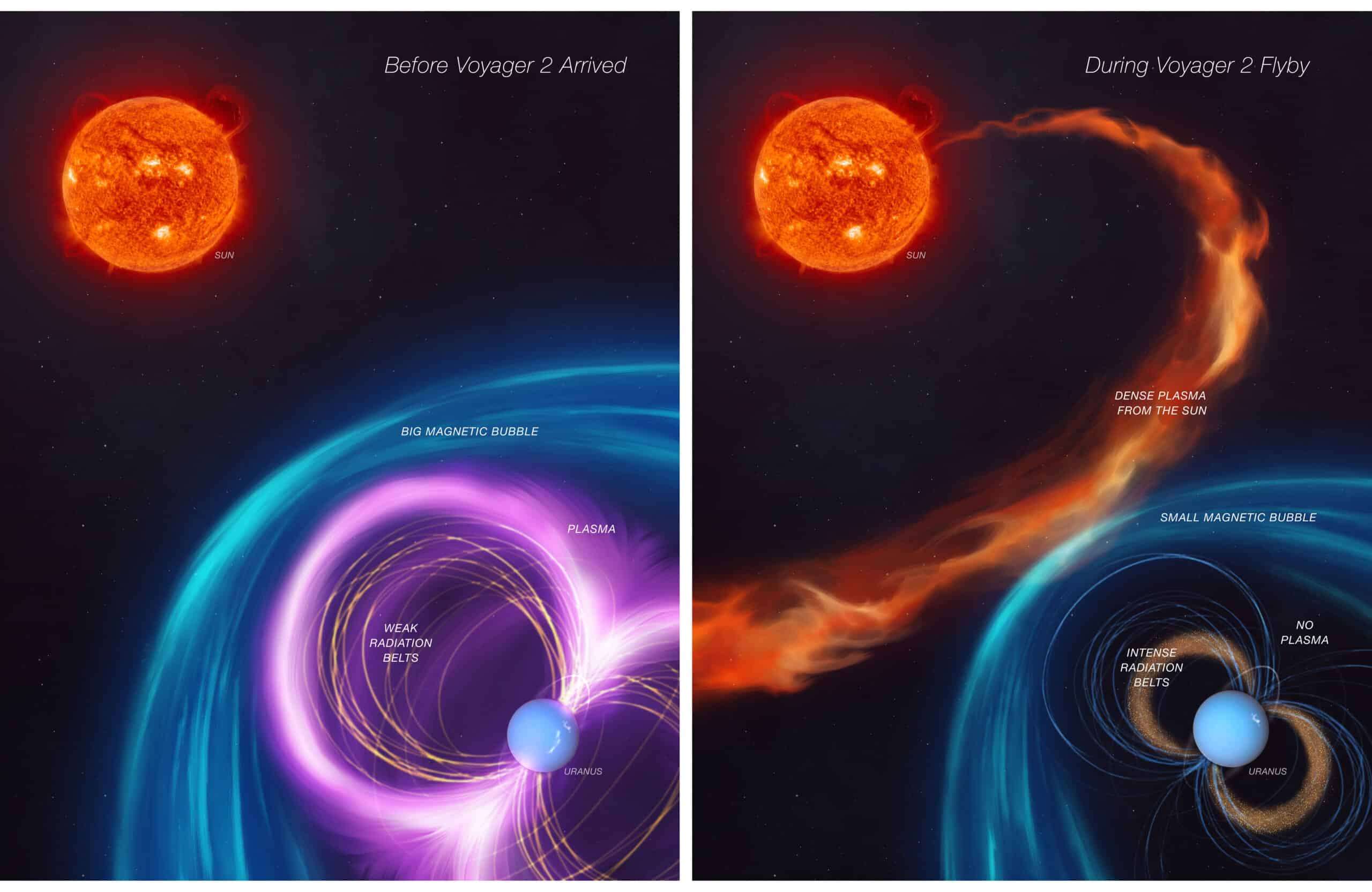
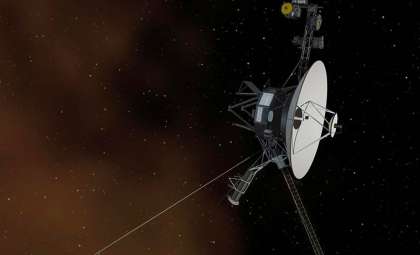
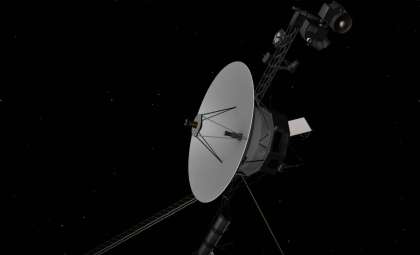
More than 35 years after Voyager 2’s 1986 Uranus flyby, fresh research points to an uncommon solar phenomenon that may have influenced the spacecraft’s measurements, resulting in a skewed interpretation of the planet’s magnetic environment. Utilizing Voyager 2’s archived information alongside new analysis, scientists found that an intense solar wind event compressed Uranus’ magnetosphere beyond normal levels, creating a temporary, atypical state around the planet.
A Sudden Solar Wind Surge Compressed Uranus’ Magnetosphere
During its brief passage, Voyager 2 detected a magnetospheric configuration around Uranus that appeared unusually compact and distorted, fueling years of speculation about the planet’s magnetic irregularities. As ScienceAlert reports, planetary scientist Jamie Jasinski from NASA’s Jet Propulsion Laboratory (JPL) revisited this data, concluding that a rapid spike in solar wind pressure drastically reduced Uranus’ magnetosphere to roughly 20% of its standard size. Jasinski noted, “Voyager 2 captured Uranus under conditions that occur in only about 4% of the time,” emphasizing how this extreme solar event impacted the original data and led to Uranus being viewed as an outlier among planets.
The five-day encounter offered a limited window of observation, and Jasinski’s team surmises that measurements taken even a week before or after would show a magnetospheric environment more consistent with those of Jupiter and Saturn. According to JPL, the compressed magnetosphere could also clarify Voyager 2’s detection of unusual electron radiation belts and surprisingly low plasma concentrations within the Uranus system—phenomena that have long puzzled researchers.

Effects on Uranus’ Magnetic Field and Its Moons
The intense solar wind pressure likely expelled plasma from Uranus’ magnetosphere, which may explain the surprising lack of water ion signatures near its five largest moons—features typically linked to geological activity. Jasinski’s study indicates this plasma deficit was probably a transient result of the solar wind spike, not evidence of geological inactivity. Voyager 2’s project scientist at JPL, Linda Spilker, remarked, “This new research helps resolve apparent inconsistencies and will reshape how we perceive Uranus,” pointing out the possibility that some of its moons might indeed show geological processes, which would transform our understanding of the planetary system.
Published in Nature Astronomy, the JPL team’s work shows that Voyager 2 observed Uranus under conditions that occur less than 5% of the time, emphasizing the variability of planetary magnetic environments. These findings underscore the necessity for new exploration missions to Uranus, which could verify these results and explore the planet’s moons in greater detail, potentially identifying geological activity masked during the original flyby.
Renewed Calls for a Uranus Exploration Mission
The discoveries bolster arguments for sending a dedicated mission to Uranus. Since Voyager 2’s sole flyby, the planet has remained relatively unexplored, and the updated analyses highlight the importance of ongoing detailed observations to better understand Uranus’ magnetic dynamics and moon activity. The 2023 Planetary Science and Astrobiology Decadal Survey, as noted by JPL, prioritizes a Uranus mission to investigate the planet’s singular axial tilt, rings, and complex magnetic field.
Jasinski’s findings serve as a reminder of the inherent limitations of snapshot flyby missions in capturing the full complexity of planetary systems. As Voyager 2 journeys into interstellar space, this renewed examination of its data illustrates how legacy missions can continue to fuel scientific breakthroughs and revise our cosmic perspective decades later.
- Categories:
- News







0 comments
Sign in to Comment